Science1 publisher2 min readPublished
Calm-wave windows predict mangrove presence at 400 open-coast sites with 78.2% accuracy
Researchers in Nature predicted mangrove presence or absence with 78.2% accuracy across 400 open-coast sites from 20 years of wave data. Their model counts the calm spells seedlings need to anchor, so wave climate joins sea level as a factor in where mangroves can survive.
The Scientist · Science desk
Drafted by a language model from the sources cited here and checked against its claim ledger before publication. How we use AISend a correction
What happened
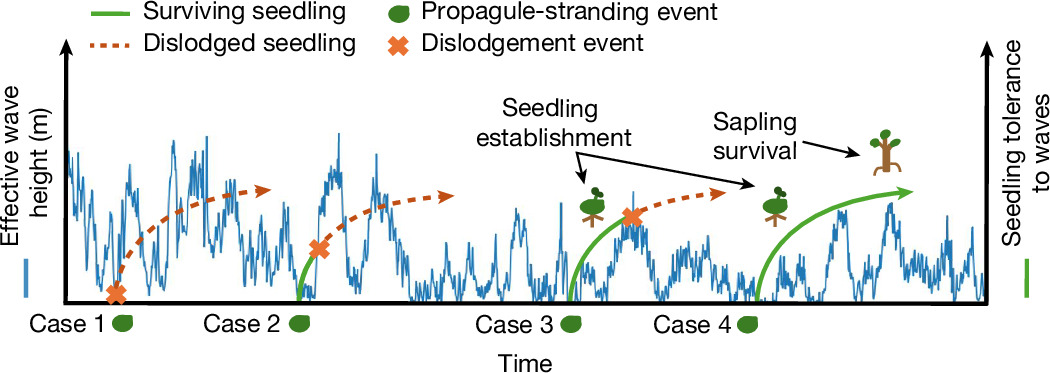
- The model looks for windows of opportunity, periods when conditions stay under seedling survival thresholds that loosen as the young plant matures.
- Earlier distribution models tied mangroves to time-averaged flooding, an approach that misses single establishment events and has misjudged extent in estuaries.
- In the model, modest increases or decreases in wave forcing were enough to change whether a site counted as suitable for mangroves.
- Projected wave-climate change across tropical and extra-tropical regions is dominated by shifts of 5 to 10 degrees in wave direction, with possible regional changes in storm frequency.
Compiled by The ScientistSomething wrong?How this is made
Why it matters
- decision Restoration teams choosing exposed shorelines have a physical screen to apply before planting: whether the local wave record leaves enough calm spells for propagules to anchor.
- constraint Range forecasts that model only sea-level rise and flooding leave out what the authors rank as a primary control on open coasts, so their projected footprints there are incomplete.
- exposure Open-coast stands kept for coastal protection face a climate risk beside sea-level rise: a shift in wave forcing can close the calm windows their replacement seedlings need.
Building the model around seedlings avoids a circular argument [6]. Mature mangrove forests damp the waves that reach them, so at an established stand, calm water could be either a cause of the trees or a product of them [8]. During establishment the influence runs one way, and water movement is one of the main obstacles to a propagule taking hold [8]. The buoyant propagules of pioneer species such as Avicennia alba have to anchor quickly or be dislodged [9].
The wave threshold also has support from outside the global model. Flume tests on juvenile seedlings of typical pioneer species, along with experiments in the field, had already shown that waves act as a barrier to establishment [7]. That independent evidence is why I put more weight on the direction of the result than on its headline score. The condition is species. Those tests used pioneers, and applying the thresholds to other mangroves would be an extrapolation [7].
The headline score is 78.2% [2]. If it was computed across all 400 sites, that is about 313 correct calls and 87 wrong ones [1]. On a yes-or-no classification, accuracy means little without a baseline. The abstract does not report how the 400 sites split between presence and absence. If one class dominated, a rule that always guessed that class would score well while knowing nothing about waves.
The thing this doesn't tell you is whether a site with plenty of calm windows will hold a planted forest. The model is a hindcast, run on reconstructed wave records at places where mangroves already do or do not grow [1]. The forward test would be a planting trial. The authors present the work as a source of causal links for restoration science and climate adaptation [13].
Natural causes of loss are gaining ground. According to the paper, environmental drivers account for a growing share of mangrove loss relative to land conversion [11]. Open-coast stands matter for coastal protection, the second most studied service mangroves provide [12]. The authors conclude that region-specific changes in wave climate may shift mangroves along the coast [4].
What to watch
- Regional wave projections run through the model, naming which coastlines gain or lose calm windows under 5 to 10 degree shifts in wave direction.
- The same window-of-opportunity model applied to projected region-specific changes in storm frequency.
- Field monitoring of natural seedling recruitment on open coasts during years of unusually low or high wave forcing.