Invest1 publisher3 min readPublished
Tabs says $400M valuation on about $92M raised, and the growth number has no denominator
Crunchbase News reports the New York billing and revenue-recognition startup at 180 employees and a founder-quoted $400 million valuation. The funding total moves by $2 million mid-article.
The Investor · Invest desk
Drafted by a language model from the sources cited here and checked against its claim ledger before publication. How we use AISend a correction
What happened
- Tabs is a New York-based AI startup, founded in 2023, that automates parts of finance and accounting.
- Tabs has raised around $90 million, employs about 180 people, and was last valued at $400 million, according to founder Ali Hussain.
- Later in the same article: Tabs has grown to roughly 180 employees, raised about $92 million in total capital, reached a $400 million valuation in its last round, and maintained triple- to quadruple-year-over-year revenue growth.
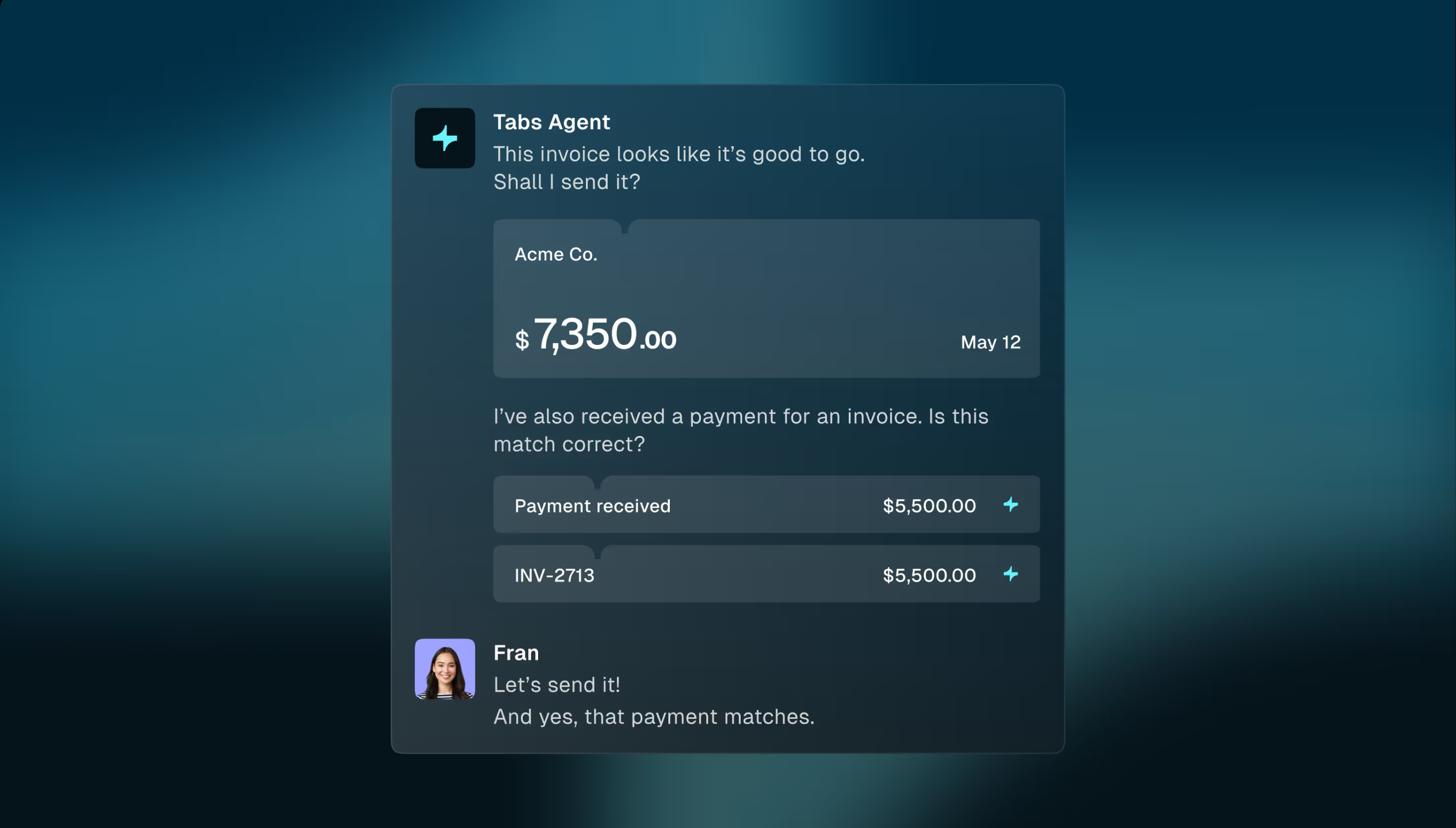
- Tabs is an AI platform that automates revenue recognition, billing and collections.
- Tabs raised a $4 million pre-seed round co-led by Primary Venture Partners and One Way Ventures.
Compiled by The InvestorSomething wrong?How this is made
Why it matters
Crunchbase News reported that Tabs, a New York company founded in 2023 that automates parts of finance and accounting, employs about 180 people and was last valued at $400 million, a figure the publication attributes to co-founder Ali Hussain [1][2]. That matters less as a founder story than as a price on a specific category: revenue recognition, billing and collections is one of the few AI markets where the output is checked by people who are paid to check it [4].
The capital line is worth reading twice. The same article puts total funding at "around $90 million" in one paragraph and "about $92 million" in another, a $2 million spread inside a piece whose headline number is a valuation [2][3][16]. Take the higher figure and Tabs carries a valuation roughly 4.3 times the capital it has consumed [13]. Against about 180 employees, that is roughly $511,000 of capital raised per head and about $2.2 million of implied value per head [14][15]. For a company founded in 2023, headcount is the variable to sit with: 180 people is a substantial payroll for a product whose premise is that software does the reconciling.
Growth is asserted rather than shown. According to Hussain, Tabs has maintained triple- to quadruple-year-over-year revenue growth [3]. No revenue base is disclosed, and beyond a $4 million pre-seed co-led by Primary Venture Partners and One Way Ventures, the article names no lead, date or amount for the rounds that produced the $400 million mark [5][17]. Tripling off $2 million and tripling off $20 million describe different companies with the same multiple.
The non-technical-founder thread is the more transferable part. Hussain took a humanities degree at Cornell, won a Marshall Scholarship to Oxford, left the PhD two months in, went to Boston Consulting Group, then joined Latch in 2015 as its first operations hire when it was a 10-person seed-stage startup, taking a large pay cut to do it [6][7]. Latch grew to tens of millions in revenue over his six years there [8]. At Tabs he paired with a technical co-founder, Deepak Bapat, and describes his own contribution as commercial vision and operational execution rather than code [10]. His stated diagnosis of what keeps non-traditional founders out is access to capital plus the playbook for building around a real problem and hiring a team [9]. Worth noting the frame: this is the third profile in a Crunchbase News series on founders from non-technical backgrounds, after MagicSchool AI's Adeel Khan and Trunk Tools' Sarah Buchner [11]. A sequence of survivors is not a base rate.
What to watch: whether the next round arrives with a named lead and a disclosed amount instead of a founder-quoted valuation [2]; whether Tabs attaches a revenue base to the growth multiple [3]; and whether headcount keeps pace with, or outruns, that revenue [2][3]. For finance teams evaluating this category, the question is not the mark but whether automated revenue recognition holds up under an audit.