Science1 publisher2 min readPublished
Suppressing a frog's skin bacteria made chytrid disease more likely in a Penn State experiment
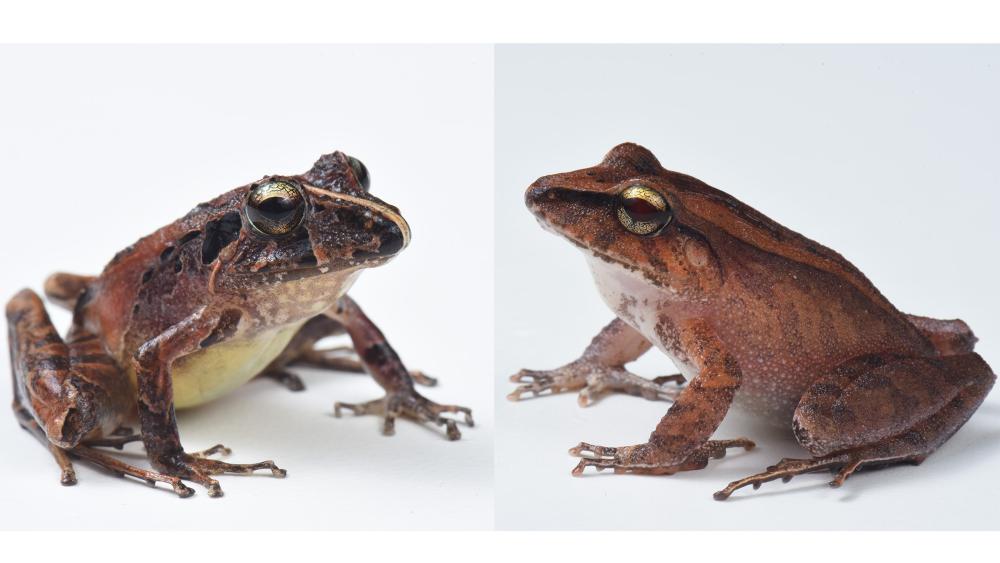
Penn State researchers suppressed skin bacteria on two Brazilian frog species with antibiotics, and only one of the two then showed more disease from the chytrid fungus. The team also screened about 700 bacterial strains to link each one's identity to its antifungal effect.
The Scientist · Science desk
What happened
- A Penn State-led team reports in Animal Microbiome a causal relationship between the bacteria on frogs' skin and their ability to survive the chytrid fungus, which damages amphibian skin and eventually causes heart failure.
- The test was a lab experiment in Brazil on two tropical species, Haddadus binotatus and Ischnocnema henselii, with DNA sequencing used to identify the bacteria living on each frog's skin.
- H. binotatus tolerated the fungus while its healthy skin community was intact, and became more likely to develop signs of disease once antibiotics suppressed that community.
- Sequencing the bacterial cultures produced a custom reference database linking each bacterium's identity to how strongly it inhibited the fungus, letting the team map protective bacteria on individual frogs.
Compiled by The ScientistSomething wrong?How this is made
Why it matters
- constraint Antibiotics knock back the entire skin community, so the survival result cannot name a responsible strain; any candidate probiotic organism still has to be isolated and tested on its own.
- capability An identity-to-inhibition database lets conservation work rank candidate bacteria by measured antifungal activity instead of by a community diversity score.
- exposure Amphibian mitigation programmes cannot treat a protective microbiome as a group-wide trait; on this evidence each host species needs its own suppression test before anyone deploys bacteria on it.
- precedent Field prevalence surveys alone are now a weaker basis for claiming a microbiome defends its host, because the manipulation that settles the question has been run.
Antibiotic suppression carries the causal claim in this design. The puzzle it was built for was already on the record: one species has one of the highest fungal prevalences of the pair, and the other has no infections in the wild [11]. Correlation of that kind has an obvious problem, because a frog's bacteria, its behaviour and its microhabitat all travel together. Suppress the bacterial community, then watch for disease signs, and you can pull them apart [4].
"This study moved us from correlation to experimental evidence that the microbiome really is important against this disease," said Laura Schuck, the Penn State doctoral student who led the work [12].
Antibiotics act on the whole community, so the suppression arm points at the community and not at the member responsible. The strain-level work was separate. Schuck cultured roughly 700 strains off the frogs' skin, grew each one, exposed the chytrid fungus to their chemical byproducts and tracked fungal growth over a week [7]. "We designed the experiment at two levels," said Gui Becker, the senior author. "First, a simple yes-or-no test to see if the microbiome was contributing a defense against disease, then we dug deeper into the function of every bacterium, building a reference database" [13].
Becker states the headline result as a claim about function, saying the key message is that "it's not simply the diversity of these bacteria ... that matters, but the protective function of these bacteria" [10]. The account of the study does not include the number of frogs per group, the increase in disease signs after suppression, or any test statistic [15].
One of the two species tested responded to suppression at all [16]. Ischnocnema henselii stayed highly susceptible whether its microbiome was suppressed or intact, and the authors take that to mean the two species depend on different defences [5]. I'd build on that asymmetry: protection here belongs to a particular pairing of host and bacteria.
The next step, the researchers said, is to look at how frogs recruit their protective skin bacteria from the environment, with the goal of safeguarding the habitats that supply them [14].
What to watch
- The Animal Microbiome paper's numbers: frogs per treatment group, how much disease signs increased after suppression, and the statistical test behind the diversity-versus-function claim.
- Whether Becker's group can show how H. binotatus acquires its protective bacteria from its habitat, which would put specific sites on a conservation list.
- Whether strains ranked as strong inhibitors in culture still inhibit the fungus on the skin of a host other than H. binotatus.