Invest1 distinct publisher3 min readPublished
The memo promises to remove layers at a company that already turns a billion dollars a quarter, and the arithmetic says the savings are earmarked for spending rather than margin, which is roughly why the stock moved less than 1%.
The Investor · Invest desk

leadership
Robotaxis Are Taking Mid-Teens Share in Three Metros. Headcount Will Not Show It.1 distinct publisher
build
Uber cuts a fifth of its managers to hold the org inside seven layers2 distinct publishers
product
Uber buys drone exposure rather than drones, and one number now carries the deal3 distinct publishers
invest
New York pulls 600,000 K-8 seats out of the student AI market for a year3 distinct publishers
Compiled by The InvestorSomething wrong?How this is made
Ten per cent of roughly 34,000 is 3,400, and the memo commits in public only to "more than 3,000", which is 8.8 per cent [1][2][1]. The gap is 400 jobs, or rather it is the room a reorganisation keeps for itself while the reassignment lists are still being written.
Run the per-head numbers and the efficiency case for this gets thin. In 2017, when Dara Khosrowshahi arrived, Uber turned about $8bn of revenue with about 12,000 full-timers, some $667,000 each [4][6][2]. It now books almost double that $8bn every quarter, an annualised run rate near $64bn across roughly 34,000 people, about $1.9m each, rising to about $2.1m once the cut lands [7][3][4]. Revenue per head roughly tripled while the company added about 22,000 people, and the cut reverses about 15 per cent of that addition [7]. Meanwhile $4.5bn of losses on $8bn of revenue became a billion dollars of quarterly profit [6][7], which annualises to roughly $4bn on roughly $64bn, call it a 6 per cent net margin [6]. This is a company with room to spare rather than one under pressure, which is why the memo's language about layers, coordination and fragmented ownership deserves to be read literally rather than as code for cost trouble [5].
The uses of the money are stated. Khosrowshahi's list covers reaching hundreds of millions more consumers, putting more into drivers, couriers and merchants, and building out the autonomous business [10]; Fortune's read on that list was "sounds expensive" [13]. So the saving arrives pre-spent, and the shareholder gets a larger bet at the same margin rather than a wider margin.
Which brings in Bill Ackman, whose Pershing Square made Uber its largest holding in early 2025 on the view that the shares did not reflect intrinsic value [8][9]. The shares were about $75 then and about $76 at the time of the memo, a move of roughly 1.3 per cent [8][5]. Being right about the operating business and flat on the tape is an ordinary outcome for that trade, and it is also the condition under which management gets asked to do something structural.
How this actually plays out sorts into a few outcomes. One, the layers genuinely come out, operating expenses flatten, margin widens, and the autonomy language was decoration for an audience that wanted cost discipline. Two, the saving is a funding mechanism, opex holds roughly flat, and investors own more autonomy exposure at the same 6 per cent [6]. Three, removing 3,400 people from a company that added 22,000 since 2017 takes out the coordination layer that made launches happen, and the simplification shows up as slower shipping [1][7][4].
This is probably wrong, but the second reading is the one the memo supports on its own terms, because every item on the CEO's list of what the money is for is a spending line [10], and after-hours buyers priced it as roughly nothing, moving the stock less than 1 per cent [11]. What would falsify it: two quarters of visibly widening operating margin with capital spending and earner incentives flat, in which case this was a margin exercise dressed in strategy, and the 3,400 came out for the shareholder after all [1].
Ranked by verification strength, evidence, and original report placement.
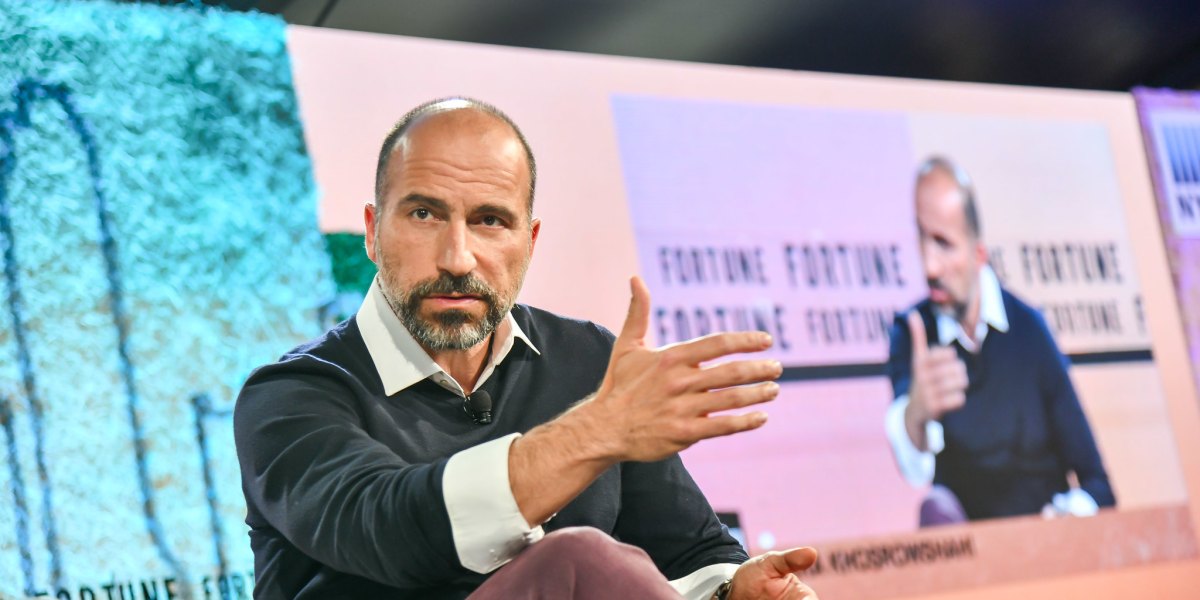
A memo titled "Building a simpler, faster Uber" from CEO Dara Khosrowshahi outlines cutting more than 3,000 of Uber's roughly 34,000 global employees, in order to "remove layers", "simplify team structures" and redirect some spending.
The reduction is described as 10% of Uber's global staff.
Khosrowshahi joined Uber in 2017, when the company had about 12,000 full-time employees on payroll.
Khosrowshahi wrote that growth "has also brought complexity: more layers, more coordination, more fragmented ownership, and in some cases structures that made sense when businesses were smaller but no longer serve us well at our current scale."
When Khosrowshahi took over, Uber lost $4.5 billion on revenues of about $8 billion.
Uber today generates almost double that roughly $8 billion of revenue each quarter and turns a billion-dollar profit.
Distinct publishers with included, body-backed reporting in this cluster.
fortune.com
1 article · September 3, 2026
Follow any of these and your For You feed starts watching them — no settings page required.
Evidence-backed comparisons of source perspectives and observed adoption signals. Read the methodology
Which Builder, Operator, and Investor concerns the observed source mix emphasized—not a truth score.
Evidence, demonstrated adoption, hype gap, incentives, and confidence are assessed independently, each on its own current evidence. How these are measured.
Verbatim memo, rounded everything else
The quoted passages read like the real document — the "more layers, more coordination, more fragmented ownership" line is too specific to be paraphrase — and that carries the organisational half of the story. The financial half is softer: "roughly 34,000", "about $8 billion", "almost double that each quarter", "a billion-dollar profit", none of it tied to a filing or a company spokesperson, and all of it arriving through Fortune alone. The report also leaves its own 10% headline and its "more than 3,000" body figure pointing at different numbers.
A memo, not a completed reorganisation
What exists today is an intention. Nobody has been shown to leave, no team has been named, no date has been set, and the only measurable external response is a share move small enough to be noise. The reduction may well happen at scale, but on the record here the change has been declared rather than executed.
Transformation language, maintenance-sized numbers
"Building a simpler, faster Uber" and "hundreds of millions more people" plus "the autonomous future" is transformation vocabulary attached to a roughly one-in-ten trim at a company already clearing a billion dollars a quarter — and the memo itself says the money is being redirected into more spending, not banked. The overstatement is modest rather than egregious, mostly because Fortune declines to launder it: the "Sounds expensive" aside and the flat share price are both left standing in the same item.
Written with an activist in the room
Three sets of interests are visible on the page. The document is the CEO's own, and the executive diagnosing the bloat is the one who took payroll from about 12,000 to roughly 34,000 — Fortune's mirror line makes that point for us. Pershing Square has had Uber as its top holding since early 2025 on an intrinsic-value thesis and has earned about a dollar a share for the wait, which is the audience a simplification memo is naturally addressed to. And the retelling itself is a newsletter whose format rewards a quip over a severance estimate.
One retelling, no filing
Confidence sits below the middle for a plain reason: strip out Fortune and nothing remains. The direction of travel is credible and the quotes are convincing, but the headcount base, the profit figure and even the after-hours move would all need a second look before anyone modelled from them — and the report's own internal inconsistency on the size of the cut is a reminder of how provisional the numbers are.