Science1 publisher2 min readPublished
Four of ten yearling scrub-jay pairs tried to nest after a 48-bird genetic rescue release
Florida scrub-jays rarely breed before age two, and six months after 48 one-year-olds were released at a site stocked to its estimated carrying capacity, four of the ten new pairs had attempted a nest.
The Scientist · Science desk
What happened
- Researchers moved 48 Florida scrub-jays into one recipient site in a single operation, enough to fill its estimated carrying capacity, where earlier translocations spread smaller numbers of birds over several years.
- Florida scrub-jays normally do not become breeders until they are two or three years old, and yearling pairs account for under 0.25 percent of nesting attempts in the long-term monitoring record.
- The team had expected about half the groups to include yearlings serving as helpers, and instead most of the translocated birds went after breeding positions of their own.
Compiled by The ScientistSomething wrong?How this is made
Why it matters
- constraint Ten pairs sets the precision for this season: one pair either way puts the rate at 30 or 50 percent. Tightening it takes another release.
- decision Anyone running a Vortex projection for this cohort has to choose an age at first breeding, and the source population's value and the recipient site's observed attempt rate will not produce the same population trajectory.
- capability Because each jay has to stand on an antenna to reach peanuts, the team can read who feeds beside whom and identify likely pairs before any nest exists, then point reproductive monitoring at those birds.
The two percentages in this result do not share a denominator. The historical figure counts recorded nesting attempts: across six decades of monitoring at Archbold Biological Station and two decades of data from the local population, fewer than 0.25 percent of those attempts came from pairs of one-year-old birds [7]. The new figure counts pairs: ten yearling pairs formed at the recipient site, and four tried to nest [8]. Dividing one into the other yields 160, and that number describes nothing real, because a share of attempts and a share of pairs count different things [17]. To say how unusual four nests is, you would need the number of yearling pairs that formed in the monitored populations and how many of them nested.
The release was designed to strip out one confound and it introduced another. All 48 birds hatched in 2025, a choice the researchers made to minimize age-related competitive advantages [5]. Every founder was therefore the same age, and the breeding positions on offer went to one-year-olds. Whether these jays nested young because they were moved, or because a same-aged cohort found open territories with no older founders above them, is not a question six months at one site can answer.
The team went in expecting most of the yearlings to stay put as helpers [9]. Instead, the figure that exists so far is a count of attempts. Genetic rescue depends on the translocated birds establishing themselves, reproducing and passing their variation into the recipient population, and the researchers say it is too early to determine the translocation's long-term effect [11].
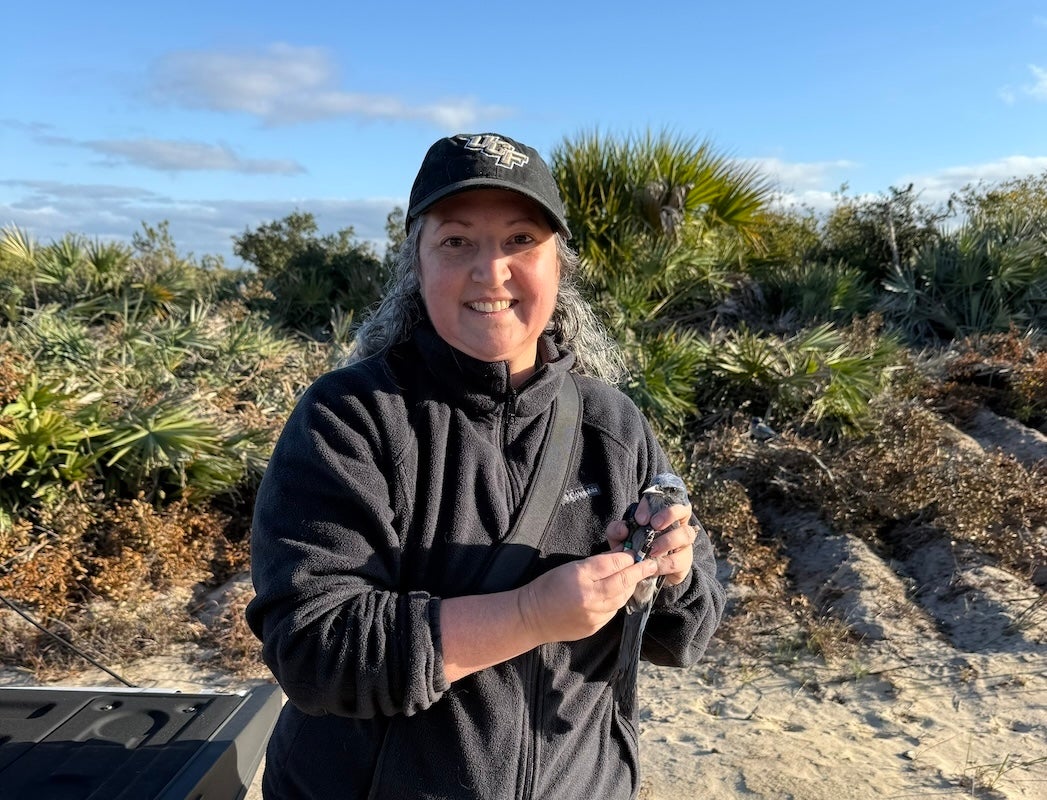
Lauren Deaner, the UCF doctoral researcher whose dissertation centers on the project, said it "gives us a unique opportunity to understand the effects of a large-scale translocation on population recovery, how mate choice is influenced when birds from different genetic units are brought together and how genetic variation changes over time" [14][1]. Mate choice across genetic units is one of the study's stated questions, so behavior is already inside the design rather than a side effect discovered late.
The recovery work this sits inside began in the late 1990s as mitigation led by the Mosaic Company, with guidance from the late Reed Bowman [16]. Mosaic's Raoul Boughton leads the current effort, with Deaner and Sahas Barve of Archbold Biological Station as co-principal investigators [15].
What to watch
- Fledging counts from the four yearling nests, and whether any young survive to disperse and breed.
- Whether the RFID pair-formation data show yearlings pairing across source genetic units or within them.
- A second release that includes older birds, which would separate translocation from the all-yearling cohort design.