Product1 publisher3 min readPublished
HPE raises its fiscal 2027 networking growth forecast to as much as the low 20s
HPE now expects networking revenue to grow in the high teens to low 20s percent in fiscal 2027, up from the 14% to 17% it guided on its last earnings call. For enterprise buyers, the plan leans on AI data center racks sold whole and reaches campus accounts through a sales force that sells the full catalog.
The Product Desk · Product desk
What happened
- HPE says its combined networking business grows from $9.3 billion in fiscal 2024 to about $11.3 billion in fiscal 2026, with operating profit rising from $1.6 billion to $2.5 billion.
- Data center networking is HPE's fastest-growing segment, targeted at low to high 50% compound growth through fiscal 2029 against a market HPE puts at 44%.
- Routing, long treated as a mature business, is targeted at low to high 20% growth through fiscal 2029.
- On Nov. 1, all 60,000 HPE partners move to a single partner program.
Compiled by The Product DeskSomething wrong?How this is made
Why it matters
- decision Teams that run Aruba on campus and another vendor in the data center now face an HPE seller on one compensation plan, with a reason to pitch both on one contract.
- exposure About nine in ten Aruba and Juniper partners sold only one line, so many buyers will be quoted after the channel change by a firm still learning the other half of the catalog.
- constraint Full-rack deals tie up HPE's working capital and push fiscal 2027 revenue toward the back of the year, so the raised guide depends on new systems ramping on time.
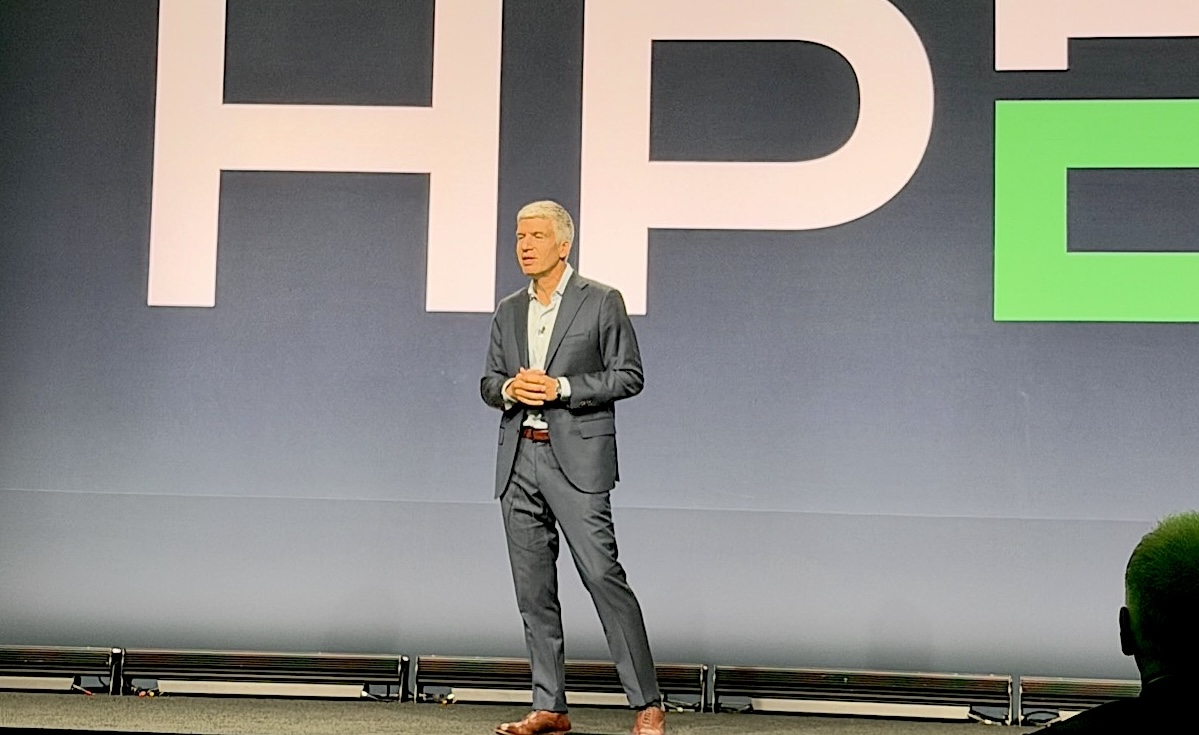
An Aruba customer with a campus refresh due this fall will get the quote from a seller who can also sell Juniper routers and AI data center switches. HPE merged the sales organizations about six months after closing the Juniper deal, and every seller now carries the full portfolio [6]. Rami Rahim, the former Juniper chief executive who runs HPE Networking, said the merge happened under "one catalog, one compensation plan" [7].
HPE framed the day around AI. "AI is reshaping the technology stack, making the network more strategic," Rahim said [5]. The SiliconANGLE analyst who covered the event wrote that any networking vendor could say the same this year [22]. HPE's own figures say more. Networking revenue grew about 10% a year between fiscal 2024 and fiscal 2026 [1], while operating margin rose from about 17% to about 22% [2]. The fiscal 2027 guide sits well above that pace [3]. Beyond it, HPE targets high-teens compound growth through fiscal 2029 at operating margins in the mid- to high 20s [4].
The customers behind those targets buy whole racks. Each rack in Vultr's Helios order uses six HPE Juniper Networking QFX5252 scale-up Ethernet switch trays to connect 72 AMD Instinct MI455X GPUs [14]. HPE tells investors the network is becoming strategic; the neocloud gets it as six trays in a rack built around the GPUs [14]. Rahim said Helios networking-tray orders already exceed $200 million, against an opportunity he put at more than $1 billion over two years [12]. "Many neoclouds value the simplicity of buying a complete system from a single technology provider," he said [16]. HPE also has a role in Oracle's gigawatt-scale AI buildout [17]. According to SiliconANGLE, Rahim was emphatic that HPE has walked away from neocloud deals when the risk was too high, and would again [18].
An enterprise campus buyer will run into the plan first through the sales force and the channel. Only about 10% of Aruba and Juniper partners overlap [9], and SiliconANGLE wrote that partner transitions are where integrations often slip [10]. Routing, long treated as a mature business, gets the same AI argument. AE Natarajan, who runs HPE's routing business, said AI traffic cannot be cached like video and that agents generate it constantly [20]. "Digital users don't fall asleep," he said [21].
Two questions place a buyer. The first is what the purchase touches: campus and branch only, or the data center and routing lines where HPE's growth targets are steepest [11][19]. The second is whether the partner on the deal sold both Aruba and Juniper before the single partner program starts [8][9]. Campus-only with a dual-line partner changes least, apart from a wider pitch. Campus-only with a single-line partner puts the buyer with a reseller learning half a catalog under a new program. A data center or routing buyer with a dual-line partner is the account HPE's plan is built for, and the useful check there is a quote for the networking both inside and outside a full system. With a single-line partner, that same buyer faces the bundle pitch and the channel transition at once.
What to watch
- HPE's next earnings call, for whether the fiscal 2027 range holds once the timing of the Helios ramp is clearer.
- A second named Helios customer after Vultr, as evidence that the full-rack sale repeats beyond one neocloud.
- Enterprise campus deals that arrive with data center or routing gear attached, the first sign the one-catalog sales force is selling the bundle outside neoclouds.