Science1 publisher2 min readPublished
Thale cress centromeres take point mutations at nearly ten times the rate of chromosome arms
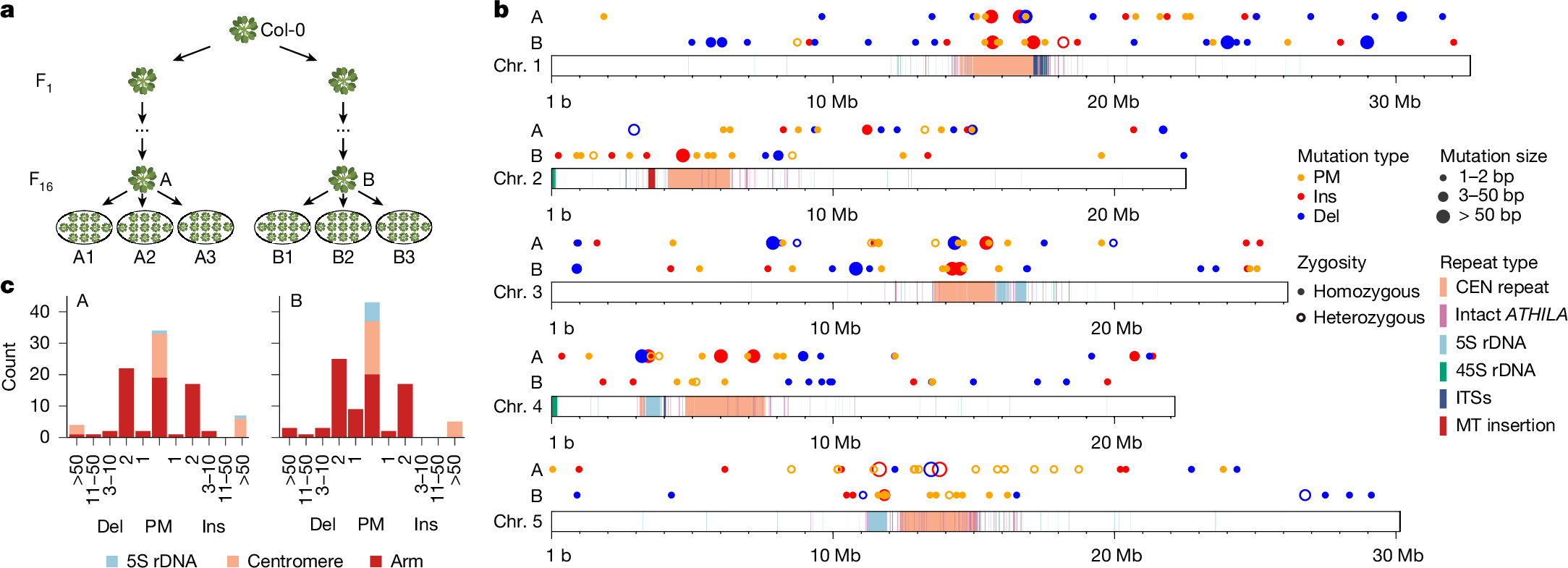
Measuring mutation one generation at a time in Arabidopsis, a Nature study found insertions and deletions that add or remove whole 178-letter repeat units, enough in simulation to build the megabase blocks seen in real centromeres.
The Scientist · Science desk
What happened
- Centromeres have done the same job for almost 2 billion years of eukaryotic evolution while the DNA sequence underneath that job has evolved at an extraordinarily rapid rate.
- An international team led by Korbinian Schneeberger of HHU scored the mutations arising inside thale cress centromeres from one generation to the next, and published the result in Nature.
- Point mutations inside the centromeres appeared at almost ten times the rate measured in the chromosome arms.
Compiled by The ScientistSomething wrong?How this is made
Why it matters
- capability Centromere architecture can now be forward-modelled from measured per-generation mutation rates, so block structure becomes a prediction a simulation can be wrong about.
- constraint A megabase block of near-identical repeats stops working as evidence for a past large rearrangement, because accumulating a few hundred kilobase-scale edits produces the same thing.
- precedent Population genomics that compares centromeres between individuals now needs a region-specific expectation for how much divergence is ordinary churn.
Centromere function goes back almost 2 billion years of eukaryotic evolution, and the DNA underneath it has been changing quickly the whole time [2]. Sequences differ between species and between individuals of the same species [3]. Comparing centromeres across species shows only the accumulated result. So the team scored mutations as they appeared, one generation at a time, in thale cress [5].
The mutations turned out to be orderly. Arabidopsis centromeres are built from a unit of roughly 178 letters repeated thousands of times [8], and the insertions and deletions almost always added or removed whole copies of that unit [9]. "At the same time, the mutations are remarkably structured: They alter the centromere while preserving its basic repetitive organization," said Xiao Dong, a doctoral researcher at the MPIPZ and first author of the study [11].
A 2,000-letter deletion, mid-range for what they measured [7], removes about eleven copies of the 178-letter unit [19]. The blocks in real centromeres run into millions of letters, roughly 5,600 units per million [12][20], so reaching one of them through 2,000-letter events takes on the order of 500 of them [21]. Simulations run over many thousands of generations with the measured rates and mutation types produced blocks of hundreds of thousands to millions of letters that closely resembled the ones in natural centromeres [14][15].
"It was previously thought that structures of this size required large mutations or long-range rearrangements to form. Our study shows that this is not the case," said Korbinian Schneeberger of HHU, the study's senior author [13]. The simulation establishes sufficiency. A megabase block of near-identical repeats therefore no longer needs a big event as its explanation, and large rearrangements could still be happening as well.
The study counted mutations; it did not test whether the altered centromeres still segregate chromosomes normally [22]. The claim that function holds while sequence churns rests on the conserved role of centromeres across eukaryotes, where the region is the attachment site for the machinery that pulls chromosomes apart [1][2]. Counting how fast a region's sequence turns over is one measurement; whether each new variant segregates as reliably as its parent is another.
"Since we began studying spontaneous mutation rates in plants almost 20 years ago, we have wondered whether different parts of the genome mutate in different ways," said Detlef Weigel of the Max Planck Institute for Biology Tübingen [17]. Point mutations inside the centromere run at almost ten times the arm rate [6], so a genome-wide average understates them by close to an order of magnitude.
What to watch
- Whether the same tenfold point-mutation elevation appears in mutation-accumulation lines of species whose centromere repeat unit is not 178 letters long.
- A segregation assay pairing newly arisen centromere variants with chromosome loss rates in the same plants.
- Whether simulations calibrated on these rates also reproduce the drastic block differences between individuals, not just the block sizes.