Loading today’s stories
Product1 distinct publisher2 min readUpdated
NNSA's first Mk4B arrives three months early, which is a claim about the factory, not the warhead
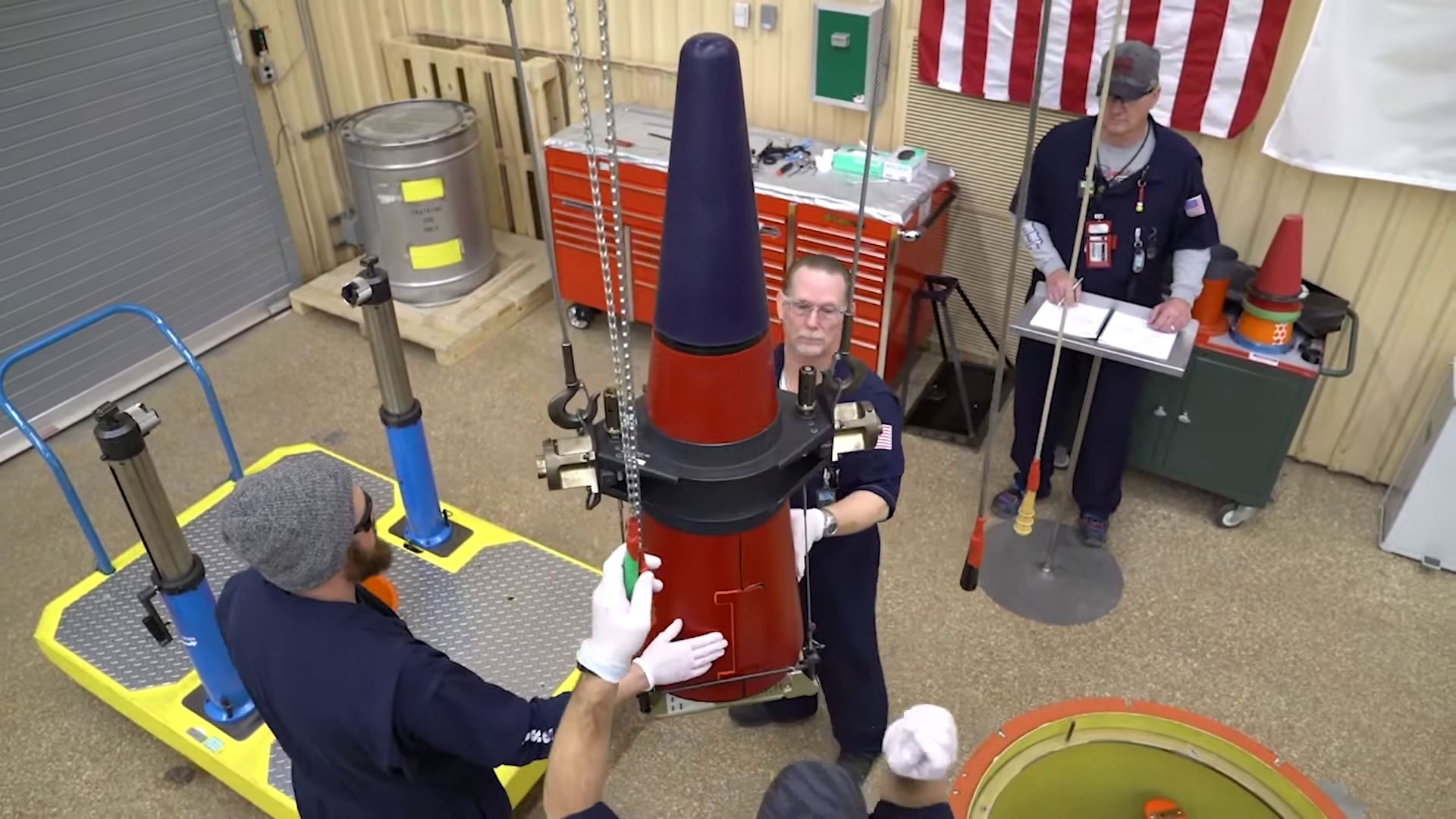
The first converted reentry body for the W76 came in ahead of schedule. What NNSA certified is a conversion line, and the number it did not publish is how many units a year that line can push out.
The Product Desk · Product desk
What happened
- The NNSA nuclear security enterprise, working with the US Navy, produced the first upgraded protective "delivery capsule" (reentry body) for the W76 nuclear warheads carried by Trident submarines.
- The Mk4B is not a new nuclear warhead but an upgrade to the reentry body and associated non-nuclear systems surrounding the warhead.
- The first Mk4B production unit was completed nearly three months ahead of schedule.
- Each Trident missile can carry multiple W76/Mk4-family reentry bodies, which separate from the missile after its powered flight.
- Reentry bodies are designed to protect the warhead during storage, launch, spaceflight and the return through the atmosphere.
Compiled by The Product DeskSomething wrong?How this is made
Why it matters
The load-bearing word in this one is "certified". NNSA says the item it handed the Navy is the first fully converted and production-certified unit, which is a statement about tooling and paperwork rather than flight performance: design, factories, assembly procedures and qualification processes are signed off for serial conversion of the rest of the stockpile [8]. Sandia National Laboratories is the system integrator and the design agency for NNSA's non-nuclear components in the Mk4B, and its nuclear deterrence manager Todd Simmermacher describes the job as making sure the requirements are met and the system is qualified [13]. Once a unit is converted, Simmermacher says, it is ready to go back to the stockpile [14]. That is the shape of the program. Units come out of the inventory and go back in, so the meaningful output is a rate, and the release does not contain one [16].
Which leaves three months as the only quantity on offer, attached to a first article [3][16]. First articles are the easiest ones to pull forward, because nothing else is competing for the same bench.
What was wrong with the Mk4A stays undisclosed. According to Interesting Engineering, NNSA says the Mk4B improves reliability but has not identified the weakness or the components that changed, and the announcement claims nothing about yield, range or accuracy [9][10]. The parts list is still informative. A reentry body carries the control, arming, fuzing and firing hardware, on top of the structure that keeps the warhead intact through storage, launch, spaceflight and the return through the atmosphere [5][6]. Reliability across that set is the probability that a warhead which arrives does what it was sent to do.
The same reentry body family serves both W76 variants: the W76-1 strategic version and the much lower-yield W76-2 introduced to provide a more limited option [7]. One conversion line therefore sits under both roles, which makes throughput a shared constraint rather than a strategic-forces detail.
Britain is the loose end. Its sovereign warhead shares design lineage with the W76 and currently uses the Mk4A, and the UK finished its own Mk4-to-Mk4A conversion in 2023 while developing the Astraea A21/Mk7 replacement [11][12]. Interesting Engineering reads that as making a Mk4B purchase unlikely, with the caveat that nobody has formally ruled it out [12]. The awkwardness is timing rather than technology, since the reentry body the Americans are now replacing remains the British one until Astraea shows up.
NNSA Administrator Brandon Williams framed the handover as making good on a commitment to accelerate production for the nuclear deterrent [15]. That framing is a hostage. Acceleration is measured across units, and only one has been delivered.
Loading topic controls
Loading related stories