Invest1 distinct publisher3 min readPublished
The ministry's figure covers 1,588 hectares of dried pond and 20 farms, but carp need three or four years to reach the scales, which turns a single hot season into a revenue line that stays missing for the rest of the decade.
The Investor · Invest desk

Compiled by The InvestorSomething wrong?How this is made
Divide 1.3 billion forints by 280 metric tons of dead fish and the ministry is valuing the loss at roughly $15,000 a tonne, or $15 a kilo [2], which is best read as an estimate of revenue those fish would have earned at a weight they had not yet reached, rather than what pond carp fetches at the gate. Spread the same money over the area that dried out and it is about $2,600 a hectare [4]; spread over the farms, about $210,000 each [3]. The drained area is 5.9% of Hungary's roughly 27,000 hectares of pond [1]. Small numbers, all of them, and that is the first thing to be honest about.
What makes this a balance-sheet item rather than a bad August is the growth cycle. Carp take three or four years to raise [14], so a year-class lost this summer bites into each of the next three or four harvests [6], which is why the head of Romania's ROMFISH association says what was lost in 2023 has shown up in every year since [15], and why Hungarian producers describe restocking as a job measured in years rather than a purchase order [11].
The response so far is triage funded out of the asset base: feeding reduced or suspended to cut oxygen demand, ponds aerated, ponds drained when there is no alternative [17], the marginal low-water ponds fished early [19] (revenue borrowed from next season, booked in this one), and in southeast Bosnia liquid oxygen dosed into a trout farm to hold stock through the summer [20]. None of that retains water in the landscape, which is what the Czech Fishing Association says the durable fix actually needs [18].
This is probably wrong, but the aquaculture number matters less for its size than for being the only line in this drought that anyone has counted. The same summer's damage to energy and water supply, to crops, and to river traffic and trade is described as a high toll with no figure attached [4], while the fish loss arrives with a hectare count, a tonnage and a forint estimate. Because the fish loss is auditable, it becomes something budgets can respond to, while the unquantified damage elsewhere stays a topic for discussion rather than a line item. And the discussion so far is countries and businesses pondering how to blunt the next event [5], with desertification advancing on the Great Hungarian Plain in the meantime [7].
The counter-case is easy to state. Millions of euros of fish [4] is a rounding error against any of these national budgets, and the emergency work reads like it: the 8 million litres Slovenian firefighters pumped into Lake Pristava [21] is 8,000 cubic metres, which at a metre deep covers about 0.8 of a hectare, roughly one two-thousandth of the Hungarian area that dried [5]. That is a gesture toward one lake, sized to match the emergency, and far short of the water policy the drought calls for. What would prove me wrong is restocking speed: if Hungarian and Romanian ponds are back at normal biomass inside a season, the multi-year impairment argument collapses into an insurable bad summer, and the retention spending never gets appropriated.
Ranked by verification strength, evidence, and original report placement.
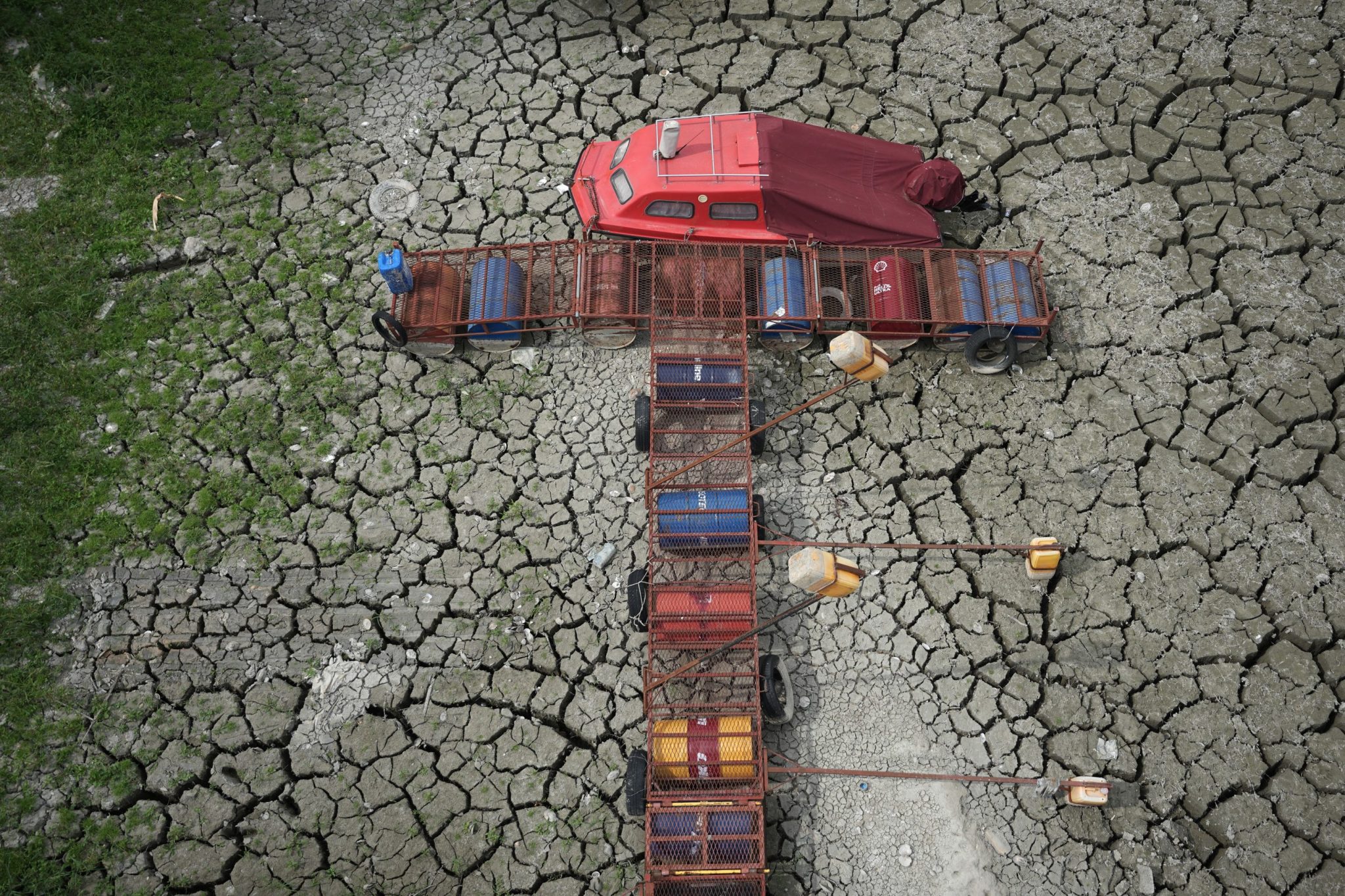
In a shriveled side channel of the Danube in northern Serbia, the water has receded into a couple of shrinking ponds under pressure from extreme drought and heat, with small boats idle on cracked ground.
Serbian fisherman Dusan Jovanovic said the juvenile fish in the two remaining ponds are in danger because there is too little water and its temperature is over 30 degrees Celsius, and that if they start to die they will all die at once.
Around 99% of Hungary's lands are currently under severe or extreme drought conditions, according to the national meteorological service.
Desertification, in which vegetation recedes because of high heat and low rainfall, threatens much of the Great Hungarian Plain.
Hungary has roughly 27,000 hectares (67,000 acres) of fish ponds.
Hungary's Agriculture and Food Economy Ministry said persistent heat and water shortages had led to 1,588 hectares (3,924 acres) of fish ponds drying out, causing the deaths of nearly 280 metric tons of fish at 20 farms.
Distinct publishers with included, body-backed reporting in this cluster.
1 article · August 29, 2026
Follow any of these and your For You feed starts watching them — no settings page required.
invest
46.9% full, 21.9 points below norm: Korea puts a number on drought's input cost1 distinct publisher
science
Budapest's Rock of Starvation surfaced in August; IIASA saw it in March soil moisture1 distinct publisher
invest
Europe's heat is now a supply event: 38.1C in the UK, reactors off along the Danube2 distinct publishers
science
Rhine at 6 centimetres: low water stops being a bad season and becomes a line item1 distinct publisher
Evidence-backed comparisons of source perspectives and observed adoption signals. Read the methodology
Which Builder, Operator, and Investor concerns the observed source mix emphasized—not a truth score.
Evidence, demonstrated adoption, hype gap, incentives, and confidence are assessed independently, each on its own current evidence. How these are measured.
One desk, official tonnage, named farmers
The scene-setting is strong and specific — Jovanovic's two ponds at 30C, Sokolik on the marginal harvest, Budjen's oxygen bottles are all first-person and named. The load of the story, though, rests on figures Hungary's ministry supplied about itself, relayed by Fortune alone: nobody weighed the 280 tonnes independently, and the 'millions of euros' regional total has no author at all.
Hoses and feed cuts, no capital
Response is real and widespread — five countries, five distinct interventions, all documented as already happening rather than announced. But every one of them is a same-week improvisation: pump, aerate, stop feeding, sacrifice a pond, harvest early. The structural fix the Czech association asks for, holding more water in the landscape, exists in this reporting only as a sentence.
Headline reaches past its own arithmetic
Fortune's framing runs to desertification and a threatened Great Hungarian Plain; the balance sheet underneath is $4.2 million across 20 farms and about 6% of one country's pond acreage. Yet the same piece under-tells the thing that actually compounds — Platon says carp take three or four years to grow, which makes this summer a subtraction from several harvests to come, and no one in the story does that sum. Overstated at the top, understated in the middle.
The damage is tallied by the claimants
Read the bylines of the numbers: a ministry sizing a farm-sector loss, a national producers' association in Romania, a Hungarian inter-branch body, a fishing association in Bohemia and another in Slovenia. These are the parties who benefit from the loss being large and officially recorded, and Platon says the quiet part out loud when he blames irrigation priority for leaving 'no water for the fish' — that is a bid in a water allocation fight, not a neutral observation. Nothing here suggests the figures are wrong; it does mean no disinterested party has checked them.
Solid on what happened, thin on what it costs
We are confident about the physical facts — heat, dead fish, ponds gone dry, emergency pumping — because they are witnessed and named. Confidence drops on the economics, where one ministry's estimate is the only figure with a decimal point, and drops further on duration, where the three-to-four-year carp cycle is the sole basis for expecting the loss to persist. Anyone acting on the money in this story should treat it as a floor reported in mid-season.