Product1 publisher3 min readPublished
Thomas Skordas told a European Parliament session that the act is not about budget, then said Europe expects a little consolidation, which leaves founders coordination on offer and payroll exactly where it was.
The Product Desk · Product desk

Compiled by The Product DeskSomething wrong?How this is made
An enabling framework is a real category in Brussels, and Skordas drew the line himself: not a regulation of the kind the AI Act and the Digital Markets Act delivered, which mostly imposed obligations, but something meant to pull parts of an industry into the same room [8]. The account of the session names no instrument behind the preference for fewer companies: no joint procurement line, and no shared fabrication capacity that two merging firms would gain access to [25].
The timetable widens the gap. A proposal is hoped for by the end of 2026 and could slip into the following year [6], while Calarco told the same room that member states "are not yet pooling their resources strategically to the extent that they should, and we cannot wait" [15]. He also called this "the last train which is passing for Europe" [14]. A last train whose departure board reads "end of 2026, possibly later" is an odd sort of train.
Europe has been spending. Public investment in quantum across the EU was reported to be outpacing the United States, and France on its own has committed 500m euros [20][21]. Cecile Perrault of the European Quantum Industry Consortium put the European content of quantum computers found in Europe at 80% [16], which leaves up to a fifth of what goes into those machines sourced from outside [23]. The complaint in the room was about what the spending has produced: effort spread across member states and competing technology approaches, plenty of prototypes, and few companies big enough to build their own manufacturing [11].
Two tests sort a founder's blockers well enough for a board meeting: whether clearing one needs money the company does not have, and whether it needs a party outside the company to agree. The act as described on 3 September reaches exactly one quadrant, the one where no new money is required but somebody else's consent is: interoperability that lets your control electronics sell into another vendor's stack, access to a facility in another member state, a public buyer that will only sign with a consortium. Anything sitting in the money quadrant runs through national programmes and private investors, because the act carries no budget of its own [1][21]. If two of a founder's top three blockers are cash, the consolidation conversation Skordas opened [9] is one to have with acquirers and existing shareholders, not with DG CNECT.
That is also why the consolidation line outlives the missing budget. Eleni Diamanti, who co-founded Welinq, said talent goes where the global leaders are, not only where the money is [19]. Hiring gets easier for whichever of the 78 grows into a company an engineer will move countries for [9], and that outcome is settled in term sheets rather than in the Quantum Act [1].
Ranked by verification strength, evidence, and original report placement.
The EU's forthcoming Quantum Act will not come with a dedicated budget. Thomas Skordas said: "The act is not about budget."
Thomas Skordas is deputy director-general of the European Commission's DG CNECT.
Skordas said: "What the act will provide is the stimulus to make sure that we move in the right direction, that we bring people together."
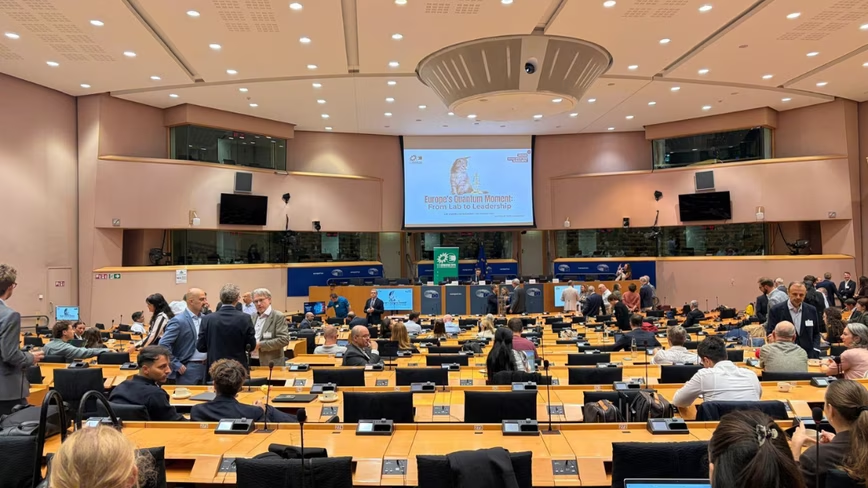
The session was hosted by the European Quantum Flagship and German Green MEP Sergey Lagodinsky, and brought together representatives from the Commission, Council and Parliament along with researchers and quantum company founders.
The Commission hopes to present the legislation by the end of 2026, although that timeline could slip into the following year.
Follow any of these and your For You feed starts watching them — no settings page required.
Evidence-backed comparisons of source perspectives and observed adoption signals. Read the methodology
Which Builder, Operator, and Investor concerns the observed source mix emphasized—not a truth score.
Evidence, demonstrated adoption, hype gap, incentives, and confidence are assessed independently, each on its own current evidence. How these are measured.
Named quotes, one notebook
The quotes doing the work come with names, titles and a date: Skordas on budget, Calarco on critical mass, Perrault on components, Diamanti on talent. Nothing documentary sits behind them. There's no draft text to read and no transcript to check the wording against. The two numbers a reader would most want tested, the 78 startups and the claim that EU public spending beats the US, both arrive unattributed.
A policy with nothing yet to adopt
There is nothing to take up. The act still lacks text and a fixed tabling date, and on Skordas's own account, it lacks money too; the Commission's hope of presenting it by the end of 2026 may slip. Real activity in the story runs beside the legislation rather than because of it: a Copenhagen chip foundry funded by the Novo Nordisk Foundation, an 80% European component share claimed by the industry consortium, and €500m of French national money.
Quantum valley rhetoric outpaces the funding
"World's quantum valley" and "the last train which is passing for Europe" were said in the same room as "the act is not about budget". The rhetoric is sized for an industrial programme; the content on offer is convening power and a preference for mergers, with the cash leg of Calarco's own three-part test missing. The Next Web is not the party inflating this, and it says plainly that no mechanism has been described.
Everyone in the room wants the act bigger
Three of the four voices have a direct stake in the act being ambitious: the Commission directorate that will draft it, the advisory board secretary pressing member states to pool funds, and the industry consortium whose members would sell into any new capacity. Perrault's 80% figure is exactly the number a trade body benefits from publicising, and it is unverified. Missing from the account are the 78 startups being asked to merge, none of whom is quoted.
One account, on the record
Single publisher, single event, but quotes attributed to named officials speaking in a public Parliament session, which makes it safe to accept that the words were said. Testing the figures around them is another matter, and no second account exists to contradict or confirm any of it.
product
Gates revives call for an AI tax, but regulators still aren't listening1 publisher
science
Text watermarks land on 2 December. The detection they imply does not.1 publisher
security
Apple dates its EU app rewrite: October 1, 2026, and the install fee becomes a 5% commission1 publisher
security
Twenty-nine MEPs ask the Commission to slow Serbia's accession over Pegasus and NoviSpy findings1 publisher
Publishers with included, body-backed reporting in this cluster.
1 article · September 6, 2026