Science1 publisher2 min readPublished
Magnetic shielding moved fly lifespans in opposite directions depending on genotype
A study in the journal Aging shielded two lines of fruit flies from Earth's magnetic field. The Pink1 mutants lived about 20 percent longer and the healthy flies died sooner, with climbing scores moving the other way in both.
The Scientist · Science desk
What happened
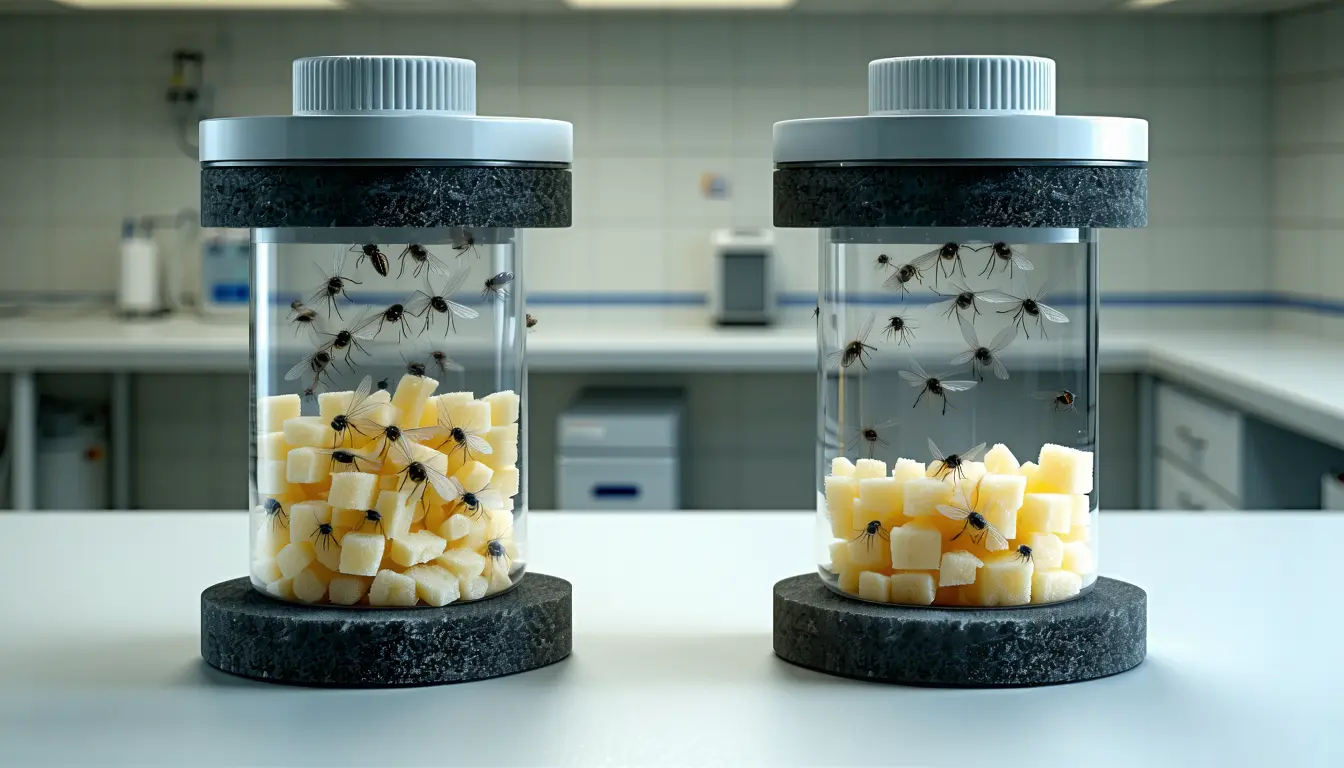
- A study in the journal Aging put healthy fruit flies and flies carrying a defect in Pink1, the gene tied to inherited early-onset Parkinson's in humans, inside a purpose-built chamber holding them at near-zero magnetic field.
- The Pink1 flies lived around 20 percent longer under shielding, and their physical performance fell.
- The healthy flies went the other way, with a shorter lifespan and better physical performance in the same hypomagnetic conditions.
- High-resolution respiration measurements and diamond quantum sensing showed mitochondrial energy metabolism changed under the reduced field, the largest change being a rise in mitochondrial complex II.
Compiled by The ScientistSomething wrong?How this is made
Why it matters
- constraint A shielded-versus-unshielded comparison run on a single fly background can return a lifespan effect whose sign belongs to that background, so one genotype is not enough to say which way the exposure pushes.
- decision Any group taking hypomagnetic exposure further has to commit to a primary endpoint first, because survival and motor performance returned opposite verdicts in both lines here.
- capability Field shielding gives mitochondrial researchers a way to change complex II activity without a drug or a genetic edit, and it can be switched on and off between runs.
- precedent A therapeutic suggestion for Parkinson's and Alzheimer's now sits in the literature attached to one mutant fly line, which sets the bar for follow-up work: reproduce the lifespan gain by raising complex II another way.
Physical performance here means a climbing test. Flies are put at the bottom of a small vial and scored on how well they get up it [5]. That measures how a fly moves on the day of the test, and in this experiment it moved opposite to survival within each line [1]. Survival itself went opposite ways between the lines, so the same exposure in the same chamber was life-extending in one genotype and life-shortening in the other [2].
The proposed cause is a single enzyme complex. The researchers say that in a healthy organism a rise in complex II could place unnecessarily high demands on mitochondria, which would account for the shorter lives, while in a Pink1-deficient fly the same rise may compensate for the deficit and extend them [8]. Both halves of that account rest on the same measured association between reduced field and enzyme activity. The Discover write-up does not include the fly counts, the size of the healthy flies' lifespan drop, or an experiment that raised complex II on its own to see whether lifespan followed.
Lisa Chakrabarti, a biochemist at the University of Nottingham and an author of the study, said in a statement: "We live our entire lives within the Earth's magnetic field. It passes through our bodies, our cells and every living organism on the planet, yet we know surprisingly little about whether and how this invisible force affects the way our cells work" [12][10]. She also said the results "raise the intriguing possibility that the Earth's magnetic field forms part of the biological environment to which life has adapted throughout evolution" [11].
That framing has a date attached. Scientists put the field at 3.7 billion years old or more from Greenland rocks of that age that recorded its strength and direction, according to a 2024 study in the Journal of Geophysical Research: Solid Earth [13]. Microbial life probably emerged almost 4 billion years ago [14].
The diseases the researchers name as possible beneficiaries of non-invasive hypomagnetic conditions are Parkinson's and Alzheimer's [9]. Pink1 flies model an inherited human disease, and the two numbers measured here are a fly's lifespan and a fly's climb up a vial [2][5]. A 20 percent gain in one mutant line that also climbs worse is a reason to run the complex II experiment.
What to watch
- Whether an independent group reproduces the genotype-dependent reversal with chamber temperature, light and vibration logged alongside the field strength.
- Whether raising complex II activity by drug or genetic means, with the magnetic field left alone, reproduces the lifespan changes in each line.
- Whether other mitochondrial-disease fly models respond in the same direction as the Pink1 line.