Science1 publisher2 min readPublished Updated
Random single-atom substitutions improved potency tenfold in 11.3% of 257 analogues
A Nature team changed 18 lead molecules one atom at a time, picking the changes at random. About 11% still gained tenfold potency, close to the rate published analogue series report.
The Scientist · Science desk
What happened
- A Nature study modified 18 lead molecules across six targets with single-atom changes and synthesized 257 analogues, with no attempt to design an improvement into any of them.
- Of those analogues, 11.3% improved potency by tenfold or more over their parent compound, a result the authors call unexpected.
- The same randomly perturbed compounds typically had worse in vitro pharmacokinetics than the parent molecules they came from.
- For comparison, 10% of analogues in the ChEMBL database meet the same tenfold bar, a figure the authors attribute partly to success bias, mixed perturbation types and irreproducibility between groups.
Compiled by The ScientistSomething wrong?How this is made
Why it matters
- decision A group claiming its optimization method works now has a threshold to clear, and with a 95% interval running from about 7% to 15%, a modest reported edge on a few hundred compounds leaves the question open.
- constraint Scoring optimization on potency alone can improve the number a program reports while degrading the exposure and half-life that decide whether a compound can be dosed at all.
- contradiction The comparator is a literature rate the authors themselves describe as success-biased, so the experiment can show published gains are matchable by chance while leaving open what deliberate design adds.
- precedent A single-atom scan across a handful of parents is cheap enough that a random arm could become expected reporting for any new optimization method.
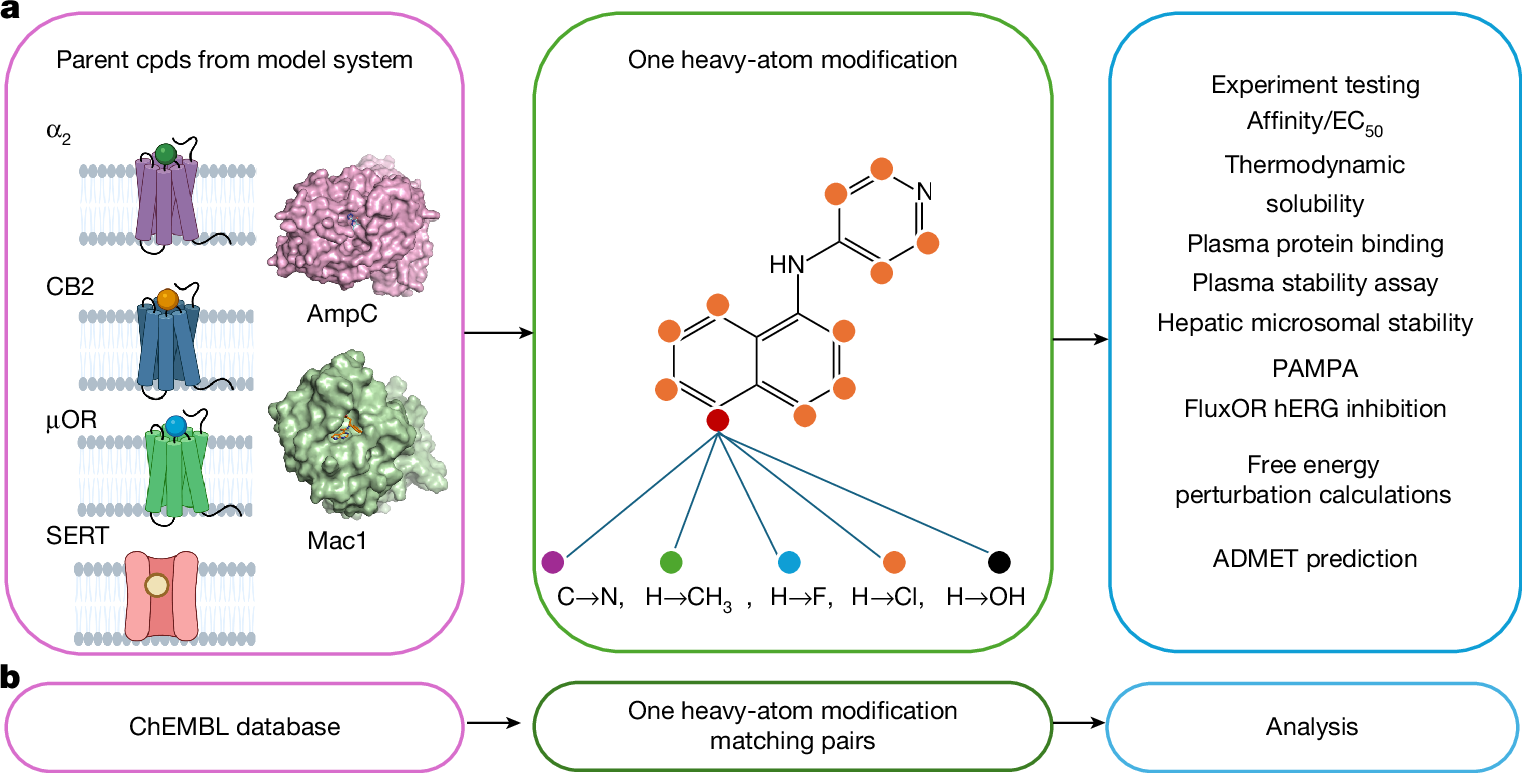
The perturbations were deliberately dull. Positional analogue scanning replaces a non-polar hydrogen on the parent with CH3, OH, Cl, F or Br, or swaps an aromatic carbon for a nitrogen [9]. The authors applied those changes "without design and without a bias towards improvement" [21], on the model of alanine scanning, which walks a protein one residue at a time to find binding hot spots [10]. No one picked the substitutions on the strength of a binding hypothesis.
Eighteen parents across six targets is three per target, and 257 compounds is about 14 analogues each [17][16]. At 11.3%, roughly 29 compounds cleared the tenfold bar [15], so a typical parent produced one or two large potency wins out of its 14 tries [18].
The binomial standard error on 11.3% from 257 compounds is about 2 percentage points, which puts a 95% interval near 7% to 15% [19]. Twenty-nine events is a thin base. A design method reporting 14% on a few hundred analogues would sit inside that interval.
The comparison here is with the literature. A retrospective analysis of 110,000 matched molecular pairs in ChEMBL found about 30% of analogues improving more than threefold on their parent [8], and the authors list success bias, mixed perturbation types and inter-group irreproducibility as reasons that database cannot settle the question [14]. What the experiment supports is narrower than design failing: random single-atom changes match the published rate for small modifications.
Hundreds and sometimes thousands of optimized analogues get made between an initial hit and a clinical candidate [11]. The paper's framing is that the efficiency of that work has been unclear because no random background existed to compare it against [12], and the strategies in use include Topliss Trees, quantitative structure-activity relationships, AI-guided pharmacokinetic prediction and free energy calculations [13].
Potency, too, was the easy endpoint. Some analogues gained enough potency to compensate for inferior exposure and half-life, producing more potent compounds in vivo [4], though the paper describes the overall result as "a frustrated landscape for ligand optimization" [5]. The experiment included no designed series, so it could not say whether a designed series would have kept its pharmacokinetics while gaining potency.
What to watch
- Whether the roughly 11% rate holds when other groups run the same single-atom scan on different chemotypes and targets.
- Whether any design method, free energy or AI-guided, publishes its tenfold-win rate against a random arm on the same parents.
- Whether follow-up work reports pharmacokinetics for a designed series on these 18 parents.