Product1 distinct publisher3 min readPublished
Platform vendors now screen data-protection startups by the thousand through accelerator judging, and the winners reach customers as marketplace apps rather than acquisitions, which hands DLP owners a fresh comparison point at renewal.
The Product Desk · Product desk

Compiled by The Product DeskSomething wrong?How this is made
Somewhere in the console there is a policy set to monitor instead of block, because it once stopped a finance analyst from mailing a spreadsheet and the ticket landed on someone senior. Teams call that tuning, and what it actually does is keep the queue quiet. Rule-based DLP spent decades producing alerts security teams could not act on [2], and the exception list is how the people on shift survived it.
The re-architecture now being sold replaces pattern matching with context classification [1]. Jazz chief executive Ido Livneh told theCUBE the company built "a context-first, business-first investigator" that reads not only what is happening to data flows but why, including intent [5]. For whoever owns the rollout, that changes the shape of the work rather than removing it. A regex explains itself: when it fires, you can read the rule aloud to the employee whose file it stopped. A model's finding is a judgment about motive, and the appeal is an argument with a conclusion. Those conversations go to HR and legal, and they go through the same person who tuned the policy.
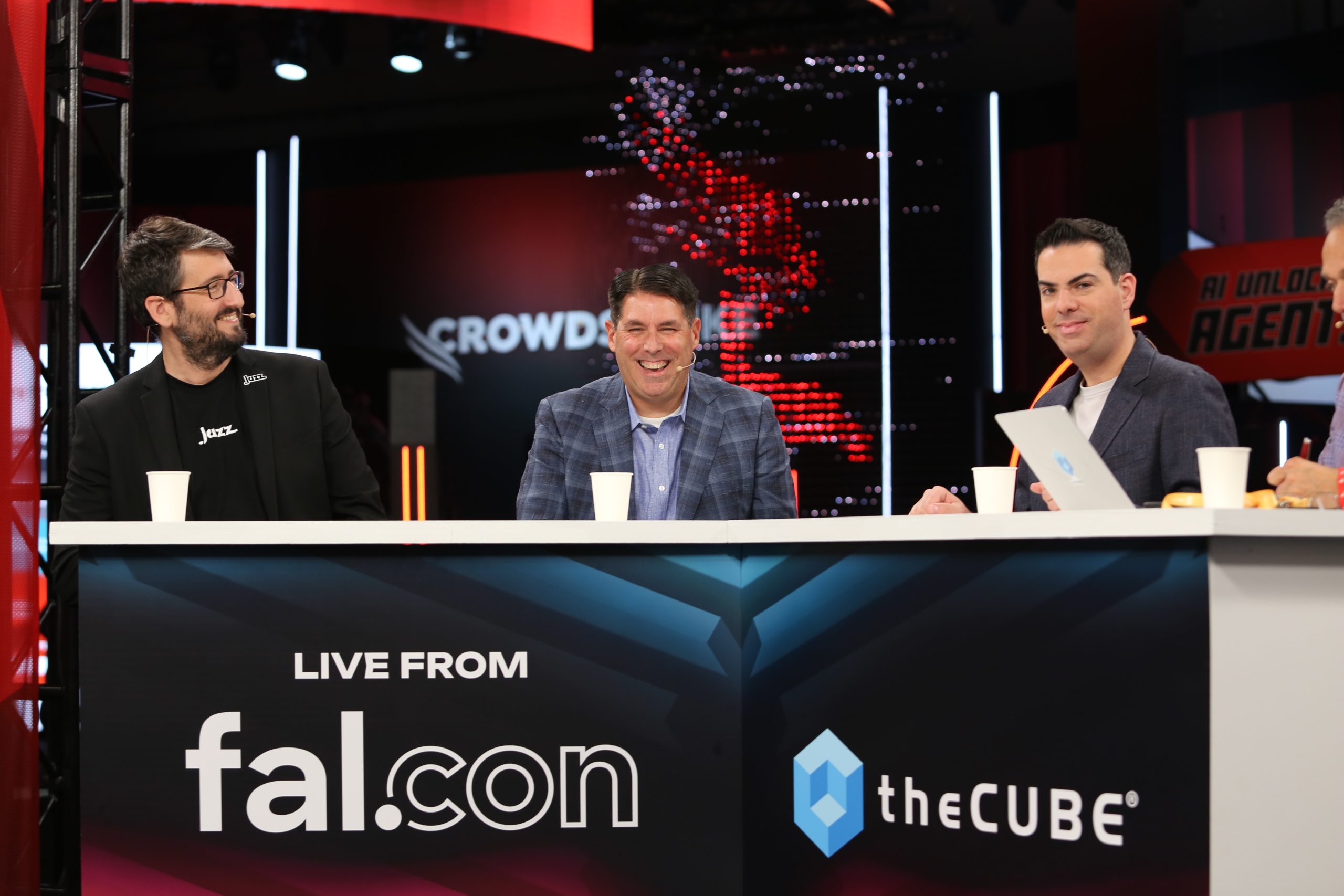
The route to the buyer is the part worth studying. Amazon security chief CJ Moses said judging the accelerator let the sponsors vet thousands of startups against gaps in their own stacks, instead of flying small teams out to meet a few dozen founders at a time [6]. CrowdStrike's Daniel Bernard framed the openness as commercial reasoning: security is not a winner-take-all market, and a vendor promising to replace everything else is probably not telling the truth, so you let the customer choose [11]. The sponsor gets a screened category entrant it never has to buy. The startup gets distribution. Both quotes came from a broadcast at CrowdStrike's own Fal.Con 2026, where theCUBE was a paid media partner [14], so read the growth figures as vendor-supplied. Divide them and the picture is early: pipeline expanding roughly 3.3 times faster than closed revenue [15], which is what inbound looks like before it converts.
Moses also argued that exposure time is now the metric that matters, on the grounds that the AI in use today is the worst anyone will ever use [13]. The supporting number is CrowdStrike's own: average eCrime breakout time down to 29 minutes, with the fastest observed intrusion at 27 seconds [12], about a sixty-fourth of the average [16]. That clock belongs to a crimeware operator racing a SOC, a different clock than the one on a departing salesperson syncing a customer list, which is the case DLP usually gets funded to cover. When the renewal deck merges the two, separate them again.
Here is the sort that makes the decision yours. Take last quarter's DLP alerts and put each into one of four boxes: blocked and correct, blocked and wrong (a ticket exists), alerted and actioned, alerted and closed with no action. Boxes one and three justify the license. Box four justifies the triage tier, and box four is precisely what a context-first classifier claims to shrink. If box four holds most of the volume, the bigger number under renegotiation is staffing, and the license price is the smaller half of the conversation.
Ranked by verification strength, evidence, and original report placement.
Jazz co-founder and CEO Ido Livneh said the company did not build "yet another pattern match or another rule-based system" but "a context-first, business-first investigator" that understands not only what is happening with data flows but why it is happening, including intent.
Jazz's agentic investigator, Melody, is now available as a native application on CrowdStrike's Falcon Foundry, the marketplace and development environment where customers build their own agents.
Daniel Bernard, chief business officer of CrowdStrike Holdings Inc., said CISOs manage about 70 tools on average and that consolidation pressure is real, but that CrowdStrike is "not here to take that number from 70 to one."
Bernard said security is not a winner-take-all market, that any vendor claiming it will replace all your other vendors is probably not telling the truth, and that the answer is to be open and let the customer choose.
CrowdStrike's 2026 Global Threat Report found the average eCrime breakout time fell to 29 minutes, with the fastest observed intrusion occurring in 27 seconds.
Decades of rule-based DLP tools left security teams buried in alerts they could not act on.
Distinct publishers with included, body-backed reporting in this cluster.
1 article · August 31, 2026
Follow any of these and your For You feed starts watching them — no settings page required.
product
CrowdStrike lets Snowflake customers buy Falcon out of capacity they already committed1 distinct publisher
build
Four concurrent MPS processes fill the L40S that one ASR request leaves 80% idle1 distinct publisher
invest
Two judges, 42 hours: Nvidia's print and Warsh's first keynote price the same trade1 distinct publisher
invest
H100 rentals are back to $2.35 an hour, and your AI cost model is stale1 distinct publisher
Evidence-backed comparisons of source perspectives and observed adoption signals. Read the methodology
Which Builder, Operator, and Investor concerns the observed source mix emphasized—not a truth score.
Evidence, demonstrated adoption, hype gap, incentives, and confidence are assessed independently, each on its own current evidence. How these are measured.
One panel, one paid partner
Everything in this story was said into the same camera at CrowdStrike's own conference, and SiliconANGLE discloses it is paid to be there. Exactly one item has a primary document behind it — the accelerator win, linked to CrowdStrike's release. The $61 million raise and the Foundry listing rest on the outlet's word, and the business metrics rest on the CEO's. Nothing is contradicted; almost nothing is corroborated.
A listing, not a customer list
One thing has demonstrably shipped: Melody is on Falcon Foundry, which proves distribution exists and says nothing about anyone using it. Not a single Jazz customer is named, no deployment is described, and the multiples on offer are ratios without a floor — a book of business doubles just as neatly from two accounts as from two hundred. The accelerator win is real validation, but it is validation by three vendors with portfolio gaps to fill, not by buyers.
Superlatives outrun denominators
The rhetoric here is doing more work than the numbers. 'Game changing' comes from a sponsor's CISO, an entire incumbent category is written off as never having worked, and four growth multiples arrive without a starting point. What keeps this from scoring worse is genuinely unusual: the platform vendor's own executive says out loud that nobody is taking 70 tools to one and that vendors promising otherwise are probably lying. That is the least inflated sentence in the piece, and it comes from the party with the most to gain from inflation.
Everyone on stage wins
Follow the money and it loops: CrowdStrike sponsors the coverage, co-runs the contest, and gains a marketplace tenant that makes Falcon Foundry more useful; AWS and Nvidia get co-branded deal flow screened against their own gaps; Jazz gets a channel and a reference customer's CISO praising its category; theCUBE gets paid to host the conversation. Even the urgency statistic is in-house — the 29-minute breakout time comes from CrowdStrike's own threat report and works as marketing as much as measurement. The disclosure is prominent and the alignment is total.
Firm on the what, thin on the whether
We are fairly sure of the mechanics: who won, what listed where, who said which sentence — all of that is stated plainly and would survive a check tomorrow. We are much less sure of anything that would tell a reader whether context-based DLP actually works or whether Jazz is growing the way it says. With one outlet, one venue and no customer or competitor voice, the assessment can be confident about the plumbing and only tentative about the substance.