Science1 publisher2 min readPublished
Killed Vibrio cells primed Red Sea corals to resist a later heat-plus-infection challenge
Corals have no adaptive immune system and the KAUST team doubted priming would work. Fragments dosed with chemically killed Vibrio coralliilyticus still held up better when heat and live infection arrived together.
The Scientist · Science desk
What happened
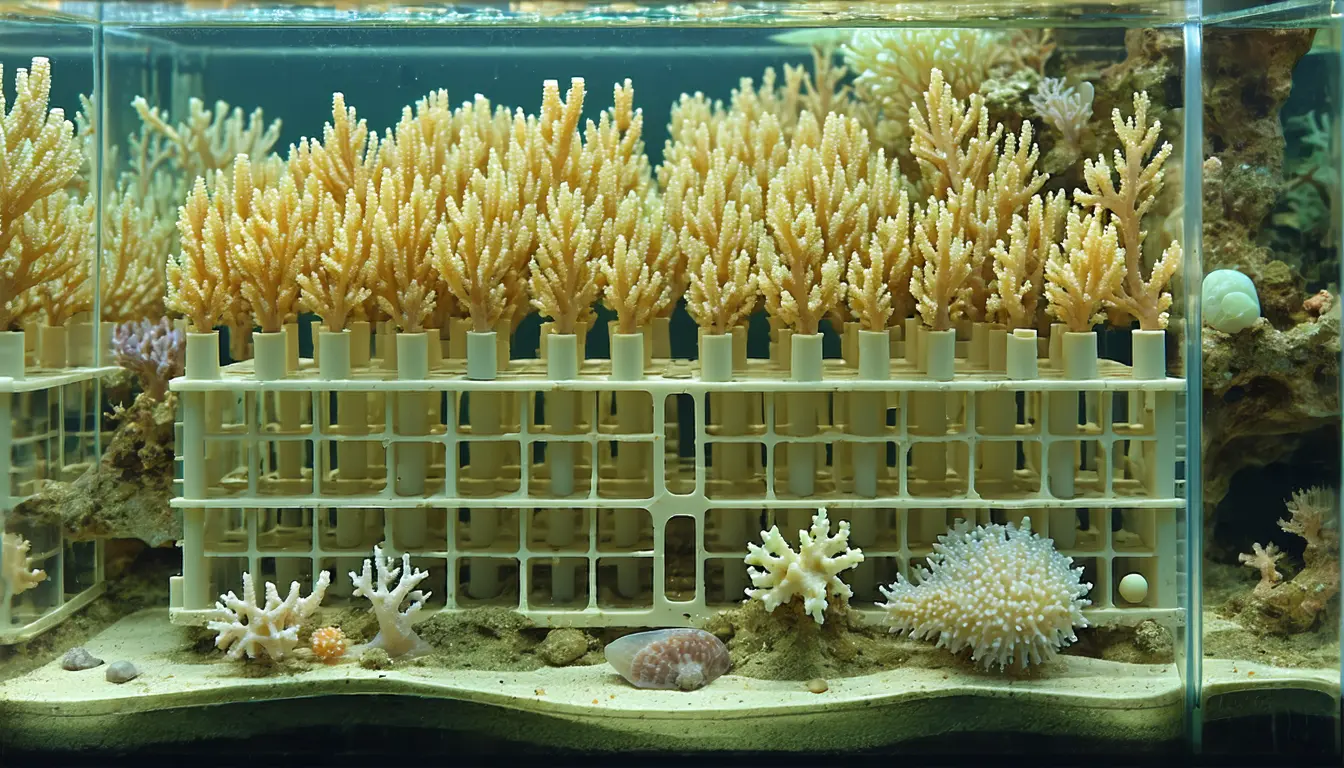
- KAUST researchers split healthy colonies of the Red Sea coral Pocillopora favosa and exposed selected fragments to either live or chemically inactivated cells of the pathogen Vibrio coralliilyticus.
- The protective effect was the same whether the corals had been primed with living bacteria or with chemically inactivated cells.
- Primed corals differed markedly from unprimed ones in both microbiome composition and gene expression, which the team interprets as conditioning of the host and its microbes alike.
- The work appears in ISME Host Microbe under the title "Pathogen priming reveals host immune training and microbiome conditioning in corals".
Compiled by The ScientistSomething wrong?How this is made
Why it matters
- capability Priming with inactivated cells gives restoration nurseries a candidate treatment they could apply to fragments without putting a live coral pathogen into the water.
- constraint The protection was measured on fragments in aquariums, where heat and pathogen dose are controlled. A reef controls neither, so the reef case is still open.
- precedent A priming effect in an animal with no adaptive immune system makes the same experiment worth running in other reef-builders before anyone treats the finding as general.
Matteo Monti said the result looked improbable going in. "Corals don't have an adaptive immune system like humans, so it seemed unlikely they could gain any protection from 'vaccine-like' exposure to pathogens," he said.
The challenge phase mattered as much as the priming dose. Heat waves and microbial infection often reach corals at the same time, and the two feed each other. "Heat and infection reinforce one another: Warming makes corals more vulnerable to disease, while infection reduces their ability to cope with warming," Monti said. A priming test run without heat would have left out the condition that produces bleaching: under prolonged heat stress the coral and its algae compete for limited resources, and the coral expels the algae and turns white.
Because fragments from each colony went into both arms, the primed and unprimed corals being compared share a genotype. That rules out the simplest alternative reading, in which the primed group happened to contain the hardier colonies.
The phys.org account says primed corals showed "a more regulated response" while unprimed corals suffered greater heat stress and pathogen-driven bleaching. It gives no numbers, either for the size of that difference or for how many colonies and fragments were involved.
The two changes the team measured imply different products. If killed cells train the coral's own innate defences, the treatment looks like something applied to fragments in a nursery. If the benefit runs through a rearranged microbial community, it looks like a probiotic, and the priming dose is only the way to install it. Host gene expression and microbiome moved together here, so the design cannot say which one carries the protection.
Killed cells working as well as live ones is the most useful single line in the study. Chemically inactivated bacteria cannot grow or invade tissue, so what the coral registered was a signal in the cell material itself, not an active infection. A treatment built from inactivated cells is plausible on that basis. Monti is direct about the distance to a reef: "This study is a proof of concept, not a treatment ready for use on reefs," he said, and "Deliberately releasing live pathogens is neither safe nor practical."
Reefs in Saudi Arabia and across the Middle East and North Africa are the focus of major restoration programs, and they support biodiversity and fisheries, protect coastlines and sustain tourism. Raquel Peixoto, who supervised the work at KAUST, said it "offers a potential nature-based strategy to address the growing threat of pathogenic infections we're seeing in the Red Sea."
What to watch
- Whether the ISME Host Microbe paper or a follow-up reports how long protection persists after a killed-cell exposure.
- An in-water or caged trial by one of the Red Sea restoration programs, instead of aquarium fragments.
- Whether another group reproduces the effect using a different Vibrio strain or a different coral pathogen.