Product1 publisher2 min readPublished
Construction at Neom's Oxagon covers 100MW of a 360MW first phase due in 2028, the first slice of Saudi sovereign AI capacity a buyer can put a delivery year against, and a small fraction of the campus figure.
The Product Desk · Product desk

Follow any of these and your For You feed starts watching them — no settings page required.
invest
Saudi Arabia's HUMAIN attaches a tenancy covenant to every check its $2.5bn fund writes1 publisher
product
AWS urges UAE and Bahrain customers off two regions it expects to be down for months1 publisher
invest
Together AI's Saudi data center pencils $20m of first-year revenue per megawatt1 publisher
product
Nvidia circles Rebellions because the low-power inference tier is not optional2 publishers
Compiled by The Product DeskSomething wrong?How this is made
A procurement lead asking where a Saudi government workload will physically sit in 2027 gets a marginally better answer from Oxagon, though the timeline still falls short of what she needs. Oxagon gives her a named site, a megawatt figure and a year: 100MW, operational in 2028 [2]. That is about two years out from the Leap 2026 stage where it was announced [15], and past the end of most contract terms being signed this quarter.
Tariq Amin, Humain's CEO, set the measuring stick himself, saying that AI ambition only matters when you can turn it into infrastructure, compute and capacity that customers can use [6]. Measured against that standard, the 100MW under construction is about 28 percent of the 360MW first phase [12] and 6.7 percent of the 1.5GW the finished campus is targeting [13]. The first phase in full accounts for 24 percent of that target [14]. Neom itself was launched in 2017 [11], which puts the first 100MW of compute inside it 11 years later [20].
One of the two items DataVolt brought to Riyadh has a crew on site [1]. The other is a memorandum of understanding with Zain KSA covering an unspecified number of data centers with no delivery timeline attached [7], earmarking capacity for Zain's own future requirements plus government entities, businesses, large enterprises, cloud service providers, digital content companies and digital platforms [8]. That customer list takes in roughly everyone in the Kingdom with an IT budget, which is usually what a list looks like before anyone has sized it.
On power, the report says the site will reportedly run on Neom's wind and solar assets [4], and it does not specify storage, firming or grid backup [17]. A cluster billed by the GPU-hour is exposed to the hours the wind is not blowing, and nothing published so far says what covers those hours. That is a tenancy-negotiation question, not a sustainability-brochure detail.
The sorting rule for anyone keeping a Gulf capacity plan honest is two tests per line item: whether a named site has land secured, and whether a megawatt number is attached to a stated year. Oxagon's 100MW answers both, so it can carry a tenant commitment. The 1.5GW target answers only the first, which makes it a forecast rather than supply. An MoU with no site count and no date answers neither, and simply belongs on a watchlist. The useful discipline is refusing to let the three sit in the same column of the same slide.
Ranked by verification strength, evidence, and original report placement.
Oxagon will lease the land to DataVolt for the development and provide the operator with infrastructure support; the site will reportedly be powered by Neom's wind and solar assets.
The DataCenterDynamics report does not specify storage, firming or grid backup arrangements for the Oxagon site's power supply.
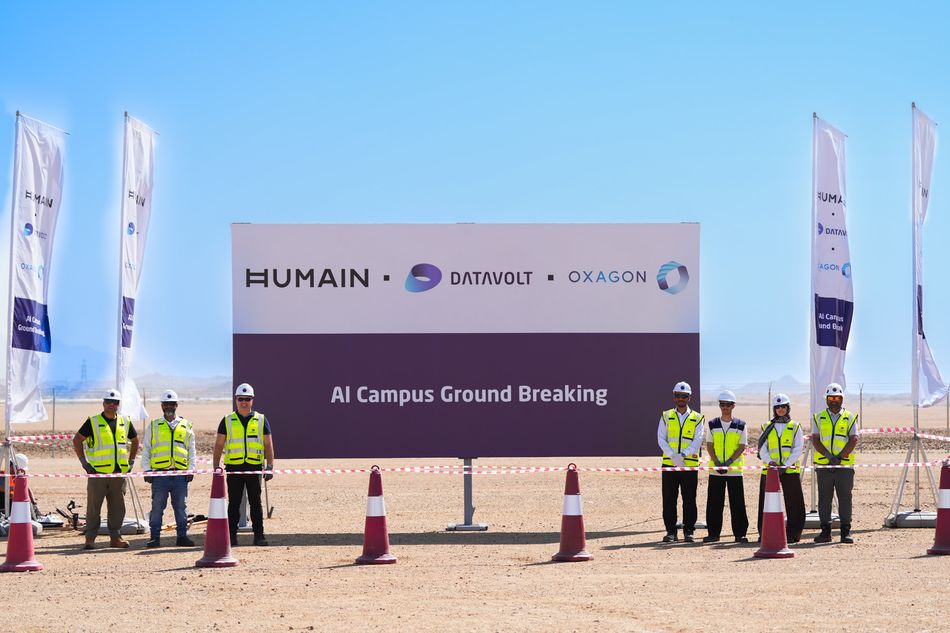
Saudi state-backed AI venture Humain and developer DataVolt have started construction of a hyperscale data center at Oxagon, Neom's industrial district on Saudi Arabia's Red Sea coast.
At the Leap 2026 conference in Riyadh, Humain and DataVolt announced an expanded partnership to develop 100MW of the 360MW of capacity in the project's first phase, expected to be operational in 2028.
The completed Oxagon campus is targeting a total capacity of 1.5GW.
Tariq Amin, CEO of Humain, said: "AI ambition only matters when you can turn it into infrastructure, compute and capacity that customers can use, that is what this partnership with DataVolt is about" and "Construction is underway, 100MW is moving forward."
Publishers with included, body-backed reporting in this cluster.
1 article · September 7, 2026
Evidence-backed comparisons of source perspectives and observed adoption signals. Read the methodology
Which Builder, Operator, and Investor concerns the observed source mix emphasized—not a truth score.
Evidence, demonstrated adoption, hype gap, incentives, and confidence are assessed independently, each on its own current evidence. How these are measured.
Company figures, one relay
Every quantity in this story — 100MW, 360MW, 1.5GW, 2028 — was spoken by Humain and DataVolt at Leap and printed by DataCenterDynamics. A groundbreaking is among the easiest claims to verify physically and no one outside the companies has done so. The power arrangement is hedged in the reporting itself, which says the site "will reportedly be powered by" Neom's wind and solar, and the memorandum with Zain KSA carries no quantity at all.
Ground broken, nothing serving
There is real activity to point at, which separates this from the announcement-only Gulf compute pipeline: a site with a lease, a developer, and steel going in. It is also 100MW of a 360MW phase that will not run until 2028, about 6.7 percent of the campus figure, with no named tenant. The Zain KSA memorandum adds intent rather than capacity.
Campus figure outruns the build
The number that travels from this announcement is 1.5GW; the number with contractors on it is 100MW, and Humain's chief executive attaches "speed and scale" to capacity that arrives in 2028, eleven years after Neom was launched. DataCenterDynamics does keep the tiers straight and labels each one, which is why the gap sits well short of pure vapour.
Announced on the Kingdom's own stage
A state-backed AI venture, a developer whose landlord is the Neom project, and a national telco all chose Leap in Riyadh to say this, with the Zain memorandum explicitly framed as support for Vision 2030. The reporting inherits that framing and closes by inviting readers to its own Riyadh data centre event, which colours the calendar more than the facts.
Uncontested but unchecked
Nothing in the file contradicts anything else, and the figures are internally consistent — but consistency is easy when there is one teller. A second account confirming the site works, or any permit, order book or grid document, would move this materially; until then the delivery date and the renewable supply are assertions in good standing rather than verified facts.