Build1 publisher3 min readPublished
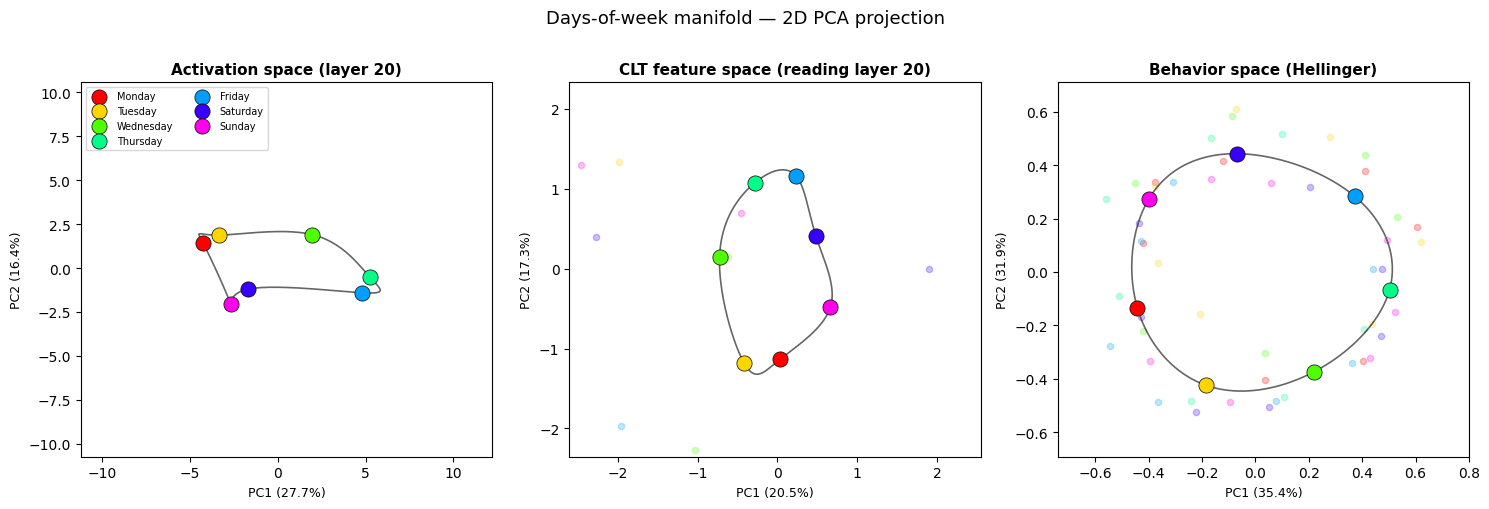
Steering 64 CLT features moves Gemma-2-2B through the ordered days at weaker token probabilities
A replication of Wurgaft et al.'s manifold steering on Anthropic's pre-trained CLT features reproduces the cyclical weekday transition in Gemma-2-2B. The author attributes the weaker push to the MLP sublayers holding only part of the signal.
The Engineer · Build desk
What happened
- A LessWrong post extends the Goodfire lab's cyclical manifold methods, from Wurgaft et al. (2026), to Anthropic's pre-trained CLT feature space on Gemma-2-2B, steering along a day-of-the-week manifold.
- Gradual perturbations along the manifold moved the model smoothly through the ordered days, while linear interpolation transported it from the start day to the end day without cleanly passing through the days between.
- In CLT feature space the steered token probabilities came out weaker than in raw residual space, and the author attributes the gap to the more limited scope of the CLT feature steering vectors.
Compiled by The EngineerSomething wrong?How this is made
Why it matters
- constraint The activation baseline replaces the whole vector at a layer while the CLT arm touches 64 selected features, so a difference in scope can produce the probability gap without locating the weekday signal in the MLP sublayers.
- contradiction The earlier instalment found the weekday manifold moderately cleaner in CLT features than in raw residuals; the steering result points the other way, so a tidier fit is not evidence of a stronger control handle.
- decision Anyone picking pre-trained CLT features over residual directions to steer a behaviour is giving up effect size on the one measurement this experiment reports.
- capability Interpolating an angle along a fitted spline gives a way to test whether a feature set carries the ordering of a cyclical variable and not merely its identity, and it applies to any pre-trained transcoder feature set.
The write path is where the two arms of this experiment stop being comparable. CLT features are read out of the residual stream and not stored in it, so the intervention cannot overwrite them in place. The post applies steering by writing the difference between the steering vector and the prompt's own features back into the stream [13]. The activation arm has no such indirection. There, linear steering replaces the entire activation vector at a layer, and manifold steering replaces only the 48 PCA components used to fit the spline, leaving the rest of the prompt's activations untouched [11].
In CLT space, both the linear and the geodesic path replace the same object: the top 64 features in a layer, ranked by a between-day F-statistic [12]. The CLT comparison is the tidier of the two, because linear and manifold interpolation run through identical coordinates and only the path differs [10]. In activation space the linear baseline touches every dimension and the manifold arm touches 48, so scope and path vary together [11].
The author suggests the weaker CLT result is evidence that the MLP sublayers where those features originate hold only a portion of the full day-of-the-week signal [3]. The support for that is a probability gap between two interventions that differ in size and in write path. The CLT arm moves 64 coordinates, 16 more than the activation manifold arm's 48 [15], and those coordinates are selected feature activations, not principal components. For the gap to be about MLPs, the additive write would have to land the read-out features on the target centroid. And it would have to get them about as close as the residual replacement gets the activation vector to its centroid. The write-up describes the gap without quantifying it [19].
Scoring runs through behavior space: the model's output distribution converted into Hellinger space, with a third manifold fit through the day centroids there [6][7]. Hellinger space is where the result can be scored, because what matters is whether the emitted token passes through Tuesday and Wednesday on the way from Monday to Thursday. The day-arithmetic prompts make that legible, for example "Q: What day is two days after Monday? A:" [8].
The sample is 16 prompts held static, drawn from a pool of 49, with each sweep divided into 50 increments [8][9]. 16 of 49 is about a third [16]. Every sweep also starts from an edit: the last-token vector is first replaced by the source-day centroid. The post says that is "already an intervention rather than the model's natural state" [17]. A control that begins with the answer vector already overwritten is an unusual control.
On this evidence the residual stream is still the stronger write point for weekday answers in Gemma-2-2B, and the Colab notebook published with the post is where the feature count and layer can be varied [14].
What to watch
- Whether a follow-up reports how closely the additive CLT write recovers the target-day centroid in feature space.
- Whether matching the coordinate counts, 48 PCA components against 64 features, closes the probability gap.
- Whether the pattern holds on more than 16 of the 49 prompts, or on a model other than Gemma-2-2B.