Product1 publisher3 min readPublished
Hangzhou put 15 robot traffic police on the street with the enforcement removed on purpose
The West Lake humanoids do perception, guidance and voice, then hand every infraction to a human officer. The scope cut is the most transferable part of the deployment.
The Product Desk · Product desk
Drafted by a language model from the sources cited here and checked against its claim ledger before publication. How we use AISend a correction
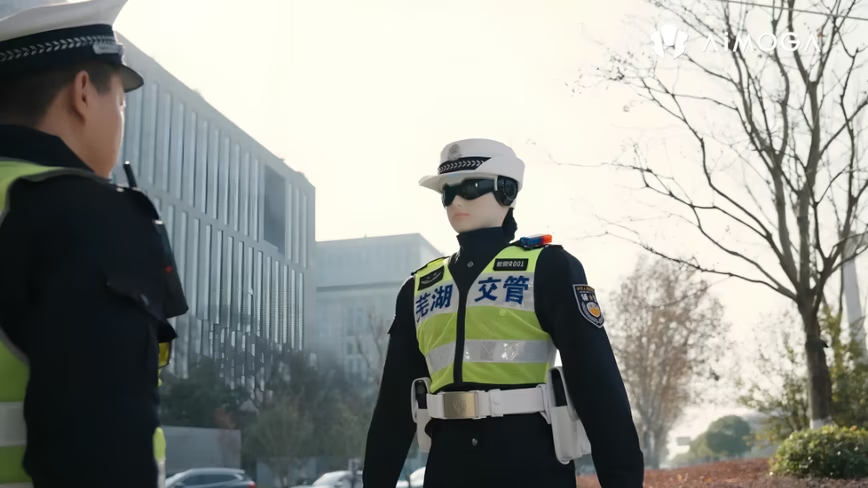
What happened
- Hangzhou's local traffic police put 15 humanoid robots on duty around the West Lake scenic area on 1 May, timed for the Labour Day crowds.
- Chinese state media described the Hangzhou deployment as the country's first robot traffic police squad, working alongside human officers rather than in place of them.
- The robots cannot stop anybody, and that limitation is written into the design rather than left to the machine's discretion.
- The machines guide pedestrians and riders of non-motorised vehicles away from violations, help manage traffic flow, and answer navigation questions from tourists using large speech models plumbed into live traffic data.
- Visual recognition picks up violations as they happen, and the robots perform traffic command gestures synchronised with the signal cycle.
Compiled by The Product DeskSomething wrong?How this is made
Why it matters
Hangzhou's traffic police put 15 humanoid robots on duty around the West Lake scenic area on 1 May, timed for the Labour Day crowds, in what Chinese state media called the country's first robot traffic police squad [1][2]. The design decision worth studying is not the hardware but the deliberate hole in the feature set: the robots can see a violation and are not permitted to act on it [3][6].
The shipped capability list is narrow and coherent. The units guide pedestrians and riders of non-motorised vehicles away from violations, help manage traffic flow, and answer tourists' navigation questions using large speech models connected to live traffic data [4]. Visual recognition flags violations as they occur, and the robots perform traffic command gestures synchronised to the signal cycle [5]. That is perception, guidance and voice interaction in a chaotic outdoor environment, which is a real product.
What happens next is where the constraint lives. When a robot spots an infraction it issues nothing and detains nobody; it records what it saw and forwards the file to the traffic police bureau's early warning centre, where a human decides [6]. According to The Next Web, that arrangement keeps the deployment inside Chinese policing law, which vests coercive powers in officers rather than equipment, and it avoids the question of what happens when an autonomous system misidentifies someone [7]. Teams building for public space tend to treat this kind of ceiling as a temporary regulatory nuisance. It is cheaper to treat it as the specification. A system whose worst failure mode is a bad referral to a human reviewer has a survivable failure mode, which is more than can be said for the more than 100 Baidu robotaxis that froze mid-traffic in Wuhan [11].
The second honest constraint is duty cycle. The Hangzhou units run eight to nine hours a day, a shift rather than a permanent surveillance layer [8]. Across 15 machines that is 120 to 135 robot-hours per day, roughly a third of the 360 hours continuous cover of the same 15 posts would need [14]. Anyone budgeting a public-space rollout should price the gap.
The commercial logic underneath is procurement, not consumer demand. China shipped tens of thousands of humanoids in the first half of this year, and municipal contracts are one of the few places those machines have a paying customer, a point sitting under Unitree's Shanghai listing and sector valuations generally [9]. Chinese robotics firms have struggled to find demand outside laboratories, and one city buying 15 units does not resolve that; public procurement is simply more patient than consumers [10]. There is also a return in kind: every hour a robot works a junction is real-world data in conditions laboratories do not reproduce, which is the input the sector says it lacks [13].
The evidence is thin in the places that matter most. State media accounts are the primary source for the deployment, no independent audit of violation-detection accuracy has been published, and the traffic bureau has not said how many robot referrals ended in a penalty [12]. Xinhua reported in January that AI-powered robots had begun taking traffic duties in several Chinese cities, and by the May holiday was describing robot patrols as urban management rather than a pilot, a rhetorical promotion of about four months [15][16].
Watch for a referral-to-penalty number, and for the first city that asks a machine to issue a fine directly. More cities are expected to follow Hangzhou, and the units now in service are effectively a field trial of what the public will tolerate [17].