Product1 publisher2 min readPublished
China builds its airborne nuclear leg on about 20 bombers derived from a 1950s Soviet design
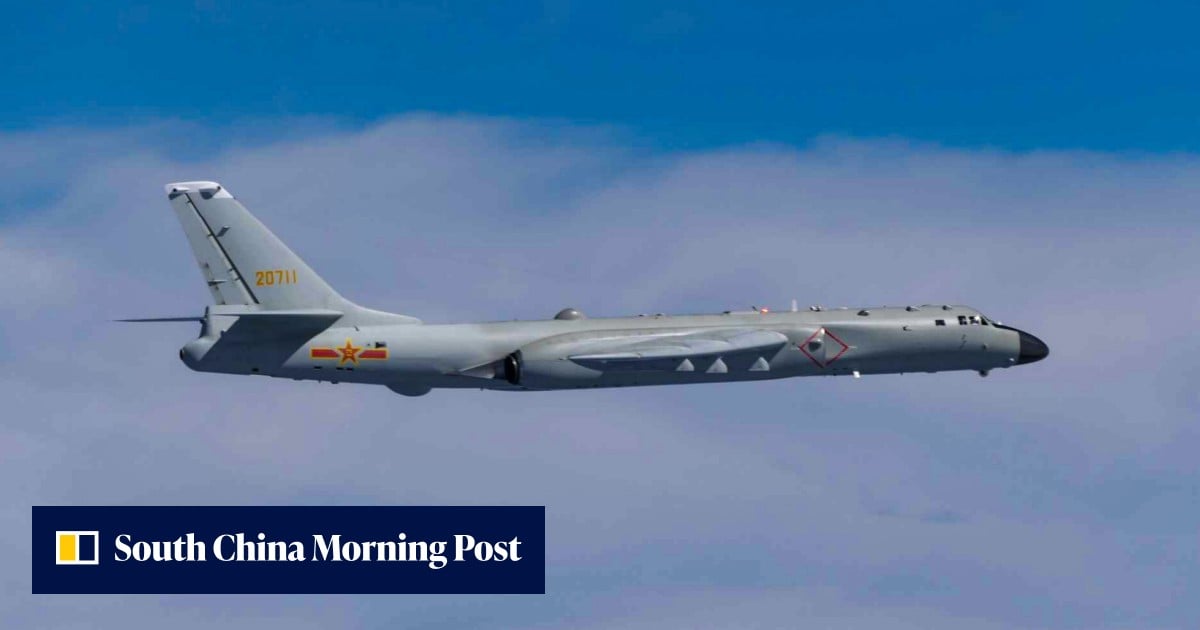
Recent footage shows an H-6N carrying the nuclear-capable JL-1 ballistic missile. The airframe traces to a licensing deal China signed with Moscow in 1957, and SIPRI puts about 20 of the bombers in service with up to 20 warheads assigned.
The Product Desk · Product desk
What happened
- Recent footage shows China's H-6N strategic bomber carrying the nuclear-capable Jing Lei-1 air-launched ballistic missile, giving Beijing an airborne option alongside its ICBMs and missile submarines.
- The H-6N gives up its internal bomb bay for a recess under the fuselage so it can carry the oversized JL-1 externally, and a nose probe lets it refuel from China's YY-20A tankers.
- SIPRI estimates China had around 20 H-6Ns in service in 2026, with up to 20 nuclear warheads assigned to the force.
Compiled by The Product DeskSomething wrong?How this is made
Why it matters
- capability The third delivery route arrives through conversion of aircraft China already builds, so the cost sits in a bomb bay modification and a refueling probe instead of a new bomber program.
- constraint At roughly one warhead per airframe across about 20 aircraft, this leg buys launch flexibility in a retaliatory scenario and very little volume.
- exposure Usable range depends on tanker support, so the YY-20A fleet is now part of the planning problem for anyone assessing how far an H-6N can strike.
- contradiction One account carries both the potentially intercontinental framing and the admission that public information on the JL-1 is limited, so the range number and the evidence behind it are not the same grade.
The cheapest way to add a capability is to modify an aircraft already in production. China began licensed production of the Tu-16 after a 1957 agreement with Moscow, according to the South China Morning Post, and the first fully domestic H-6 flew in December 1968 [9][10]. More than 230 of the aircraft have reportedly been built [11]. The H-6N is that airframe with the internal bomb bay taken out, a recess cut into the belly for an oversized external weapon, and a refueling probe on the nose [4][5].
That leaves 69 years between the licensing deal and SIPRI's 2026 count of the fleet [19].
The evidence for the pairing is footage of the bomber carrying the missile [1]. No launch has been reported [20]. A combat radius of more than 2,175 miles plus a missile range of up to 5,000 miles is 7,175 miles from takeoff to impact point, unrefueled [6][7][17]. Both figures are reported, and the same account says publicly available information about the JL-1 remains limited [7]. It also says the range on any given mission depends on payload, flight profile and tanker support [14].
The H-6N's reach depends on tankers. The probe mates with China's YY-20A [5], and the H-6K and naval H-6J variants that account for most of the family are conventional strike platforms [12].
Then the count. SIPRI estimates around 20 H-6Ns in service in 2026 with up to 20 nuclear warheads assigned to the force, about one warhead per aircraft [13][18]. The account frames the value of that as flexibility in a retaliatory scenario [22].
There is no island-chain framing in the article. It says the combination potentially extends China's reach well beyond the western Pacific, and it describes the JL-1 as derived in part from the DF-21 medium-range family, launched from the bomber at altitude [21][16][8].
Footage shows carriage. The fleet is about 20 aircraft, and the headline range figure depends on tanker support. On that record China has restored the airborne leg of its triad as a working option [15], sized at up to 20 warheads, with the intercontinental part of the claim resting on range figures the source itself calls limited [13][7].
What to watch
- A reported or filmed JL-1 launch from an H-6N, which would move the record past carriage.
- A later SIPRI estimate raising the H-6N count or the warhead allocation above 20.
- Published YY-20A tanker numbers, since usable range is tied to tanker support.