Loading today’s stories
Product1 distinct publisher3 min readUpdated
Two Chinese booster recoveries, one state and one commercial: reflight is still the untested part
Recovery is not reflight, and no recovered Chinese stage has flown twice yet. What changed in under two months is how many independent programs could get there.
The Product Desk · Product desk
What happened
- On August 19, Chinese commercial launch company LandSpace successfully landed the first stage of its Zhuque-3 rocket on solid ground after an orbital launch.
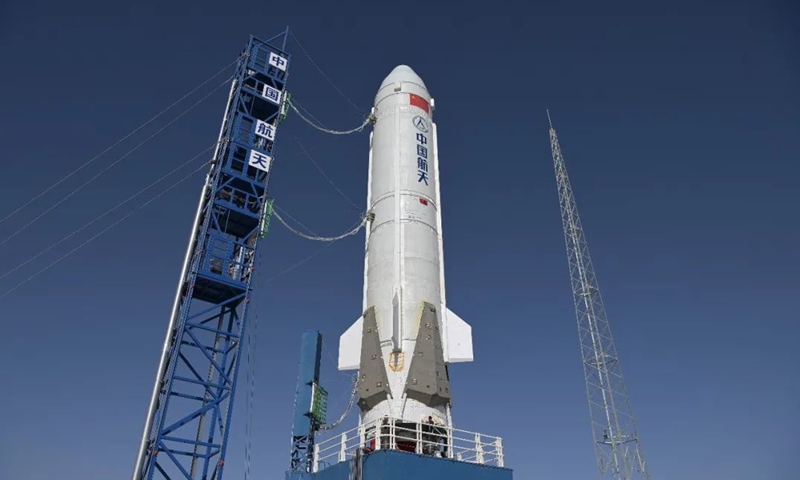
- In July, state-owned China Aerospace Science and Technology Corporation (CASC) recovered a Long March 10B first stage using a net-based system on an offshore platform, China's first controlled recovery of an orbital-class rocket booster.
- China achieved the two reusable rocket recovery milestones in little more than a month.
- China has now demonstrated two different methods of recovering orbital-class rocket boosters: an offshore net capture by CASC and a vertical land landing by LandSpace.
- LandSpace's Zhuque-3 used a conventional vertical recovery with engine-powered deceleration and deployable landing legs.
Compiled by The Product DeskSomething wrong?How this is made
Why it matters
Most of the coverage has routed through the People's Liberation Army, and the source material follows it: defence analysts cited by the South China Morning Post argue that reusable rockets would let China put replacement communications or ISR spacecraft up faster, which would blunt attacks on the space-based links in a kill chain [12]. The War Zone extends that to access itself, arguing a higher launch and replenishment tempo could erode a standing US advantage in reaching orbit for commercial and national-security purposes [13].
For anyone whose product plan is priced in dollars per kilogram, the more useful delta is organisational rather than military. One recovery belongs to CASC, a state-owned corporation, which guided a Long March 10B first stage into a net on a specialised recovery vessel in July [2]. The other belongs to LandSpace, a commercial company, which put a Zhuque-3 first stage down on solid ground on 19 August after an orbital launch [1]. The source characterises these as two tracks, state-backed and commercial, running at once [15]. That matters because a stall in one lane, technical or financial, no longer stalls the capability.
The hardware disagrees with itself too, which is a sign of real engineering rather than a copied template. Zhuque-3 braked on its engines and came down on deployable legs [5]. The Long March 10B carried no legs at all, and Chinese officials say net capture avoids that weight penalty while giving a wider margin for error on the way in [6]. Both are pointed at the same conditional the source states plainly: if the expensive parts come back and fly again, cost per launch can fall and frequency can rise [9].
Note which half of that sentence has been demonstrated. Neither program has shown routine reuse of a recovered booster [7]. LandSpace says the Zhuque-3 first stage is designed for multiple flights and CASC is continuing work on reusable architectures [8], and a design intent is not a turnaround time. The pair of recoveries are, on the source's own reading, an important step and not the end of the technical problem [7].
So the operator's read is narrower than the headline. Until a Chinese stage flies a second time, the assumption that mass to orbit keeps getting cheaper still rests on the single demonstrated case, which the source locates in the US ecosystem through SpaceX [10]. What the last two months altered is the odds on the back half of this decade. The two milestones landed little more than a month apart [3]; with the later one dated 19 August and the earlier one placed in July, the outside gap is about seven weeks [14]. Two architectures, two ownership models, two capital sources, all clearing the recovery bar inside that window. If your roadmap has a line item that only closes below some price per kilogram, the question worth re-running is not whether China gets there but what happens to your supplier leverage if a second and third launch line arrives with reflight economics in 2028 instead of never.
Loading topic controls
Loading related stories