Product1 publisher3 min readPublished
China prices Japanese deposition gas out of its own fabs with a 99.2% deposit
A deposit at customs bills the importer, and Chinese memory makers are the first to feel it. The qualification calendar runs months, so they cannot buy their way out of it this quarter.
The Product Desk · Product desk
What happened
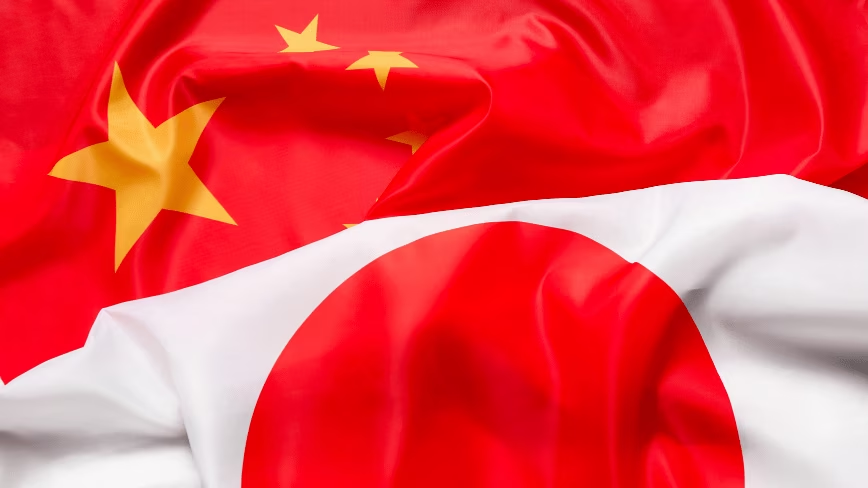
- A cash deposit of up to 99.2% now applies at Chinese customs to imports of a Japanese chemical that fabs use to build the films inside logic and memory chips, and it took effect on Tuesday.
- Dichlorosilane feeds chemical vapour deposition, laying silicon and oxide films a few atoms thick in both logic and memory production, and it is consumed continuously rather than bought once.
- The measure is provisional, following an investigation China opened on 7 January, and interested parties have ten days to comment before the final ruling.
- Chief Cabinet Secretary Minoru Kihara lodged a protest and said Tokyo would respond appropriately.
Compiled by The Product DeskSomething wrong?How this is made
Why it matters
- exposure The bill arrives inside China before it arrives anywhere else, and heaviest on memory production, which leaves CXMT under cost pressure from its own government while it contests a US listing in court.
- constraint Qualification time rather than price is what forecloses substitution, because a fab changing DCS supplier buys months of work before wafers move, so the deposit bites for at least that long.
- precedent A trade remedy with a petitioner and a comment period does the work of a licence refusal without presenting itself as policy, which makes the instrument straightforward to reuse on other fab consumables.
The person who has to answer for this is whoever signs the DCS purchase order at a Chinese fab, because an import duty bills the buyer, not the exporter [15]. Post a 99.2% deposit against an invoice of 100 and the shipment clears at 199.2 [20]. That is the arithmetic behind the word prohibitive [1], applied to a gas the fab consumes continuously rather than buys once [5].
The rate table closes the obvious door. Shin-Etsu Chemical draws 99.2%, and so does every other Japanese exporter [4]. The one name below the top rate is Denal Silane, the Denka and Air Liquide joint venture, at 80.8% [4], which buys 18.4 points of relief [21] and still leaves four fifths again on top of the invoice.
Switching suppliers outside Japan means running a qualification project, not cutting a purchase order. Deposition chemistry is unforgiving about contamination, and a fab that changes supplier buys months of qualification work [18]. So the pitch and the practice come apart in a familiar way: a bill of materials can list two approved vendors while the line has only ever run material from one.
The beneficiary here is clear. Tangshan Sunfar Electronic Materials, a Chinese producer, filed the application on 8 December 2025 [11], and a protective duty exists to hand a domestic producer the market at a price importers cannot match. The heaviest users on the buying side are Chinese memory makers, because memory stacks far more deposited layers than logic does [16]. CXMT, the country's largest DRAM producer, is contesting a US listing in the Washington courts while its input costs rise by order of its own government [17].
Instrument choice matters as much as the rate. Export controls on gallium, germanium, graphite and rare earths announce themselves as policy [8]. An anti-dumping case arrives with a petitioner, an investigation, a determination and a comment period, all recognised under WTO rules, and the European Union ran the same instrument against Chinese electric vehicles [9].
The petition landed roughly a month after Prime Minister Sanae Takaichi suggested in November that Japan's military could intervene in a Taiwan contingency, and Beijing has imposed dual-use export controls on Japanese firms in the months since [12]. The record does not establish that one caused the other, and petitions of this kind take months to prepare [13].
Estimates of Japan's global market share vary too widely to support any claim about world supply. Estimates of Japan's share range from under a tenth to three quarters with no primary source behind any of them, in a market the Associated Press calls highly competitive [7]. AP does describe Japan as the leading producer of ultrapure dichlorosilane for chip fabrication [3]. The demonstrated exposure is narrower than a global chokepoint and harder to fix than a price rise: Chinese buyers of Japanese DCS, paying near-double landed cost, with a qualification calendar in the way.
For anyone keeping a single-source register, the useful column is a date rather than a vendor name, and the date is the last time production material actually shipped from the second source. Where that cell is empty, the input has one supplier whatever the approved vendor list says, and a filing in a ministry gazette can idle the line as neatly as a refused licence [10]. Chinese memory fabs are reading that column now. European PC buyers, whose desktop shipments are already falling after three quarters of sharp DRAM rises, meet the result later in the price of a finished module rather than in any shortage of gas [19].
What to watch
- The final determination after the ten-day comment window, and whether the 99.2% rate survives it unchanged.
- Whether CXMT or another Chinese memory maker qualifies a domestic DCS source, and how long that line qualification takes.
- Whether Tokyo's promise to respond appropriately becomes a WTO complaint or a counter-measure on Chinese inputs.