Product1 distinct publisher3 min readPublished
The request sits at roughly twice the €120M fine handed to X, and the substantive ask is buried in nine questions about advertiser checks and takedown times.
The Product Desk · Product desk

Compiled by The Product DeskSomething wrong?How this is made
The questionnaire matters more than the euro figure. Of the nine questions Warsaw put to Meta on 18 August, two ask for operational measurements rather than policy statements: how the company verifies advertisers, and how long it takes to remove an ad once it has been reported [3]. A seven-day deadline was attached [3], which makes both a reply and a silence usable. Deputy minister Dariusz Standerski had already said in public that the next letter would go to Brussels if the answers did not satisfy [4], so the questions were written in the knowledge that they would be read by the only body that can impose a penalty [5].
The number reads as a bid rather than a punishment. The Commission's visible reference point is the €120M levied on X last year over transparency obligations [8], and Poland has asked for roughly 2.1 times that [19]. The statutory ceiling is 6% of global annual turnover, which for Meta runs to several billion euros [6]; on that basis the request is at most about a tenth of what the instrument permits [21], and every DSA fine so far has sat in the low hundreds of millions [7]. Warsaw picked a figure inside the observed range. Whether Brussels acts on it is a separate matter: it sets its own priorities and, on TNW's reading, has not been quick to conclude the Meta cases it already has open [9], alongside consumer-group complaints over financial scam advertising against Meta, TikTok and Google filed in May [17] and separate proceedings on addictive design and child protection [18].
The part that changes arithmetic is the March judgment. The Warsaw Court of Appeal, hearing a case brought by Rafal Brzoska and Omenaa Mensah, refused Meta the DSA's hosting liability shield [13], holding that a company that "receives remuneration and offers advertisers support and tools (algorithms)" is an active participant in the advertising and therefore outside Articles 6 and 7 [14]. Meta ran the usual argument, that it hosts what advertisers submit, and the court declined to treat a seller of targeting tools taking a share of the spend as a bystander [22]. Read together with the questionnaire, that is why removal latency is the metric to watch: if the platform is a participant in the ad, the interval between report and takedown is no longer an internal service level, it is the period during which the platform was publishing something it can be sued over. Advertiser verification is the same logic one step earlier, at the point where money changed hands.
The politics that produced this are personal rather than doctrinal. Fraudulent investment ads have used Brzoska's manipulated likeness for years, including a false claim that he had died which reached his own children [10], and Meta suspended his Instagram account after he criticised the ads publicly [11]. Gawkowski called that "censorship in its darkest form" [12]. Ministers do not usually name a fine in public over an abstraction, and platforms that sell placement in the EU should expect the next such letter to arrive with a deadline and a request for two numbers they may not currently publish.
Ranked by verification strength, evidence, and original report placement.
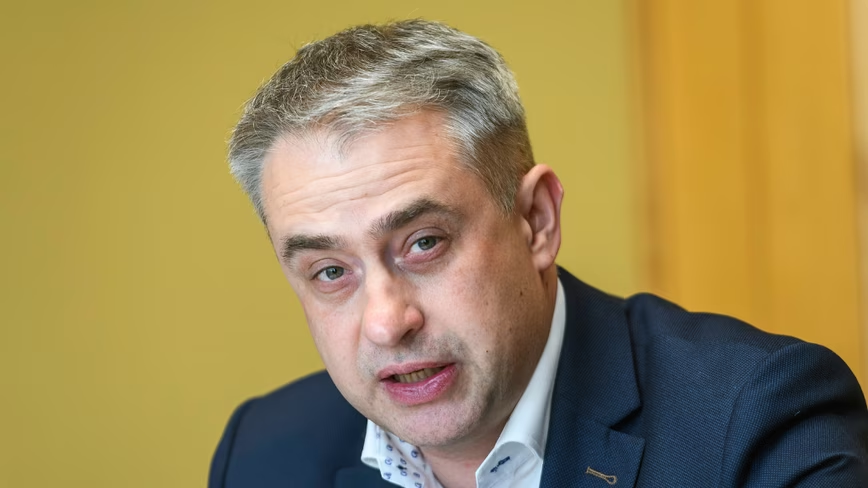
Poland's deputy prime minister and digital affairs minister Krzysztof Gawkowski has asked the European Commission to fine Meta EUR 250M, roughly USD 291M, over scams and false advertising on Facebook and Instagram.
Warsaw sent Meta nine written questions on 18 August, covering the scale of scam advertising in Poland, how the company detects deepfakes, how it verifies advertisers, and how long it takes to remove a reported ad, with seven days to respond.
Deputy minister Dariusz Standerski said at the time that if the answers did not satisfy, the next letter would go to the Commission asking it to open proceedings under the Digital Services Act.
Poland cannot fine Meta and cannot set the figure, because enforcement against very large online platforms sits exclusively with the Commission, so the EUR 250M is a request rather than a penalty.
The DSA allows fines of up to 6% of global annual turnover, which for Meta would run to several billion euros.
The Commission has so far issued DSA penalties in the low hundreds of millions.
Follow any of these and your For You feed starts watching them — no settings page required.
Evidence-backed comparisons of source perspectives and observed adoption signals. Read the methodology
Which Builder, Operator, and Investor concerns the observed source mix emphasized—not a truth score.
Evidence, demonstrated adoption, hype gap, incentives, and confidence are assessed independently, each on its own current evidence. How these are measured.
Specific and internally consistent, but single-source and unverified against primaries
The cluster contains exactly one publisher report. It is detailed and internally coherent — named ministers, a dated questionnaire with a stated deadline, a quoted appellate holding, and comparable fine figures — but no primary documents are cited, and neither Meta nor the Commission is quoted. Key temporal anchors ('in March', 'last year', 'this month') are relative rather than dated.
Referral filed; no enforcement action, no platform response
Real-world uptake of the asserted outcome is minimal: a member state has escalated a questionnaire into a request, but the Commission holds exclusive enforcement power, has not opened proceedings on this matter, and has been slow to conclude existing Meta cases. Meta has not responded publicly. The only concrete, materialised actions are the 18 August questionnaire, the referral itself, and the earlier Warsaw appellate ruling.
Political ask outruns legal authority; the source itself discounts it
The publicised claim — a €250M fine on Meta — overstates what has happened, since Poland can neither levy nor set such a fine and no proceedings have been opened. The gap is modest rather than large because the single source is explicitly deflationary: it calls the figure 'plausible rather than punitive', benchmarks it at roughly twice X's €120M and at most a tenth of the statutory cap, and flags that Poland only enacted its own DSA implementation this month. The genuinely material development, the Warsaw hosting-shield ruling, is arguably under-amplified relative to the fine number.
Visible political and litigation incentives, disclosed by the source
Incentive pressures are strong and openly reported rather than hidden. The Polish ministry gains politically from a high-profile demand it cannot itself execute, in the context of a public feud over the suspension of a prominent businessman's account and immediately after its own delayed DSA implementation cleared a presidential veto. Meta's incentive runs the other way, toward asserting the hosting shield to keep paid advertising a pass-through business. Consumer groups' parallel complaints add advocacy pressure.
Moderate-low: coherent single report, no corroboration or party comment
Confidence is limited by cluster composition rather than by internal contradiction. One publisher, no Meta or Commission statement, no linked primaries, and relative dating of the court ruling and the X fine mean the direction of the story is credible while specifics remain unconfirmed. Nothing in the cluster contradicts the account.
product
France's under-15 ban failed on the age check, not the age limit1 distinct publisher
science
3.2 million replies, 88 candidates, and the gender gap that prevalence metrics erase1 distinct publisher
product
Pennsylvania's Snap case makes an App Store questionnaire the alleged lie1 distinct publisher
product
Australia just made refusing to negotiate a taxable act, not a product decision1 distinct publisher
Distinct publishers with included, body-backed reporting in this cluster.
1 article · August 27, 2026