Science1 publisher2 min readPublished
Alkylthianthrenium salts let chemists vary both partners in cyclopropane synthesis
Alkylthianthrenium salts act as safe carbene donors that let both the olefin and the carbene partner vary in cyclopropane synthesis. The authors report it removes the explosive reagents chemists have long accepted, and scales even as ball-milled solids.
The Scientist · Science desk
Drafted by a language model from the sources cited here and checked against its claim ledger before publication. How we use AISend a correction
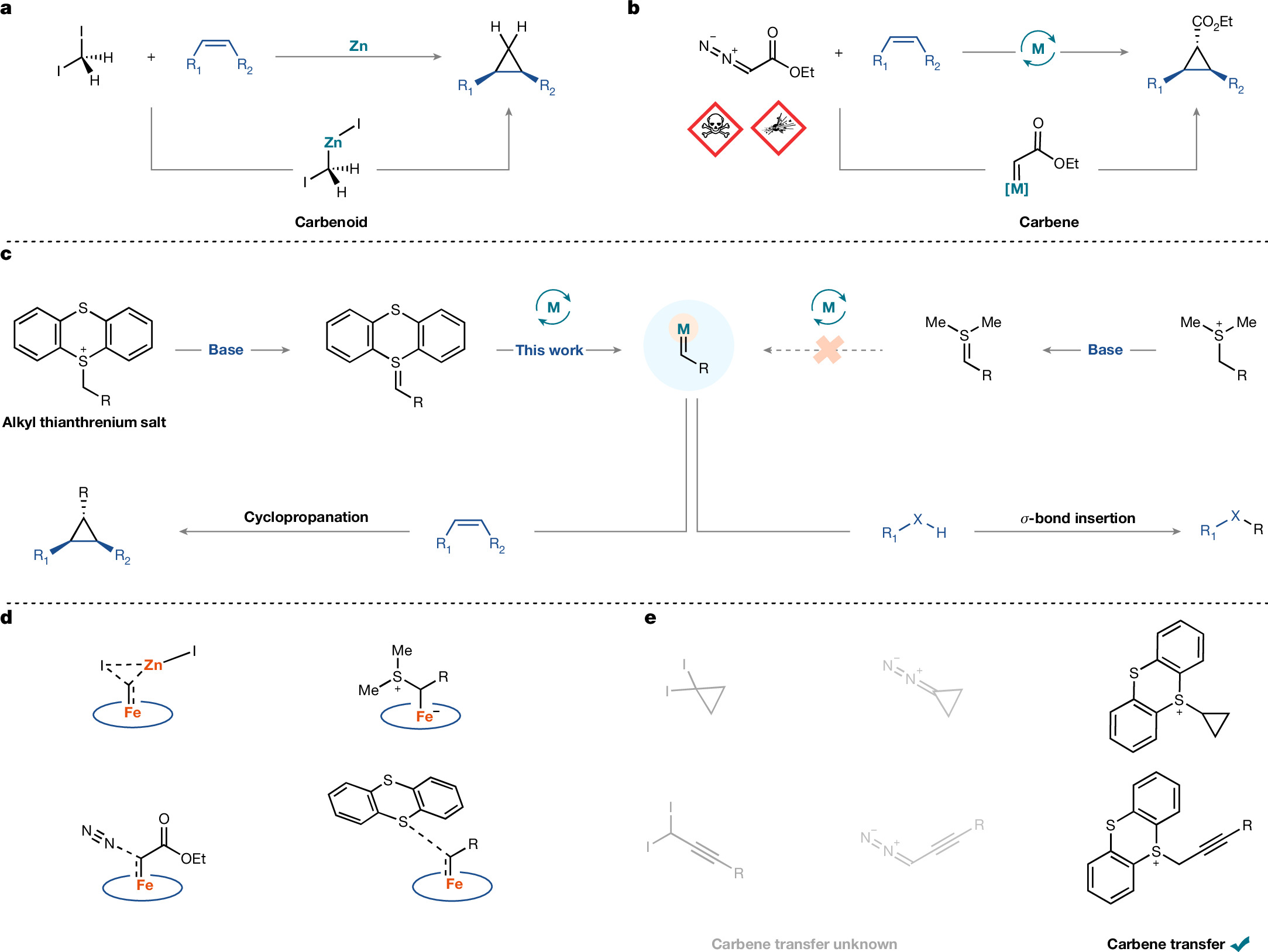
What happened
- Every cyclopropanation reported before offered diversity in either the olefin or the carbene partner, and several modern reactions worked only on activated olefins such as styrenes.
- The Simmons-Smith reaction still has the broadest olefin scope of any method but transfers only a methylene group, so the carbene never changes.
- The authors present the same ylides as a general carbene-transfer class reaching past cyclopropanes into sigma-bond insertion and sigmatropic rearrangements.
Compiled by The ScientistSomething wrong?How this is made
Why it matters
- capability Varying the carbene and the olefin in one method widens the set of cyclopropane structures a single route can reach, and those strained rings are sought in drug and agrochemical design.
- decision A bench-stable donor that scales as a ball-milled solid gives labs a cyclopropanation route that does not require the flow reactors or in-situ generation built to tame diazo and zinc hazards.
- precedent If the ylides behave as the general metal-carbene class the authors describe, insertion and rearrangement chemistry could adopt the same reagents next.
Sulfonium salts were supposed to be the safe answer. They are steadier than the reagents chemists normally reach for, and yet they have not competed, because most of them do not hand off a carbene efficiently [3]. The paper's explanation is structural. Thianthrene is bulky and a weak Lewis base, and those two properties keep the salt from settling into low-energy resting states that trap other sulfonium salts off the reaction path [6]. Freed of those traps, the salt gives up its carbene.
That reactivity is what lets both halves of the reaction change at once. The Simmons-Smith reaction, discovered in 1958, still has the broadest olefin scope of any method, but it moves only a CH2 unit, so the carbene itself never varies [9][10]. Diazo chemistry runs the other way: ethyl diazoacetate is the workhorse for cyclopropanes carrying an ester and lets chemists decorate the carbene, but many modern versions work only on activated olefins such as styrenes [12][4]. Chemists got variety from one partner or the other, not both.
The safety problem is specific. Simmons-Smith builds high-energy intermediates when zinc adds to 1,1-dihaloalkanes, and diazoalkanes are toxic, shedding nitrogen as they form the metal carbene [11][13]. Both are what make scale-up hazardous, and the field's recent history is a set of workarounds for exactly that: the Carreira group generated diazomethane in situ, and the Davis group ran diazo chemistry in continuous flow [15]. Thianthrenium salts, by the report, scale even as ball-milled solids [7].
The reason to bother is that cyclopropanes are valued in drug and agrochemical design, a value the authors trace to the unusual electronic structure of the strained three-membered ring [14].
The authors call the ylides a general class for metal-carbene reactivity, extending past cyclopropanes to sigma-bond insertion and sigmatropic rearrangements [8]. The abstract and introduction make that case conceptually; they do not include the yields, substrate counts, or enantioselectivities that would show how general the method really is.
What to watch
- Whether the full paper's substrate tables back the both-partners claim across unactivated olefins and substituted carbenes.
- Whether an enantioselective thianthrenium version arrives, given asymmetric cyclopropanation has leaned on rhodium and iron-porphyrin catalysts.
- Whether the promised sigma-bond insertion and sigmatropic rearrangement reactions materialize with these ylides.