Science1 publisher3 min readPublished
Nearly 300 mm of rain in two days pushes Bangkok's drainage to full capacity
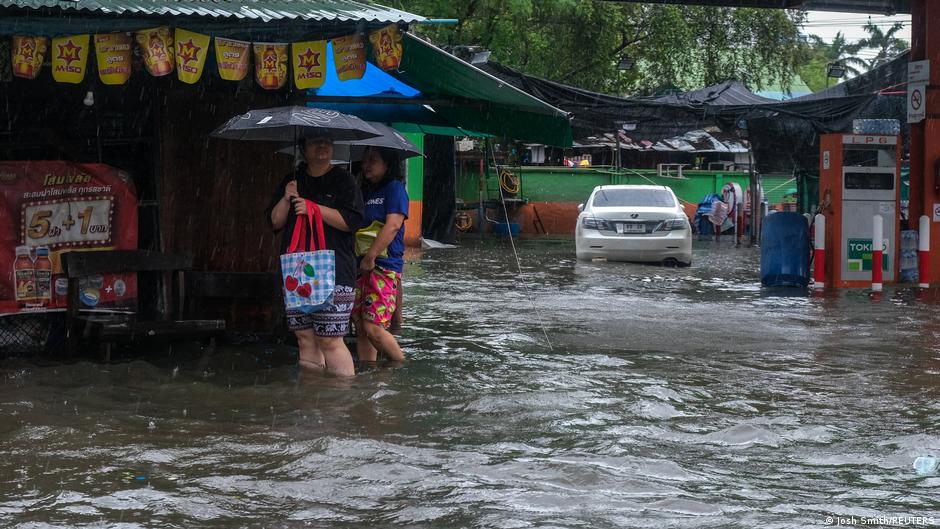
Bangkok declared a flood disaster in all 50 districts after almost 300 mm of rain in two days, with its pumps already at full capacity. Draining will take two to three days once the rain stops, the governor says, and low pressure is forecast through Sunday.
The Scientist · Science desk
What happened
- Bangkok's city government declared a flood disaster in all 50 districts on Saturday, a step that gives local organisations special powers to act.
- Almost 300 mm of rain fell over nearly 48 hours of near-continuous rain that began on Thursday afternoon.
- The Bangkok Metropolitan Administration said its pumping stations were running at full capacity, moving a combined 1,200 cubic metres of water a second.
- About 980 people were in temporary shelters, 36 bedridden people had been moved to hospitals, and at least 13 roads were under water.
- The Department of Disaster Prevention and Mitigation warned of low pressure over eastern, northeastern and central Thailand until Sunday.
Compiled by The ScientistSomething wrong?How this is made
Why it matters
- constraint The pumps are already at their maximum, so any rain before the low pressure clears adds to standing water. The two-to-three-day drain-down starts only once it stops, and eastern and canal-side sites will wait longest.
- exposure Bangkok is draining water through nearby provinces to cut what flows into the capital. Suppliers and facilities outside the city limits now carry part of the load the city cannot hold.
- contradiction A resident calls this worse than 2011, but the 2011 floods killed more than 500 people across Thailand. Bangkok's current counts are in the hundreds sheltered, so the comparison holds for one canal-side street and not for the country.
At 1,200 cubic metres a second, Bangkok's pumps move about 104 million cubic metres of water a day [21]. The figure measures how fast the city can push water out. Governor Chadchart Sittipunt placed the constraint before the water ever reaches the pumps. "Our problem is that the canals are full," he said [4]. With the pumps at their maximum and the canals that feed them brimming, extra rain stays on the streets. The flooding has been worst in the east of the city and along the canals [8]. The city is built on former marshland about 1.5 metres above sea level [16].
The rain was well outside the city's own baseline. The drainage and sewage department recorded 487 mm from September 1 to 25, against a 1991-2020 average of almost 269 mm for the same window [9]. That is roughly 81 percent above normal [10]. The storm's 48-hour total alone exceeds the 25-day average [11]. "We thought this year would be dry, so we didn't expect the flooding to be this bad," said Kwan Nobnom, a municipal worker clearing rubbish from drains [15]. AFP's report sets the storm beside the general scientific warning that fossil-fuel heating will make extreme weather more intense and more frequent [18]. One wet month is consistent with that projection, though a single month cannot attribute this particular storm to warming.
For this event, the city's own statements support the view that Bangkok's drainage is at its limit. The relief plan sends water outward. "We are cooperating with nearby provinces and trying to drain water through other areas, minimizing the amount that flows into Bangkok," Chadchart said [6]. The thing this doesn't tell you is whether the network is undersized or met a storm far beyond what it was built for. The BMA has not published the rainfall rate its canals and pumps were designed to carry, and one event cannot separate those two explanations.
The comparison with 2011 comes from Somkid Pheuk-ngam, a 67-year-old vendor who lives beside a canal north of central Bangkok. "It's like at my waist level now," she told AFP [23]. She has kept her shop shut for two days [22]. "I think this time is worse than the 2011 flood," she said [12]. She is describing her own canal-side street. The 2011 floods spread across Thailand, killed more than 500 people and damaged millions of homes [13]. Bangkok's Saturday figures ran to hundreds in shelters and dozens moved to hospital [7].
Chadchart said on Saturday afternoon that the situation had "stabilized" [14]. His timetable is conditional. "If the rain stops, it is expected that it will take 2-3 days to drain the floodwater," he said [5].
What to watch
- Whether the rain stops once the low-pressure system clears after Sunday, since the governor's 2-3 day drain-down is counted from that point.
- The design rainfall rate for Bangkok's canals and pumps, if the BMA publishes it; that figure would separate an undersized network from an extreme storm.
- Flood reports from the neighbouring provinces Bangkok is routing water through.