Science1 publisher2 min readPublished
Mississippi State model reproduces copper- and zinc-driven amyloid-beta clumping seen by microscopy
Mississippi State's kinetic model of copper and zinc speeding amyloid-beta clumping matches atomic force microscopy data, the university says. Its two simulated anti-plaque strategies could guide lab work if the fit holds on data the equations were not tuned to.
The Scientist · Science desk
What happened
- Mississippi State mathematician Shantia Yarahmadian published a kinetic model of metal-induced amyloid-beta aggregation in the Bulletin of Mathematical Biology.
- In the simulations, modest local changes in copper and zinc concentration shift the nucleation threshold and speed the conversion of soluble monomers into insoluble fibrils.
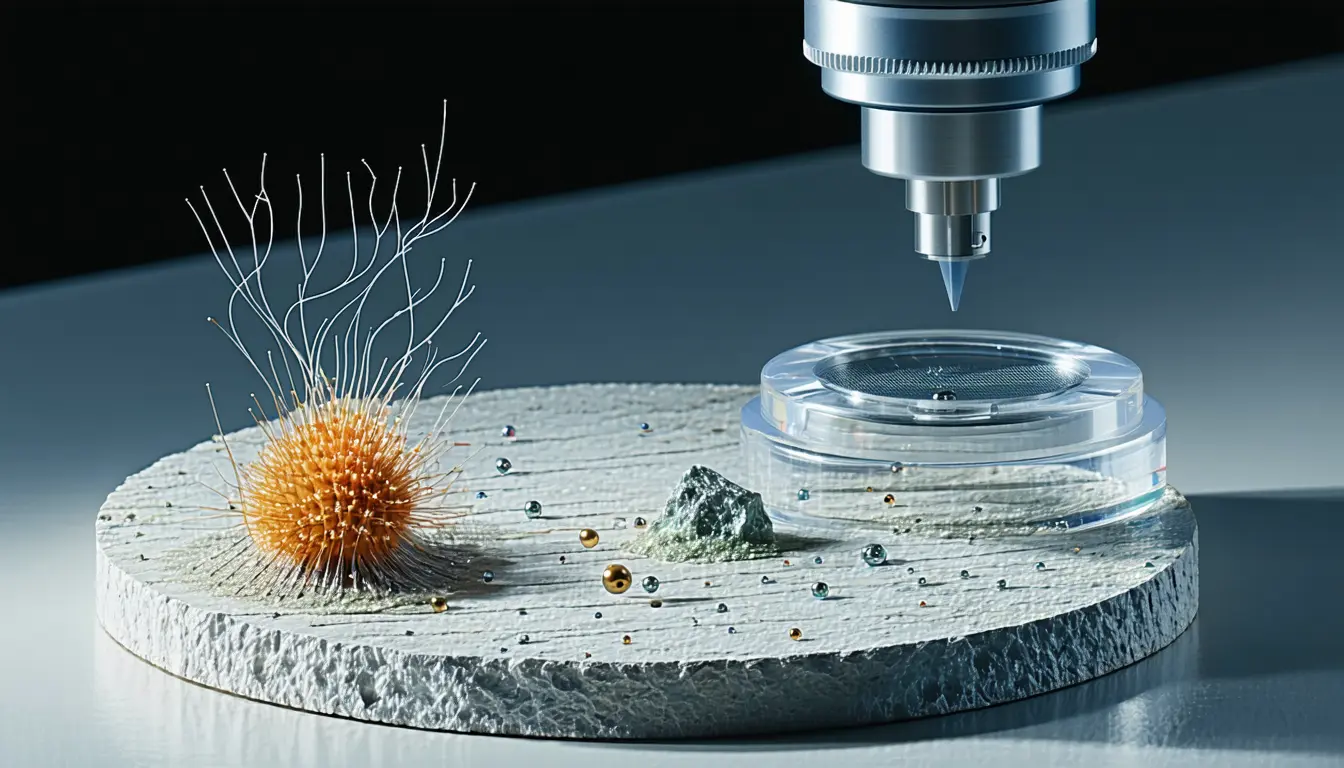
- According to the university, the model reproduced the aggregation trajectories and structural patterns seen in atomic force microscopy measurements made in the lab.
- The framework also simulates two interventions, one chelating free metal ions and one destabilising early oligomers at their binding interface.
Compiled by The ScientistSomething wrong?How this is made
Why it matters
- decision A lab weighing chelation against fibril disruption could use the simulation to pick which to test first, provided the model predicts data it was not fitted to.
- contradiction The account calls the AFM step both calibration and validation, and the difference decides whether the reported match shows the model can predict or only that it can be fitted.
- constraint Because the check used laboratory aggregates, the model cannot yet say how brain metal levels affect plaque growth in patients.
The published account uses two words for the microscopy step. Its summary says the models were "calibrated with" atomic force microscopy, and its text says the framework was "validated against" that data [6]. Those are separate tests. Calibration tunes rate constants until the simulated curves fit the measurements. Validation asks the tuned equations to predict measurements they were never fitted to. The release does not say which AFM runs set the parameters and which judged the result, or how close the fit was [5].
The instrument makes sense for the job. The university describes amyloid-beta nucleation as extraordinarily difficult to track in real time [10]. AFM images individual aggregates at the nanoscale and records their topology and mechanical properties [4]. The equations, a system describing reaction rates and molecular diffusion [3], fill in the kinetics between those images. If the assumed chemistry were wrong, the simulated trajectories should drift away from the imaged ones. According to Mississippi State, they did not [5].
The thing this doesn't tell you is how those kinetics behave in a person. The measurements came from laboratory samples [4], so the match concerns protein and metal ions under prepared conditions. Patient brains are a further step. The model also cannot settle whether metals matter in the disease at all. The release itself calls the role of copper and zinc "influential yet controversial" [9]. A model built around metal-catalysed assembly [1] shows how that pathway would run if it operates. Its fit to lab images supports the proposed chemistry; it does not show that this chemistry drives plaque growth in patients.
The therapeutic side is a screen with two entries [8]. A small screen still has a use. Running both interventions on the same kinetic equations lets a group compare where each one acts on the aggregation cascade before committing bench time. I think that comparison is the model's most practical use today, on one condition: that the fit survives AFM data it was not tuned on.
Yarahmadian frames the work in similar terms. "Mathematics does not replace laboratory or clinical research; it complements it by helping us understand the larger system, identify the most influential mechanisms and guide future experiments," he said [11]. He also said that "because of its abstract power, mathematics allows us to uncover patterns, test hypotheses and make predictions that may not be possible through observation alone" [12].
What to watch
- Whether the Bulletin of Mathematical Biology paper separates the AFM data used to fit rate constants from the data used to test predictions, and reports how close the fit was.
- A bench experiment checking whether chelation or fibril disruption slows aggregation in the order the simulation predicts.
- Whether the equations hold when run against aggregation measurements from other groups or at metal concentrations outside the original data.