Product1 publisher3 min readPublished
IMC Rare Earths averaged 81.1% terbium recovery from its best Itarantim clay composite
Bench testwork on the Brazilian company's Itarantim project peaked at 95.2% terbium recovery and averaged 81.1% on the same composite. The domain the material came from grades 8 parts per million terbium.
The Product Desk · Product desk
What happened
- IMC Rare Earths said laboratory testing at its Itarantim project in Brazil produced terbium recoveries of up to 95.2% and also yielded a mixed rare earth carbonate, with the work still at bench stage.
- Itarantim is an ionic adsorption clay deposit spanning Bahia and Minas Gerais with about 1.1 billion tonnes of inferred resources containing neodymium, praseodymium, dysprosium and terbium.
- The company has engaged ANSTO Minerals for further quantitative metallurgical testing, expected to give more detail on recovery rates and on the properties of the mixed rare earth carbonate.
Compiled by The Product DeskSomething wrong?How this is made
Why it matters
- constraint Recovery is what decides whether an ionic clay deposit can be processed economically, so a buyer looking for a second terbium source cannot qualify anything until the number comes off continuous operation on ordinary feed.
- cost With roughly 846 tonnes of contained terbium in the assayed domain, terbium has to be modelled as a credit against neodymium and praseodymium revenue, and whoever funds the next phase pays to find out how big that credit is.
- decision The choice in front of IMC and any partner is who writes the cheque for work beyond the bench, given the company's own position that commercial potential is not yet established.
- capability If the leach numbers survive scale-up, motor and defense programmes gain a second place to qualify the elements that keep magnets working hot. A mine alone does not solve that part of the supply chain.
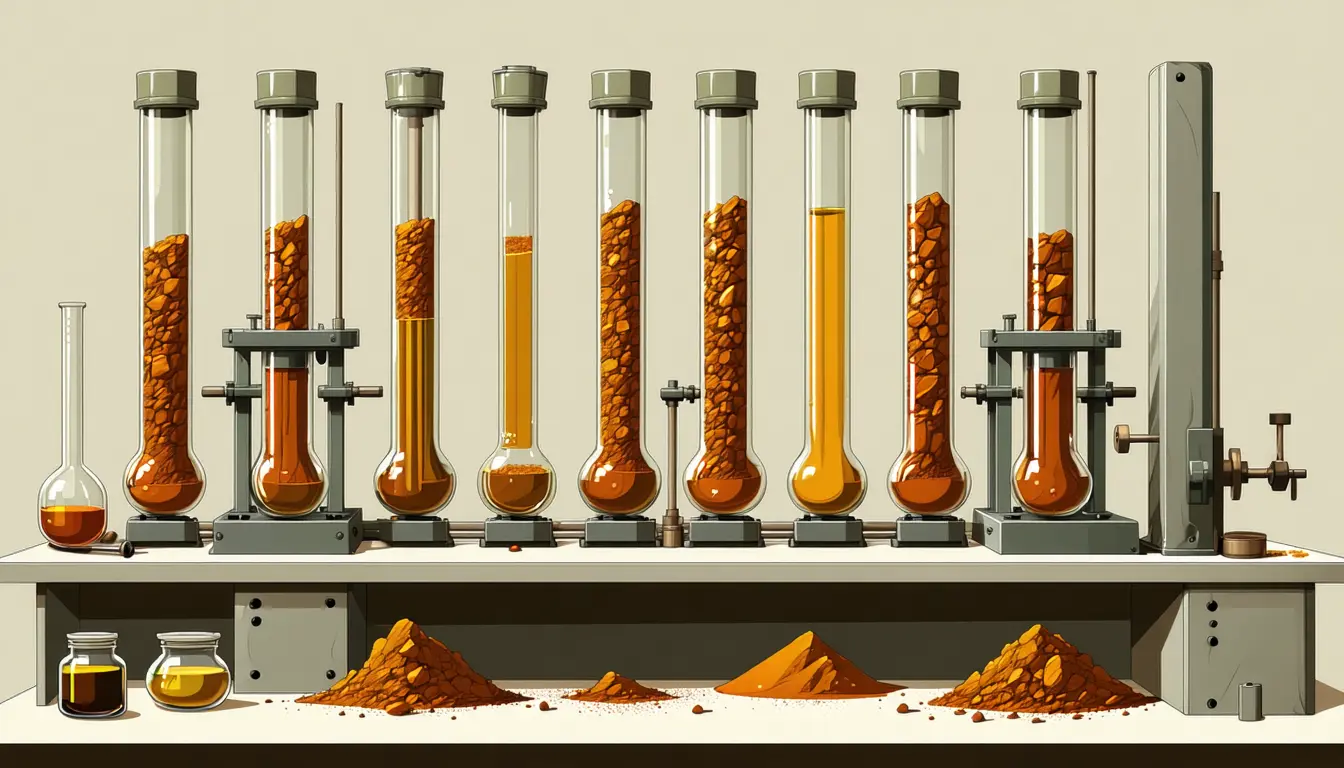
A composite is a laboratory sample, and a magnet buyer orders from a plant. IMC Rare Earths' best one, labelled COMP C2, averaged 81.1% terbium recovery and reached a maximum of 95.2% in laboratory testwork at Itarantim [2][1]. That is 14.1 percentage points between what the sample did routinely and what it did at its best [17]. Bench programmes report both figures because both are real, and 81.1% is the one a plant gets paid on.
What a recovery rate is worth depends on grade. IMC reports an average of 8 parts per million terbium across a 105.8 million tonne inferred domain [4]. 105.8 million tonnes at 8 grams per tonne is 846 tonnes of contained terbium in that domain [15]. Recover 81.1% and you have 686 tonnes; recover 95.2% and you have 806 [16]. So the gap between the average and the peak is worth about 119 tonnes of terbium across the entire domain, spread over however many years it takes to move that much clay [16]. The domain is roughly a tenth of the 1.1 billion tonnes of inferred resource IMC describes [18][3], and the company did not publish a terbium grade for the other 994 million tonnes [20].
Ionic adsorption clays give up numbers like these early because the rare earths sit loosely attached to the clay minerals and can be released by leaching [8]. The trade-off is that recovery, and not concentration alone, decides whether such a deposit can eventually be processed economically [7], and recovery is the figure that moves when the feed stops being a chosen composite.
The testwork ran with the Instituto Federal do Rio Grande do Norte and its EMBRAPII-affiliated CT Mineral laboratory [5]. "Terbium and dysprosium are among the scarcest and most highly sought-after elements," the company said in a statement [9], pointing to permanent magnets in EVs, wind turbines, robotics, electronics and defense systems [13]. Both elements are in those magnets to hold performance at high temperature [12], and refining capacity for rare earths is concentrated in China [14].
"We are very encouraged by these results, which mark an important step forward in our project. There has been an awakening around the world that we need greater supplies of rare earths from diverse areas," said Frank Scolaro, CEO and chair of IMC Rare Earths [10].
Any recovery figure sits somewhere on a grid with two axes: batch versus continuous operation, and hand-built composite versus run-of-mine feed. Four boxes. Nearly every first number lands in the batch-composite box, and 95.2% is a first number [1]. Getting it out of that box costs a pilot circuit and a variability programme. That is real money spent on a project IMC says still needs additional technical work before its commercial potential can be established [19].
What to watch
- Whether IMC puts a number on the dysprosium leach recoveries it has so far described only as strong.
- Whether ANSTO's quantitative phase tests composites other than COMP C2, or feed closer to run-of-mine.
- Whether IMC reports a terbium grade for the inferred tonnes outside the 105.8 million tonne domain.