Science1 distinct publisher3 min readPublished
A Sandia-led team pulled the energy of New Glenn's May 29 hotfire explosion out of infrasound recorded as far away as northeast Texas, putting the blast at an estimated 0.131 kilotons of TNT equivalent using infrasound data alone.
The Scientist · Science desk

Compiled by The ScientistSomething wrong?How this is made
Infrasound yield work runs backward from two properties of a recorded wave: how far it travelled, and where its energy sits in frequency [8]. Sound below the range of human hearing loses little energy on long atmospheric paths [13], and the dominant period of the signal scales with the energy that made it, which is why a sensor in northeast Texas, roughly 1,046 miles from the pad, still held usable information about a booster failure in Florida [6]. The analysis appeared Aug. 12 in The Seismic Record, with Elizabeth Silber of Sandia National Laboratories in Albuquerque as first author [5][7].
The footprints are worth comparing. The shockwave people actually noticed reached about 135 miles, and thousands of Florida residents reported a boom, according to Florida Today [12]. The farthest infrasound detection sat about 7.7 times that distance from the pad [21], which on a map is close to 60 times the area [22]. The audible shockwave stayed local, while the instrument record spanned a continental distance.
The number the arrays produced sits slightly above the initial blast that destroyed the Chornobyl reactor in 1986, by the estimate in a 2009 study [9]. That is a statement about energy release and nothing more: no one at Cape Canaveral was hurt [3], and the debris and mushroom cloud stayed on the range [2].
Where the independent reconstruction stops is cause. The oxygen valve identified as the likely culprit came from Blue Origin itself, disclosed on Aug. 5 according to Space.com [4]. So the division of labour is clean. Public sensors, operated for other purposes entirely, can show how much energy a pad released and roughly what share of propellant fed the initial blast, but they offer no way to identify which component let go.
That share, put at 3% to 6% of the booster's cryogenic load, carries a denominator nobody outside the company has, because the exact quantity of fuel aboard is unknown [10]. New Glenn stands 320 feet, about the height of NASA's Space Launch System [18], so the absolute mass behind that percentage is large and unstated. Silber's explanation for why the fraction looks small next to the fireball is chemical rather than instrumental: "In a large propellant accident, the fuel and oxidizer do not necessarily mix and react all at once," she said, with some material contributing to the initial blast and the rest burning more gradually in the fireball and plume [11]. The authors call the range consistent with expectations [10].
The thing this does not tell you is how tightly bounded the energy estimate is. A single central value is what reaches the reader, and without a stated uncertainty band, the figure is better read as an order-of-magnitude anchor for one of the largest prelaunch explosions on record [20] than as a measurement to be compared decimal by decimal with a company's own accounting. Silber called it a rare opportunity to study a large real-world energetic event [23], which is the right framing: the interesting result is that the method worked at 1,000 miles on a target of known origin and known approximate size.
That is also where its value lies. Silber's group has run the same instruments on meteors and on reentering spacecraft, including the OSIRIS-REx return capsule [17], and argues infrasound is underused for tracking spacecraft accidents and other large explosions [16]. When a cooperative operator publishes a valve fault, the array becomes redundant on cause, but for an uncooperative operator, or for an event with no operator report at all, a network that was already listening becomes the only witness.
Ranked by verification strength, evidence, and original report placement.
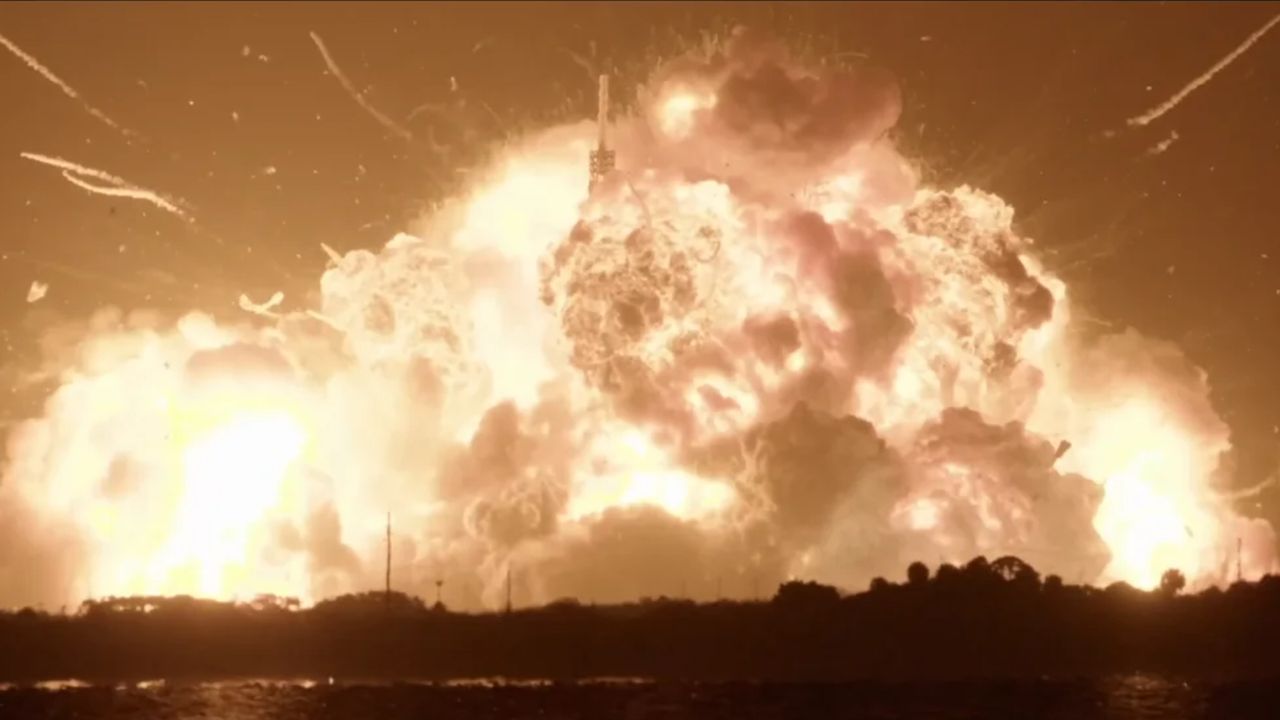
On May 29, during a static hotfire test at Cape Canaveral Space Force Station, shortly before New Glenn's planned fourth launch, the rocket's booster violently exploded without warning.
The blast shot bits of flaming debris into the air and unleashed a massive mushroom cloud that briefly lit up the night sky.
On Aug. 5, Blue Origin revealed that a faulty oxygen valve likely caused the explosion, according to Live Science's sister site Space.com.
The study was published Aug. 12 in the journal The Seismic Record and analysed data from listening stations across the U.S. for infrasound coinciding with the blast.
At least 36 stations picked up infrasound signals from the explosion; the farthest was in northeast Texas, about 1,046 miles (1,684 km) from Cape Canaveral Space Force Station.
Distinct publishers with included, body-backed reporting in this cluster.
1 article · September 4, 2026
Follow any of these and your For You feed starts watching them — no settings page required.
invest
Trump's 1,000-launch target is a permitting subsidy, and SpaceX owns the queue1 distinct publisher
science
Katalyst's servicer spent its fuel on its own tumble instead of raising NASA's Swift telescope1 distinct publisher
product
The launch target that will be decided by spectrum slots, not rockets3 distinct publishers
science
China points a drill, not a flag, at Shackleton's shadows2 distinct publishers
Evidence-backed comparisons of source perspectives and observed adoption signals. Read the methodology
Which Builder, Operator, and Investor concerns the observed source mix emphasized—not a truth score.
Evidence, demonstrated adoption, hype gap, incentives, and confidence are assessed independently, each on its own current evidence. How these are measured.
One paper, retold once
Every quantity here traces to a single peer-reviewed study, reported by a single outlet. That study is named and dated, its first author and institution identified, and its two detection facts, 36 stations and 1,046 miles, are the kind of thing station records could confirm. What Live Science does not attempt is a check on the yield model or a response from Blue Origin. The borrowed material is thinner still: the year-long pad repair and the 135-mile shockwave radius arrive from Ars Technica and Florida Today with no account of how either was established.
One lab, one existing network
As a forensic technique this has one demonstrated practitioner in the story, the Sandia group, working off a station network that already existed for other purposes and happened to record the blast. Their earlier tracking of meteors and the OSIRIS-REx capsule shows the approach is repeatable rather than a one-off. Nothing here indicates a launch operator, range authority or accident investigator uses infrasound to reconstruct pad failures, and the researchers themselves call it underused.
The data stays modest; Chornobyl supplies the drama
Two framings outrun their support. The comparison to Chornobyl's initial blast and the description of this as one of the most powerful prelaunch explosions ever seen come with no named authority and no yields from other pad accidents to rank against. The paper's own arithmetic is more restrained: between 3% and 6% of the cryogenic propellant reacted in the initial blast, which the researchers call unremarkable for an accident of this type. And 0.131 kilotons is a model output inferred from sound waves, presented in the headline register as a reading taken off a dial.
Self-diagnosis, in-house citation
What can be known here is shaped by three interested parties. Blue Origin investigated its own failure and has offered one sentence about a faulty oxygen valve. The Sandia team argues infrasound is underused, which is also an argument for the value of its own instrument and expertise. Live Science attributes the valve finding to Space.com, a title it identifies as its sister site. None of that makes the measurements wrong, but no adversarial check appears anywhere along the chain.
Solid event, narrow sourcing
What happened is not in question. A booster destroyed on a Florida pad in front of thousands of witnesses, with a company statement on the cause, leaves little room for dispute about the event. Confidence is limited by breadth rather than quality: one outlet, one paper, an unpublished propellant load underneath the headline yield, and the consequences that matter most to Blue Origin's customers all arriving from other newsrooms.