Science1 publisher3 min readPublished
Ten tidal disruption events pin black hole jet launching to 2% of the Eddington limit
Andrew Mummery and Adelle Goodwin report that late radio jets in ten star-shredding events switched on as the feeding rate fell to about 2% of the Eddington limit, the threshold already known from Milky Way black holes.
The Scientist · Science desk
What happened
- An international team examined twenty tidal disruption events, the flares produced when a star passes close enough to a supermassive black hole to be pulled apart, in optical, ultraviolet, X-ray and radio light.
- Ten events survived quality cuts, the ones where both the black hole's feeding rate and the timing of its radio outflows could be reliably determined.
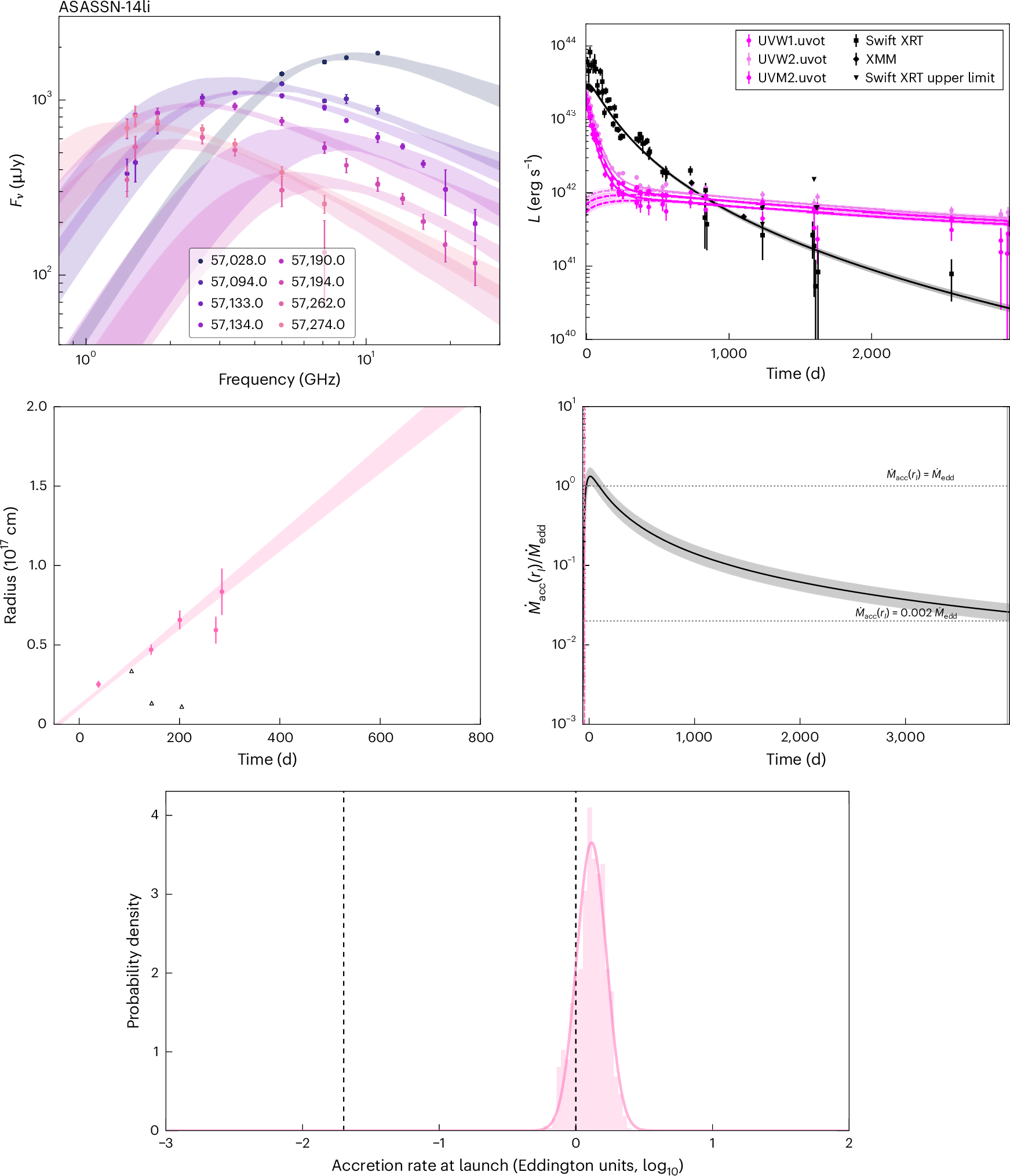
- In those events a second jet-forming episode appeared hundreds to thousands of days after the star was destroyed, as the feeding rate fell to about two percent of the Eddington limit.
- The same two percent threshold is already known to trigger jets from much smaller black holes in the Milky Way, which is why the authors went looking for it around supermassive ones.
Compiled by The ScientistSomething wrong?How this is made
Why it matters
- capability A tidal disruption turns a question about mass scaling into something observable, because one feeding episode plays out in a few years instead of the thousands to millions that ordinary accretion takes.
- constraint Ten events carry the whole result, and half the starting sample was dropped, so a handful of well-measured counterexamples would move the threshold or break it.
- decision Radio follow-up of a newly discovered star-shredding flare can be scheduled to the decline of the disc rather than run continuously for years on the chance of catching something.
- precedent If feeding rate sets the trigger, a tidal disruption that looks radio-quiet is an object caught before its threshold crossing, and the same logic should apply to any accreting black hole in between the two mass scales.
The threshold is quoted as a percentage of each black hole's own Eddington limit, the feeding rate at which the outward pressure of radiation balances the inward pull of gravity [9][6]. That is what makes a comparison across mass possible at all. At one end are stellar-mass black holes of about ten solar masses; at the other, holes millions of times heavier [8], a span of at least five orders of magnitude [18].
The study design solves a timing problem. Accretion around a supermassive black hole normally changes over thousands or even millions of years [10], which outlasts any observing campaign. A tidal disruption compresses one feeding episode into a few years [11], so a single object can be tracked from an extremely high accretion rate down through the threshold and out the other side. Andrew Mummery of the Institute for Advanced Study and Adelle Goodwin of Curtin University's International Centre for Radio Astronomy Research worked out the idea while talking in a bar at an astrophysics conference in Madrid [2][15].
The puzzle they were after was the inconsistency. "Why do some supermassive black holes blast out radio jets right after shredding a star, while others just sit there looking completely dormant, only to suddenly fire up their jets months or even years later?" Mummery said [13].
Twenty events went in, observed in optical, ultraviolet, X-ray and radio light [3]. Ten came out: half the starting sample was set aside because the feeding rate or the radio timing could not be reliably determined [4][17]. The surviving ten were chosen for data quality, which means they are not a random draw from all tidal disruptions, and the fraction of disrupted stars that produce a late jet is not a number this sample can supply [4].
Ten matched timings also do not establish that crossing 2% of Eddington causes the jet. They establish that the late radio brightening and the threshold crossing occur together in the events where both were measurable [6][4]. The order of the work is what gives that coincidence weight: the threshold came from the stellar-mass literature first [7], and the twenty events were then examined to test whether it held for holes millions of times larger [3].
The early phase is separate. The researchers report jets forming twice, once while the black hole is consuming material at an extremely high rate, and again hundreds to thousands of days after the star was torn apart [5][6]. Only the second epoch is tied to the 2% figure.
What comes off the black hole is not tidy. "When a black hole tears apart a star, it does not swallow everything neatly," Goodwin said [14]. Some of the stellar debris falls inward while much of it is expelled in outflows that can carry material across vast distances and affect the evolution of the host galaxy [16]. The paper, "A universal critical accretion rate for black hole jet formation," appears in Nature Astronomy and combines data from telescopes in America, Australia, India, South Africa and in space [1][12]. The Institute for Advanced Study's own summary puts it at the level the sample supports, saying black holes of vastly different sizes "may launch powerful jets according to the same universal rule" [19].
What to watch
- An unbiased radio survey of tidal disruptions would show what fraction produce the late jet and how tightly the trigger clusters around 2% of Eddington.
- The published paper's spread and uncertainties on the threshold across the ten events, which decide how sharp a boundary this is.
- Whether the early, high-rate jet epoch turns out to have a critical rate of its own, or is governed by something other than the feeding rate.