Science1 publisher2 min readPublished
Jets switch on at 2% of the Eddington limit whether the black hole weighs 10 suns or a million
Adelle Goodwin and Andrew Mummery modelled ten stars torn apart by supermassive black holes and found the late radio jets turning on at the same accretion threshold already known from much smaller black holes in our galaxy.
The Scientist · Science desk
What happened
- Adelle Goodwin of Curtin University's radio astronomy centre and Andrew Mummery of the Institute for Advanced Study in Princeton report one jet-launching rule for black holes of very different masses in Nature Astronomy.
- The pair identify two separate jet-launching phases in the same events: one early, while the black hole is feeding at extreme rates, and a second long after the star has been destroyed.
- The analysis drew on optical, ultraviolet, X-ray and radio observations of 20 tidal disruption events, gathered by telescopes in Australia, the United States, India, South Africa and in space.
- Such events, in which a star strays too close and is torn apart, squeeze a supermassive black hole's feeding episode into years, against the thousands of years these objects usually take to change.
- Black holes of very different sizes have been expected for decades to follow the same basic physics, and that expectation has been hard to test.
Compiled by The ScientistSomething wrong?How this is made
Why it matters
- capability A quiet tidal disruption event can now be re-targeted on the basis of a modelled accretion rate rather than watched continuously on the chance that radio emission appears.
- constraint Ten modelled events set the threshold, so any dependence of the switching point on black hole mass that is smaller than the scatter in that sample stays invisible for now.
- decision Time allocation committees at oversubscribed radio facilities face a different request: observing runs booked hundreds of days after an optical discovery, when the source looks dead.
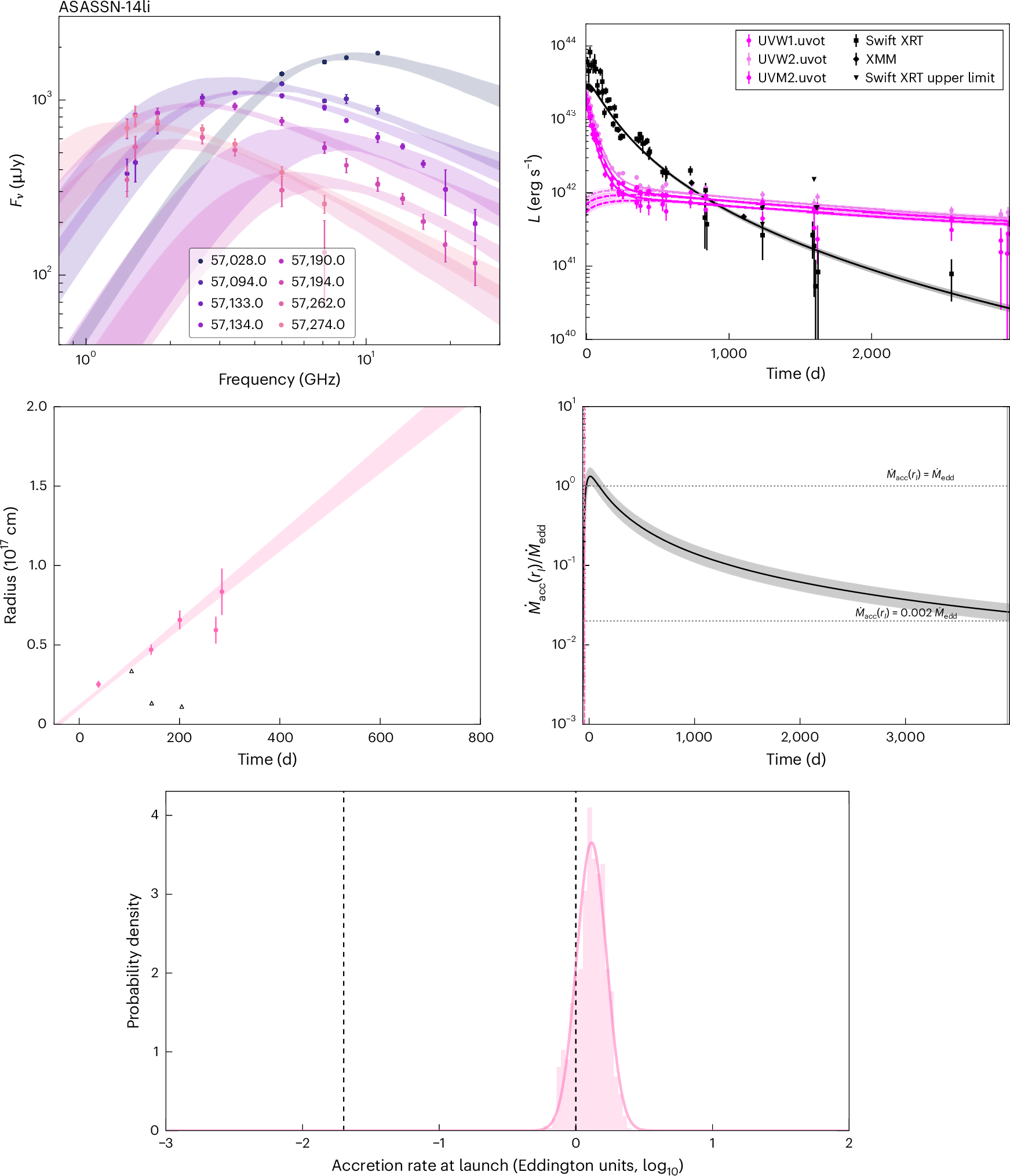
Both mass scales switch on at about 2 percent of the Eddington limit. The Eddington limit is the point at which a black hole's outward radiation pressure balances its gravity [6]. Goodwin and Mummery place the late jet phase hundreds to thousands of days after the star is destroyed, at the moment the feeding rate has dropped to roughly that fraction [5]. The same 2 percent was already established as the trigger for jet formation in much smaller black holes in our galaxy [7]. "The delayed jets were appearing when the black hole's feeding rate dropped to the same critical point already known from much smaller black holes," Goodwin said [11].
Ten of the twenty events carried that comparison, the ones where both the feeding rate and the timing of the radio outflow could be modelled reliably [3]. Half the sample dropped out at that step [22]. The paper does not list the individual black hole masses, and the authors do not explain why 2 percent in particular should be the switching value [19].
The mass span is large either way. Ten solar masses at one end and millions at the other is five to six orders of magnitude [9][10]. "These black holes are separated by enormous differences in mass, but they appear to switch on their jets at the same point in the feeding process," Goodwin said [12]. Two independently measured quantities agreeing at masses that far apart is consistent with one accretion state change common to both. It does not demonstrate one.
The inference here runs from the small black holes outward. A threshold measured in our own galaxy explained why some tidal disruption events light up in radio quickly and others stay quiet for a year or more before switching on [16]. Running it the other way, treating a fast-cycling stellar-mass black hole as a stand-in for a supermassive feeding episode, needs the timescales to map as cleanly as the threshold did. That is a separate measurement from this one.
Goodwin puts the near-term use in terms of telescope time. "Radio telescopes are incredibly powerful, but knowing when to look is just as important as knowing where to look," Goodwin said [13]. She and Mummery recognised the pattern in a bar in Madrid while attending a conference [15].
What to watch
- Whether the next tidal disruption events with modelled accretion rates land on the 2% threshold or widen the scatter around it.
- Whether anyone publishes a scaling relation linking a stellar-mass black hole's cycle time to a tidal disruption event's.
- Whether radio facilities begin approving follow-up time hundreds of days after an optical discovery on the strength of a predicted accretion rate.