Science1 publisher2 min readPublished
NSF backs a diatom-inspired route to the rare earths locked in coal ash
A five-year, $3.3 million project led at Worcester Polytechnic Institute will test whether the biology that builds sea sponge skeletons can break silicon-rich industrial waste apart gently enough to free the minerals inside.
The Scientist · Science desk
What happened
- Worcester Polytechnic Institute leads a team that has won a $3.3 million award from the National Science Foundation's Growing Convergence Research program to recover critical minerals from industrial waste.
- The five-year, two-phase project is led by Mingjiang Tao of WPI's Department of Civil, Environmental, and Architectural Engineering, with Carrick Eggleston and Yan Wang as co-principal investigators.
- The team plans to adapt the way diatoms, sea sponges and certain plants handle silicon into lower-energy methods for breaking down coal ash, red mud and other silica-rich waste.
- The announcement cites one estimate that 11 million tons of rare earth elements in U.S. coal ash landfills are worth $8.4 billion, nearly eight times current raw domestic reserves.
- Researchers at George Mason, UC San Diego, UMass Amherst and the University at Buffalo join the WPI group, pooling geochemistry, materials science, metallurgy and computational chemistry.
Compiled by The ScientistSomething wrong?How this is made
Why it matters
- constraint Two phases over five years puts any process a refiner could evaluate near 2031, and scale-up beyond bench and modeling work is not inside this budget.
- capability The feedstock here has already been mined, crushed and impounded on U.S. soil, so any supply it yields would come out of waste handling; the announcement includes reduced reliance on new mining in its pitch.
- decision Anyone modeling this route has to put a price on the leftover silica, because on Tao's design the process sells silica products as well as a rare earth basket.
The estimate behind the economic case comes to about $764 a ton once you divide it out: $8.4 billion of rare earth value across 11 million tons of contained metal [6][15]. That is a gross figure for material already sitting in landfills, ponds and impoundments [10], quoted before any leaching or separation cost. The WPI announcement credits it to "one estimate" and does not name a study [18].
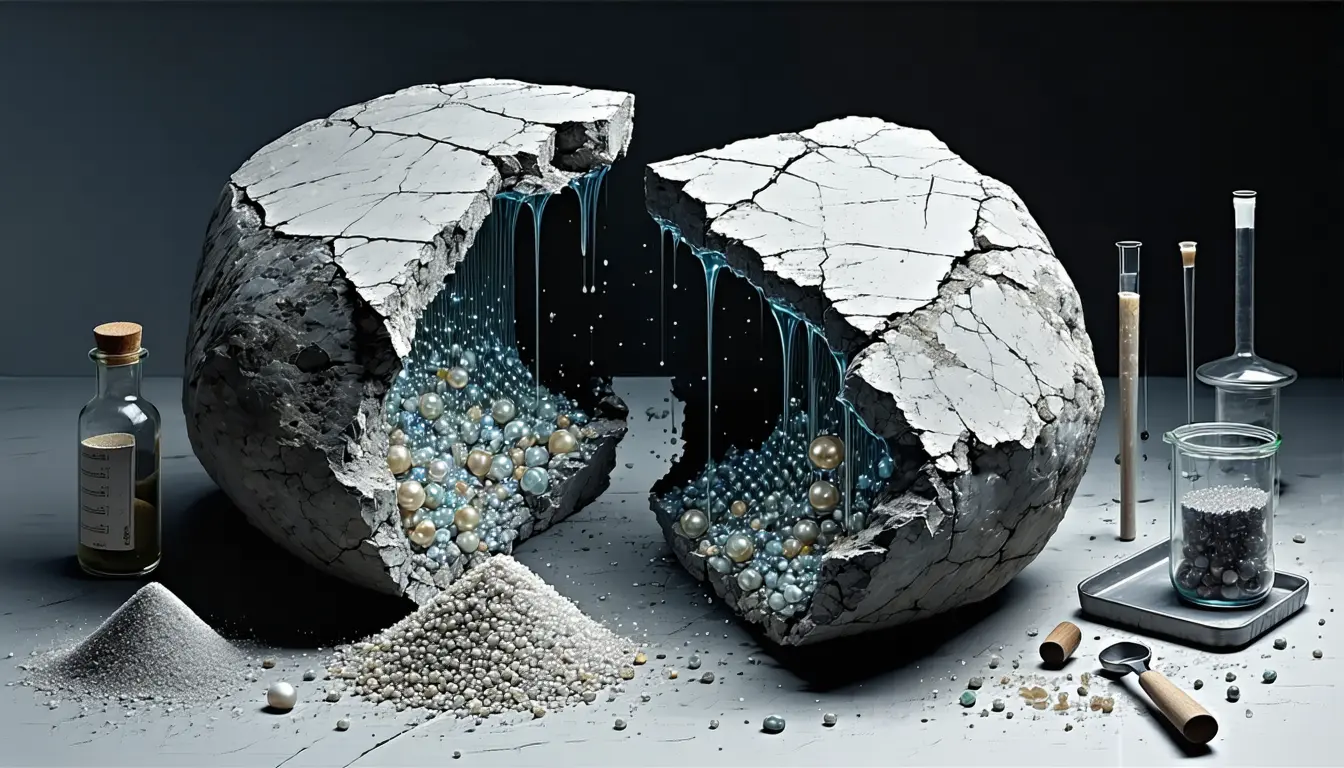
Diatoms, sea sponges and certain plants collect dissolved silicon and assemble it into complex silica structures under relatively mild conditions, using biological molecules and organic scaffolds to do it [7]. This project wants that chemistry running the other way. Engineered versions of those molecules would break silicon-rich waste apart under similarly mild conditions, freeing the rare earths and other critical minerals held inside and leaving silica that can be turned into products [8]. The incumbent comparison is conventional production of silicon-derived materials for concrete, glass, ceramics, semiconductors and silicones, which the release describes as needing high temperatures, large amounts of energy and intensive chemical processing [9].
Silicon is the bulk of these streams, and the rare earths are one of several things they contain [10]. "Recovering critical minerals is only part of the opportunity," Tao said [5]. He said the team wants a process that uses "as much of each waste stream as possible, separating strategically important elements while converting the remaining material into useful products" [5].
The award is $660,000 a year, and five institutions are named on the work, which leaves something near $132,000 each per year [16]. That pays for graduate students, instrument time and computation. The artificial intelligence in the plan is doing candidate design: modeling to propose specialized biomolecules and predict how they will interact with silicon-rich waste [11]. The modeling narrows candidates, and measured recovery on actual ash comes after.
What would settle this is energy and reagent consumption per kilogram of oxide recovered, measured on real feedstock against whatever route a refiner runs now. Tao is directing the biosilicification and bio-enabled metallurgy work himself while coordinating the project [12]. The schedule announced on September 18, 2026 runs two phases over five years [2][14].
What to watch
- A published dissolution and recovery figure on real coal ash or red mud, rather than on synthetic silica, would be the first hard test of the biomolecule route.
- Whether NSF funds the second phase, and which milestone the transition is gated on.
- Whether a utility or alumina producer agrees to supply impoundment material for testing at more than laboratory quantities.