Science1 publisher2 min readPublished
Max Planck chemists make metal carbenes from bench-stable thianthrenium salts instead of diazo compounds
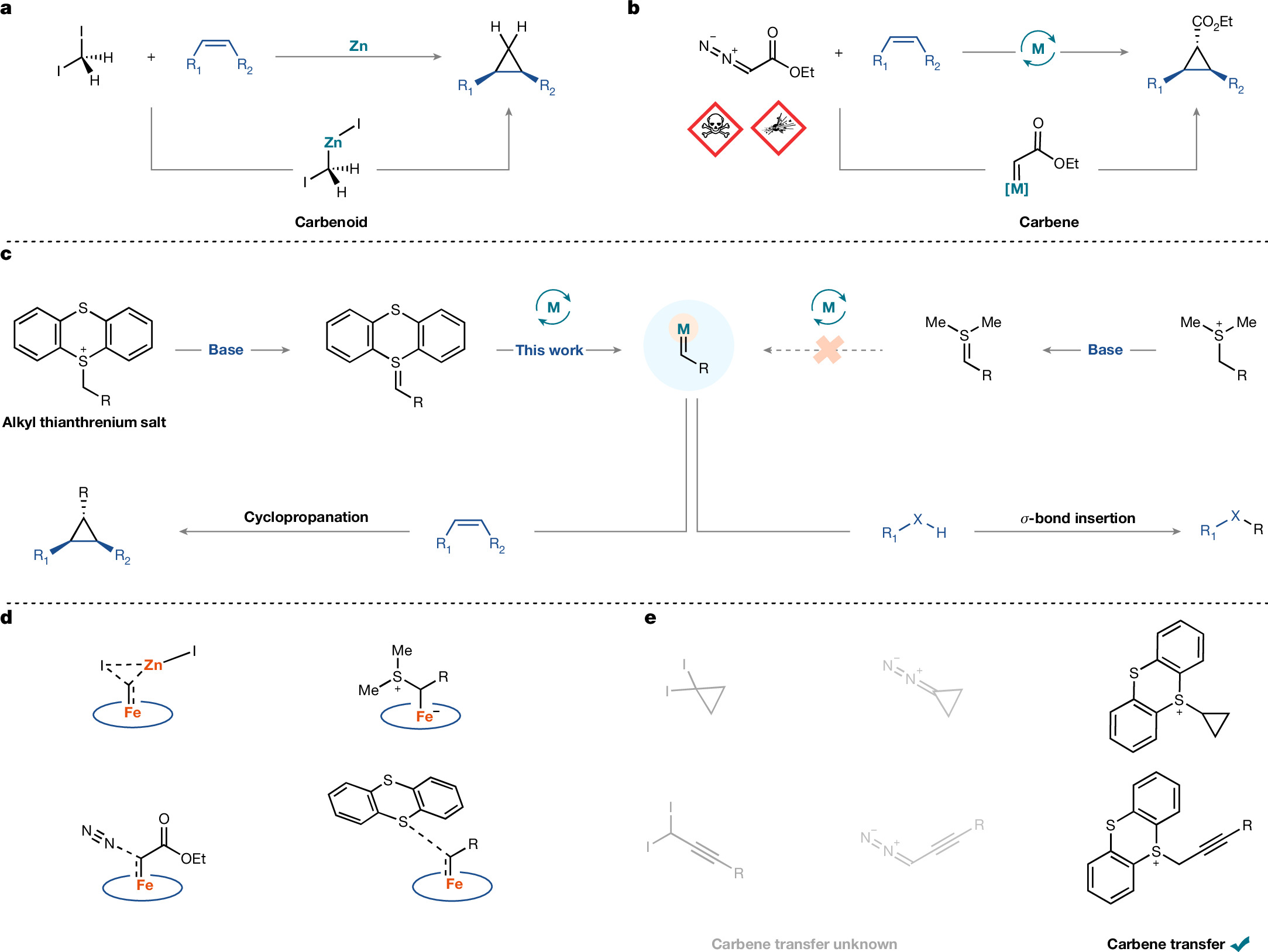
Max Planck chemists made metal carbenes from bench-stable thianthrenium salts and ran cyclopropanations at decagram scale with no diazo reagents. Labs wary of toxic, potentially explosive diazoalkanes now have a carbene source they can isolate and store.
The Scientist · Science desk
Drafted by a language model from the sources cited here and checked against its claim ledger before publication. How we use AISend a correction
What happened
- Sulfonium salts are safer but had failed as general carbene sources, because the sulfide's Lewis basicity hampers transfer to electrophilic metal carbenes.
- The thianthrenium route cyclopropanated a broad range of alkenes, including internal, unactivated ones, using diverse carbene fragments.
- The group also ran sigma-bond insertions and sigmatropic rearrangements from thianthrenium ylides.
Compiled by The ScientistSomething wrong?How this is made
Why it matters
- capability Unactivated alkenes, out of reach for sulfonium ylides confined to Michael acceptors, can now be cyclopropanated from a precursor that sits on a shelf.
- decision Groups that avoid diazoalkanes on safety grounds now have a storable carbene source to trial, but switching depends on yields and costs that only the paper's data can settle.
- constraint The safety evidence covers the salts tested, at tens of grams; a lab making a new alkyl salt or planning larger runs still needs its own thermal data.
- precedent If thianthrene's transfer advantage holds across insertion and rearrangement, other carbene reactions that now depend on diazo compounds become candidates for the same swap.
Ritter's group put the carbene fragment on thianthrene, a sulfide whose unusual electronic and steric properties make handing the carbene to the metal more favorable, according to the institute's account [4]. Substrate scope is how you test that claim. "Sulfonium ylides have been used in cyclopropane chemistry for almost 60 years, but their reactivity was limited to Michael acceptors," said Deepak Behera, first author of the Nature paper [6][13]. Internal, unactivated alkenes fall outside that class [5]. A cyclopropane on one of them is evidence that a metal carbene did the work, since the old ylide chemistry could not reach those substrates [6].
The safety case starts from the hazard it is meant to remove. Diazoalkanes can be toxic, unstable and potentially explosive [1]. The alkyl thianthrenium salts, by contrast, are readily prepared and can be isolated and stored [7]. The thermal result covers only the salts the team tested, and for those it found no detectable exotherm [8].
Scale came from solvent-free ball milling, which the team used to run cyclopropanation at decagram scale [9]. That means tens of grams [1]. "The combination of bench-stable reagents and solvent-free ball milling makes the carbene chemistry particularly attractive from a practical and scalability perspective," said Sagnik Chatterjee [10]. For a methods paper, tens of grams is a solid bench demonstration. The public account does not give yields, name the metal catalyst, or compare costs with diazo routes, so anyone weighing a switch will have to go to the paper itself [13].
The work beyond cyclopropanation bears directly on the substitution question. Diazo compounds have been the standard way to generate carbenes for decades [1], so every reaction class the salts can handle is another place a lab could stop using them. The group showed sigma-bond insertion and sigmatropic rearrangements as well [11]. "Our aim was to establish a general approach to carbene-transfer chemistry that allows diverse carbene fragments to participate in different classes of reactions," said Ritter, director at the Max-Planck-Institut für Kohlenforschung [12][2].
In my view the substitution case holds for the reactions shown. A lab that avoids diazoalkanes now has a storable precursor for cyclopropanation, including on unactivated alkenes, and for insertion and rearrangement chemistry [5][7][11]. "Stand in for" is a fair description for the salts tested, at bench scale [8][1]. Production use is a separate question, and the published evidence so far stops at tens of grams [1].
What to watch
- Yields and selectivities in the Nature paper for unactivated alkenes, set against established diazo-based cyclopropanations of the same substrates.
- Calorimetry or kilogram-scale runs of thianthrenium carbene transfer from process groups outside the Ritter lab.
- Extension of the thianthrenium ylide approach to further carbene reaction classes beyond insertion and sigmatropic rearrangement.