Product1 publisher2 min readPublished
Tianmushan moves the TMS-10 into final assembly ahead of an end-2026 supersonic flight
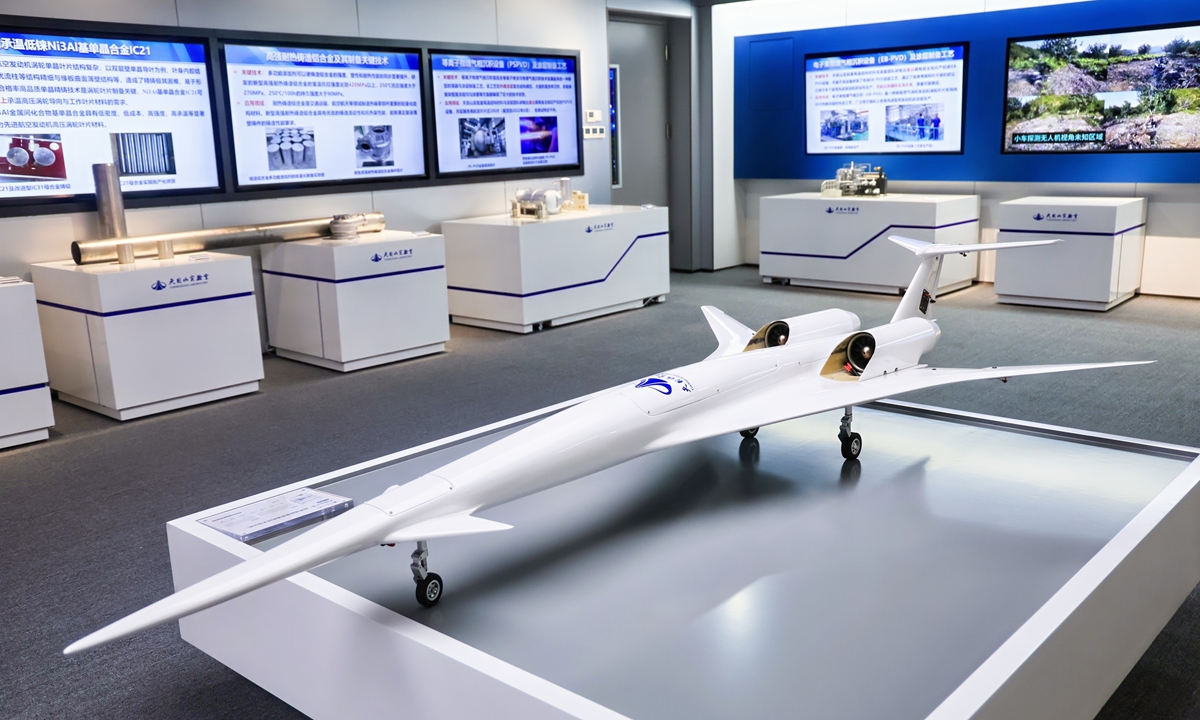
Tianmushan Laboratory says the wind tunnel work and the airframe are finished. The next flight is meant to measure a sonic boom on an aircraft sized for 10 to 15 passengers, well short of the airliner behind state media's 30-minute Beijing to Shanghai figure.
The Product Desk · Product desk
What happened
- Tianmushan Laboratory, set up with support from Beihang University, has the TMS-10 low-boom demonstrator in final assembly and plans a supersonic test flight by the end of 2026.
- The laboratory says aerodynamic wind-tunnel testing, flight-control design and airframe manufacturing are finished, and the next flight is meant to hold supersonic speed while the sonic boom is measured.
- A 1:18-scale demonstrator first flew in June 2025 from Dingzhou Airport in Hebei below Mach 0.2, checking low-speed takeoff and landing, stability and control.
- The design targets a 10- to 15-seat business aircraft cruising at up to Mach 2, with subsonic cruise around Mach 0.95.
Compiled by The Product DeskSomething wrong?How this is made
Why it matters
- capability Anyone arguing about overland supersonic flight would have measured booms from two independent airframes in the same year instead of one, with NASA's numbers no longer the only reference point.
- constraint A boom measurement settles one variable and leaves the ones that decide whether passengers ever board: structural durability, thermal management, reliability and operating cost all belong to an aircraft nobody has built.
- exposure If the end-2026 date slips, the project's demonstrated flight envelope stays at a scale model under Mach 0.2. Funders and partners would have to judge it on that.
A Beijing to Shanghai flight takes about two hours in the air now, and the 30-minute figure carried by Chinese state media describes what the technology might do inside a larger passenger aircraft later [4]. The difference is roughly 90 minutes [16]. The configuration actually in assembly is a business aircraft for business travel and high-end tourism [5], so that saving, if it ever arrives, goes to whoever books the cabin.
Tianmushan Laboratory says the three-surface layout, a forward canard with a T-tail, is meant to stop shock waves from the nose and wings from merging into one stronger wave, with the rear arrangement redistributing and weakening what is left [9]. The upcoming flight is also supposed to check the flight-control system and how the aerodynamics and the propulsion system work together [8].
The public flight record so far is one scale model. It first flew in June 2025 from Dingzhou Airport in Hebei and stayed below Mach 0.2, Global Times reported [7]. June 2025 to the end of 2026 is about 18 months [17], and going supersonic means at least five times the Mach number that model demonstrated [18].
NASA's X-59 reached supersonic speed in 2026 and has since flown at Mach 1.4 at 55,000 feet [15], on a program built around how loud a boom sounds to people underneath it [14]. Two low-boom aircraft are therefore set up to produce measured booms inside the same year [20]. Neither account mentions certification or any rule on overland supersonic flight [19]. Tianmushan describes its own work as pre-research and technology validation, not commercial aircraft development [13].
Hold the next announcement out of the lab against that description. The stated path to a passenger aircraft runs through a larger low-boom demonstrator of roughly 10 tons, more flight testing, and validation of critical structural components [12]. It also runs through an engine that does not exist yet: future versions need variable-cycle propulsion that works efficiently at both supersonic and subsonic speeds, according to the laboratory [11], and researchers on the project named the engine core, the air intake and the exhaust system as the areas needing more development [10].
So there are four checkable gates. When the next release lands, the question is whether it reports a measured boom level, a 10-ton airframe, structural validation, or an engine on a test stand. A speed claim with none of those attached tells you about a demonstrator, and that is what will fly at the end of 2026 if the schedule holds.
What to watch
- Whether Tianmushan publishes a measured boom level from the end-2026 flight or only a Mach number.
- Any start of work on the roughly 10-ton larger low-boom demonstrator the lab says comes next.
- Whether a variable-cycle engine core, intake or exhaust reaches a test stand under the project.