Science2 distinct publishers3 min readPublished
A Nature study of eight Myotis genomes argues pathogen adaptation, longevity and cancer resistance run through shared, pleiotropic genes, redirecting where aging and cancer researchers might look.
The Scientist · Science desk

Compiled by The ScientistSomething wrong?How this is made
The mechanism the authors lean on is pleiotropy, one gene holding down more than one job. If the genes that adapted under viral pressure are the same genes sitting in longevity and cancer pathways [9], the bat's three famous tricks are not separate systems but one system read three ways. That is the move that matters for anyone hunting drug targets: a locus an immunologist flagged for antiviral work becomes, on this account, a candidate an oncologist or a longevity researcher would want too.
The route the paper emphasizes is copy-number variation rather than point mutation. Co-lead author Elise Lauterbur of the University of Vermont argues that coding changes usually break a gene rather than repurpose it, while duplicating a gene lets one copy keep its old function and another diversify [12]. The worked example is EIF2AK2, also called PKR, a key immune factor the team found duplicated in Myotis-specific ways and carrying ancient copy-number polymorphisms shared across species [11].
The sharpest contrast with humans is in which viruses did the shaping. Across the genome the bats show positive selection for proteins that interact with DNA viruses and raised copy-number variation for those interacting with RNA viruses [3], a pattern the authors say differs from every other mammal they examined [4]. Humans run the other way, with selection concentrated on RNA-virus proteins such as those engaging SARS-CoV-2 and influenza, while bats lean toward DNA viruses like hepatitis B and herpesviruses [5]. The authors read that mismatch as one reason a pathogen crossing between the species can find both poorly prepared [6]. On the aging side, the repeated evolution of long life across Myotis tracks with positive selection in cancer pathways [7], and primary cells from the long-lived little brown bat showed a distinctive response to DNA damage [8].
There is real spread to work with. Within the genus lifespan varies sixfold, from Myotis brandtii at 42 years to Myotis nigricans at 7, in lineages that split only about 10.6 million years ago [13]. That closeness is the useful part, because it narrows the set of genetic differences that could explain so large a gap.
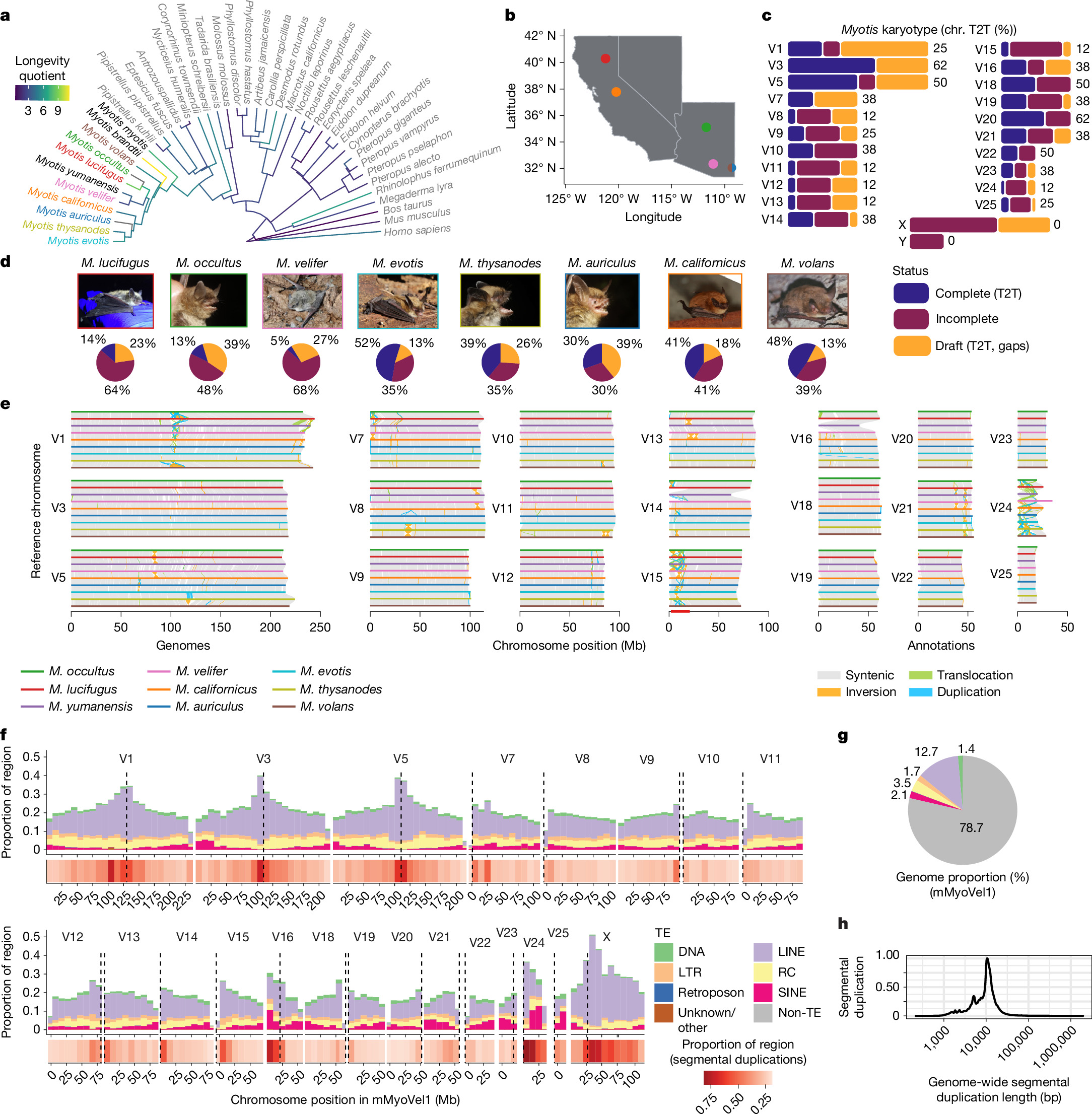
The evidence, published in Nature [1], rests on eight near-complete genome assemblies that place an average of 98.6% of nucleotides on 22 to 23 chromosomal scaffolds [16], built from wing skin punches rather than dissected organs, a sampling method co-lead author Manny Vazquez of Penn State designed so the animals live [14]. That matters most for the little brown bat, North America's longest-lived bat and the species hit hardest by white-nose syndrome [15]. The correlations are strong and the cell work is suggestive, but the paper stops at linkage.
Ranked by verification strength, evidence, and original report placement.
The study was published in Nature by an international team led by researchers from the University of Vermont and Penn State University.
The team generated primary cell lines and near-complete genome assemblies for eight closely related Myotis bat species.
Bats exhibit genome-wide over-representation of positive selection for DNA-virus-interacting proteins and elevated rates of copy-number variation for RNA-virus-interacting proteins.
The bats show distinct modes of adaptation to DNA and RNA viruses compared with all other mammals examined.
Humans show positive selection for proteins that interact with RNA viruses such as SARS-CoV-2 and influenza, while bats have greater selection for proteins that react to DNA viruses such as hepatitis B and herpesviruses.
The recurrent evolution of longevity seen in Myotis is associated with positive selection in cancer pathways.
Follow any of these and your For You feed starts watching them — no settings page required.
Evidence-backed comparisons of source perspectives and observed adoption signals. Read the methodology
Which Builder, Operator, and Investor concerns the observed source mix emphasized—not a truth score.
Evidence, demonstrated adoption, hype gap, incentives, and confidence are assessed independently, each on its own current evidence. How these are measured.
Strong primary evidence, single research group
The core findings rest on a peer-reviewed Nature paper with quantified assembly metrics (98.6% of nucleotides in 22-23 syntenic scaffolds, QV 66, BUSCO 98.2-98.5%), genome-wide positive-selection and structural-variation screens, and functional experiments in primary cells. Coverage is consistent with the paper. Evidence stops short of full marks because the supplied text is partial, all findings come from one collaboration, and the functional validation is cell-line-based with no independent replication shown.
Resource just released; no uptake shown
The only observable event is same-day publication of the assemblies and cell lines. The supplied sources disclose no downstream reuse, citations, data-portal downloads, follow-on studies, or institutional deployment of the resource or the wing-punch sampling method, so adoption cannot be measured without inference.
Mildly overstated in translation
The paper hedges appropriately ('suggest', 'associated with'), and the coverage headline is also hedged ('may connect'). Overstatement is modest and concentrated in the translation layer: an unquantified spillover-vulnerability inference, PKR copy number described as 'suggesting additional copies have a protective effect that promotes longevity', and the leap from cell-line results toward human evolutionary medicine. Because no adoption or clinical validation exists yet, the framing runs slightly ahead of what is demonstrated.
Normal academic promotion incentives
Both sources originate with the same parties: a Nature paper by the authoring team and a science-news item built from the authoring institutions' own quotes and framing, with no independent voices. That creates a routine reputational and grant-visibility incentive to emphasize significance. The supplied material discloses no commercial sponsor, funding source, product, or financial stake, so the incentive load is moderate rather than high.
Confident on findings, thin on consequences
Confidence is high for the descriptive genomic and functional results, which are peer-reviewed, quantified, and consistently reported across both sources. It is materially lower for the interpretive layer - spillover vulnerability, human-health translation, and any implication of practical uptake - because those rest on single-source attribution and no adoption evidence exists.
science
A phage kinase with no target list: EMBL finds one enzyme that breaks several bacterial defences1 distinct publisher
science
HIPAA Covers Less Than You Think, And "Anonymized" Is Not A Legal Shield1 distinct publisher
product
LLNL closes a 20 percent gap in diamond melting, and stakes a fusion gain claim on it1 distinct publisher
science
Psilocybin's 'oneness' now has a brain-network correlate, and it was found by sorting people on self-report1 distinct publisher
Distinct publishers with included, body-backed reporting in this cluster.
nature.com
1 article · August 25, 2026
phys.org
1 article · August 26, 2026