Science1 publisher2 min readPublished
Seven years of bank records show savings draining before women disclosed financial abuse
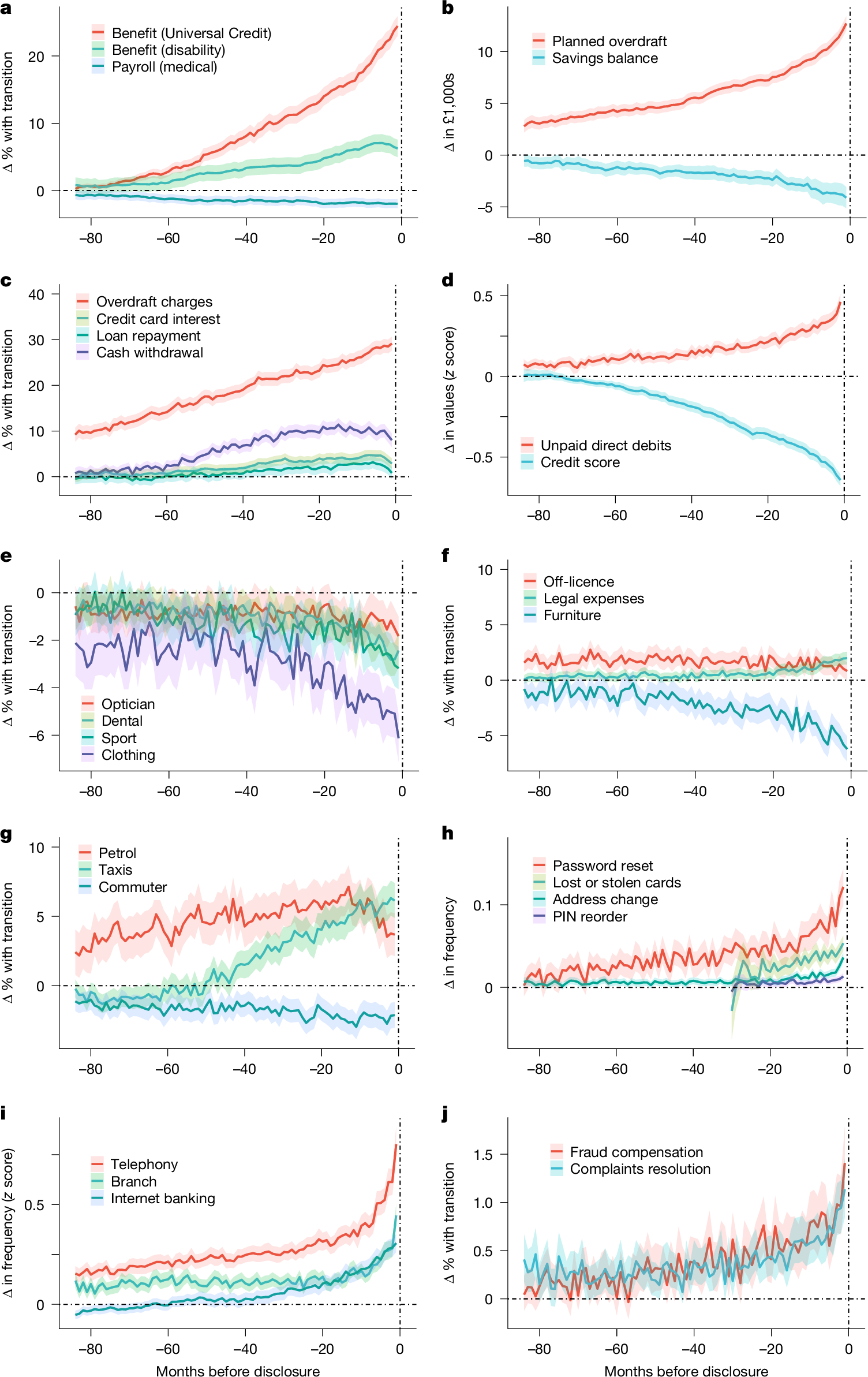
Researchers matched 5,428 women who disclosed financial abuse to a UK bank against 15,602 customers who did not, using profiles from seven years earlier, and then tracked 373 financial measures across both groups.
The Scientist · Science desk
What happened
- Researchers used anonymized records from a major UK retail bank to compare 5,428 women who had disclosed financial abuse with 15,602 customers who had not.
- Against the matched controls, the disclosing group's savings depleted and debts grew, ending in missed payments and declining credit scores.
- They also spent less on self-care, paid more for transport and legal costs, withdrew more cash, changed addresses and passwords more often, and claimed welfare benefits more.
Compiled by The ScientistSomething wrong?How this is made
Why it matters
- constraint Every case in the sample was found because a customer told the bank, so the study cannot say how many non-disclosing customers show the same account pattern, and that share decides whether a screen would find abuse or find divorce and job loss.
- capability The everyday evidence on financial abuse has come mainly from small qualitative surveys, so a bank can now hold a live account against a demographically matched control group instead of a caseworker's impression.
- decision Acting on a suspicion before a customer speaks carries its own cost, because financial abuse includes control over the victim's bank accounts, and a letter or call about the account may reach the person exercising that control.
- precedent A form of abuse that has been harder to evidence than physical violence now has a documentary trail that does not depend on the victim describing it.
The match happens seven years before disclosure. At that baseline the two groups looked alike on demographic and socioeconomic characteristics [2], so a later gap in savings or debt is not simply the case group having started out poorer. The design does not fix when the abuse began. Financial abuse often starts early in relationships [12], so for some of the 5,428 women the baseline year may already sit inside it.
Those 15,602 customers had no known disclosures [1]. A clean file records what the bank was told, not what happened to the customer. An estimated 12.6 million people in England and Wales have experienced domestic abuse, 30 percent of women against 22 percent of men [7], and an estimated 97 percent of domestic abuse cases involve some form of economic abuse [9]. Multiply the two and roughly 29 in 100 women have lived through a case with an economic component [4]. Some of them will be sitting in the control group, and each misclassified case pulls the measured gaps toward zero [5].
The sample runs 2.87 controls per case, 21,030 people in all [2][1], each tracked on 373 transactional and non-transactional outcomes [3]. The abstract reports the direction of each difference. It gives no sizes [8]. At a conventional 5 percent threshold, 373 tests would throw up about 19 chance separations on their own [6].
All of it is measured backwards from a disclosure [1]. Using the pattern as a screen needs the conditional in the other direction: of customers whose accounts look like this, the share who are being abused. That share depends on how often the same pattern shows up in people who are not, and a sample whose cases were defined by disclosure cannot supply it [7]. A bank that already holds a disclosure has, in the paper's outcome list, a documented expectation of what follows [4][5].
The cost estimates explain the appetite for data this granular. Domestic abuse in the UK costs an estimated £66 billion a year at 2017 prices, £91 billion at 2026 prices, mostly through harm, lost productivity and health care [8]. Around £14.4 billion of UK debt has been estimated to relate to economic abuse at 2020 prices, £18.78 billion at 2026 prices, and surveys of victim-survivors put average individual debt at £32,000 [10]. The paper cites an estimate that financial abuse precedes around a third of domestic homicide cases [12].
What to watch
- A forward test: applying the account pattern to customers with no disclosure and publishing how many later disclose, with false positives counted.
- Whether the full paper reports which of the 373 outcomes diverge earliest before disclosure, and by how much.
- Whether UK banks or regulators write the pattern into staff procedures under the Domestic Abuse Act 2021 definition of economic abuse.