Product1 publisher3 min readPublished
Australia bought 500,000 home batteries. Wholesale power prices fell by nearly half.
A 30 percent battery rebate that began in July 2025 now underwrites three hours of free midday power. The blocker in the US, per Rewiring Australia, is permits, inspections and tariffs.
The Product Desk · Product desk
Drafted by a language model from the sources cited here and checked against its claim ledger before publication. How we use AISend a correction
What happened
- Over the past 12 months, Australian wholesale electricity prices dropped nearly in half.
- Millions of Australian consumers can now sign up for three hours of free power in the middle of the day.
- Last year, US home electric bills surged at more than twice the rate of inflation.
- At least one in three American households struggle to pay energy bills.
- The Australian government rolled out a new 30% discount on home batteries, with the program launching in July 2025.
Compiled by The Product DeskSomething wrong?How this is made
Why it matters
Australia's wholesale electricity prices dropped nearly in half over the past 12 months, and millions of consumers there can now sign up for three hours of free power in the middle of the day [1][2]. Last year in the United States, home electric bills surged at more than twice the rate of inflation, and at least one in three American households struggles to pay energy bills [3][4].
The instrument is unglamorous. In July 2025 the Australian government launched a 30 percent discount on home batteries [5]. In the first three weeks, more than 1,000 batteries a day were installed [6], which is more than 21,000 in three weeks at that rate alone [1]. More than 500,000 have gone in since the program started [7]. The original goal was 1 million installations by 2030; lawmakers doubled it to 2 million [8], which leaves the current count at roughly a quarter of the revised target [2].
The logic is dispatch, not virtue. Batteries charge on solar during the day and discharge in the evening, and enough homes now do it that utilities can avoid starting more expensive gas plants [9]. Saul Griffith of Rewiring Australia, who previously cofounded Rewiring America and helped shape parts of the Inflation Reduction Act, describes the target as the 6 p.m. peak when everyone gets home and the network is stressed [10][11]. His modelling, he says, showed that against the cost of retiring coal and building gas to replace it, heavily subsidising batteries was cheaper, and also hugely politically popular [12]. Fast Company reports that home batteries have helped drive the cheap prices; the account does not decompose how much of the wholesale fall is batteries versus everything else [13].
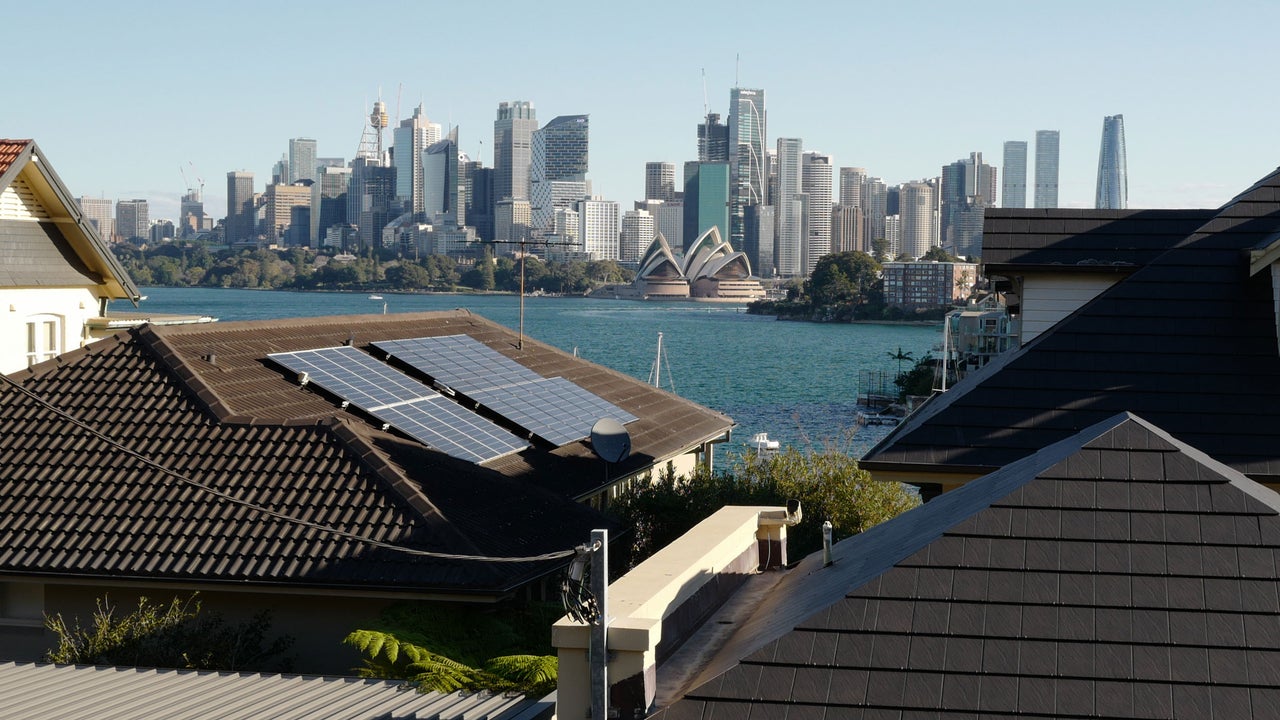
None of it works without the installed base underneath. More than one in three Australian homes has solar panels [14]. Griffith argues that is not a sunshine story, since two-thirds of the US is equally sunny [15]. Panel hardware has fallen more than 90 percent globally since 2010 [16], so the gap is soft cost, and it is large: installing rooftop solar in the US can cost six to eight times what it costs in Australia [17], meaning the Australian job runs at roughly 12 to 17 percent of the American one [3]. Australian homeowners request a permit through a phone app and have it within 24 hours, with panels up the next day rather than in two or three months [18]. Fewer inspections are required [19], a government training program raised safety standards in a way that cuts contractor liability and insurance cost [20], and some installers buy directly from Chinese manufacturers instead of through middlemen [21]. On the US side sit tariffs and jurisdiction-by-jurisdiction permitting rules [22]. Griffith calls it death by half a dozen paper cuts, and says the US needs a "get the government off my roof" campaign [23].
The end state is visible in the network. Solar is now the cheapest electricity available to Australian consumers [24], and many substations run negative on some days, pulling nothing from grid generators because local homes are producing enough [25].
Watch whether the 2 million target holds now that the subsidy has been repriced upward by demand, and whether any US state attacks soft costs, meaning app-based permits and standardised inspections, rather than adding another hardware rebate on top of a six-to-eight-times install stack [17]. The counterfactual is already estimated: residential prices in some US areas could be as much as 40 percent higher in 2030 than in 2025 [26].