Science1 distinct publisher2 min readPublished
Cervical cancer is falling where vaccination took hold. HPV throat and mouth cancers tripled in US data to 2004 and again in Danish data to 2017, mostly in men, with no screening test.
The Scientist · Science desk

Compiled by The ScientistSomething wrong?How this is made
Cervical cancer control runs on two instruments: a vaccine that keeps new infection out of adolescent cohorts, and a screening test that finds precancerous change in people already infected. Australia's expected elimination by 2035 is credited to both working together [14]. Cancers of the tonsils and the base of the tongue have the first instrument and, per the Live Science report, "no good screening, diagnostics or interventions" [10]. The missing arm is the one that does anything for people already carrying the virus.
That is most of the people in the current numbers. Roughly 80% of sexually active adults acquire HPV, about half of them a high-risk type, and most clear it within a year or two [16]; in some it persists and damages DNA [11]. Electra Paskett, a cancer epidemiologist at Ohio State, told Live Science that immune control of a chronic infection can slip as people age, with chronic stress possibly contributing [12]. That is the route from an exposure in the 1970s to a tumour after 65, which is where 40% of these cases now land [8].
The counting is worth doing carefully, because the two diseases are usually discussed as though one were much larger. On CDC annual averages, HPV-attributable oropharyngeal cancer totals about 16,000 cases a year, some 44% more than the 11,100 cervical cases [19]. Male cases alone run about 2,500 a year above the cervical figure [21], at close to six men for every woman [20].
Nor is the male rise an artifact of the vaccine's success in women. The American tripling closed in 2004, two years before Gardasil was licensed [23]. The Danish tripling ran to 2017, inside the vaccine era, but among birth cohorts never offered the shot as adolescents: a person who was 18 at launch is 37 nineteen years later [4][24]. Two separate curves, one of which had a programme built around it.
Why the burden sits with men is partly behavioural and partly not. In a Baltimore patient study, men were more likely than women to carry oral HPV, their risk tracked their number of recent oral and vaginal sex partners, performing oral sex was associated with oral infection in men but not in women, and men cleared these infections more slowly [13].
Vaccinating boys is the right instrument and the wrong timescale for the 13,600 men diagnosed each year [5][8]. Anal, penile, vaginal and vulvar cancer rates are rising too, and oropharyngeal cancer is already more common than any of them [18]. What would move the near-term count is a detection test, and the reporting says there is not one [10].
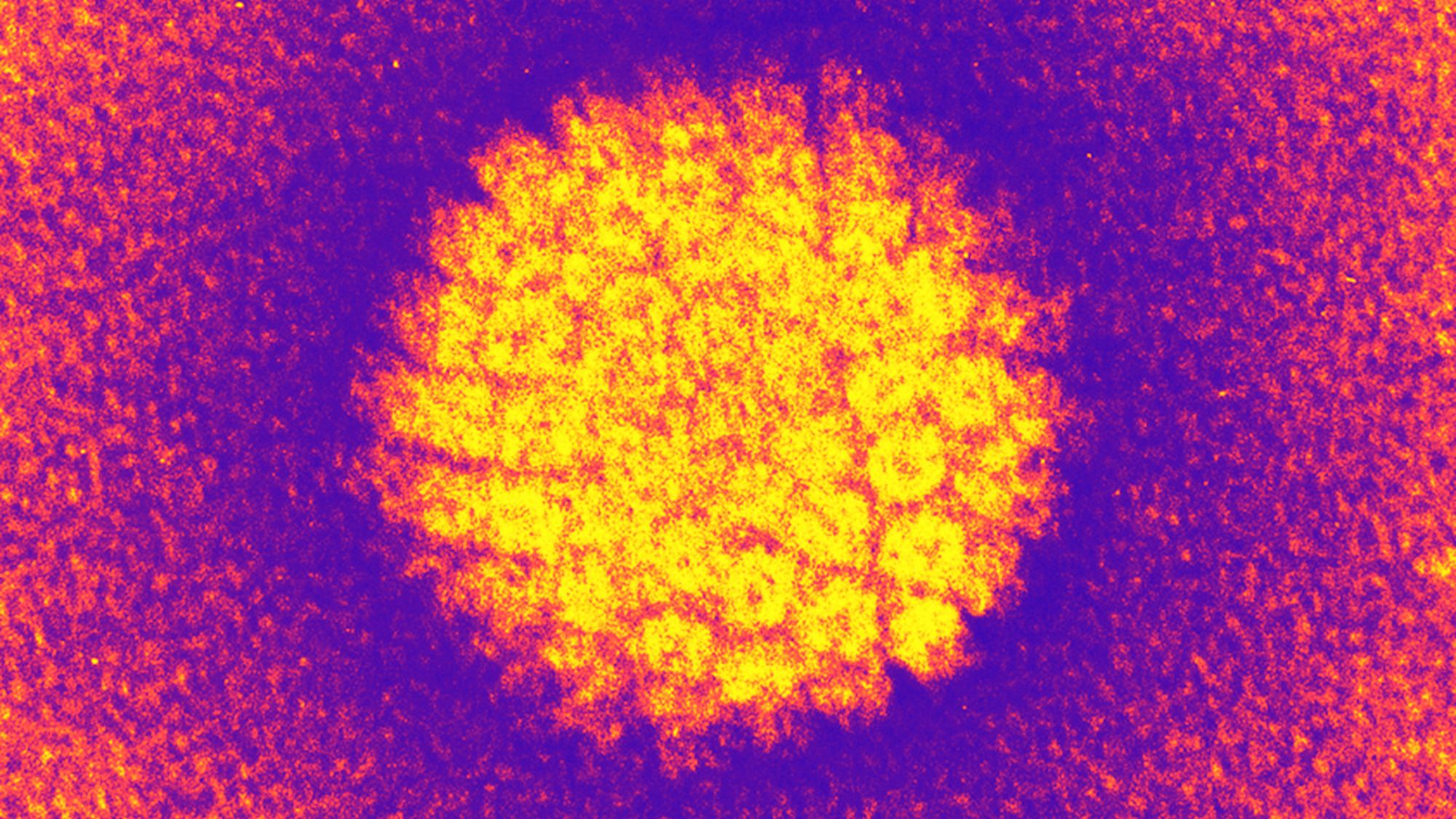
Ranked by verification strength, evidence, and original report placement.
The first HPV vaccine, Gardasil, became available in 2006.
Vaccination against HPV has drastically reduced cervical cancer rates among women who received the vaccine.
HPV-linked throat and mouth cancers (oropharyngeal cancers, affecting the back of the throat along the tonsils and the base of the tongue) are rising, mostly in middle-aged and older men.
A 2023 study of the U.S. found cases of HPV-related oropharyngeal cancer had more than tripled between 1988 and 2004, with the bulk of that trend driven by male patients.
One Danish study found another tripling of HPV-related oropharyngeal cancer between 2000 and 2017.
CDC data show an average of 13,600 oropharyngeal cancer cases likely caused by HPV diagnosed in men each year.
Follow any of these and your For You feed starts watching them — no settings page required.
Evidence-backed comparisons of source perspectives and observed adoption signals. Read the methodology
Which Builder, Operator, and Investor concerns the observed source mix emphasized—not a truth score.
Evidence, demonstrated adoption, hype gap, incentives, and confidence are assessed independently, each on its own current evidence. How these are measured.
Multiple institutional datasets, but all relayed by one outlet with no primary links
The core epidemiological claims are attributed to identifiable bodies of evidence — CDC annual case averages, a 2023 US study, a Danish 2000-2017 study, a Baltimore infection study, National Cancer Institute prevalence figures — and two named academic experts speak on the record about the screening void. That is well above anecdote. It is discounted because the cluster contains a single secondary article with no citations, cohort sizes or links to the underlying studies, and because the piece states a male case share (80%) that conflicts with the counts it itself reports (~85%).
Prevention proven on the cervical endpoint; nothing deployed against the throat cancers
There is concrete deployment evidence on one side of the story: a vaccine shipping since 2006, >50% cervical cancer declines in high-uptake US states, and Australia's program on track for elimination by 2035. Against the cluster's actual subject — HPV-linked throat and mouth cancer in men — deployed countermeasures are near zero: no screening or diagnostic pathway exists, diagnosis is symptom-triggered, and the population carrying 40% of cases is over 65 and predates the vaccine. Male vaccination coverage is never quantified, so uptake on the relevant endpoint cannot be scored higher.
Slightly understated relative to its own numbers
The article's language is restrained and mechanism-led: it credits vaccination for cervical gains, sources the trend to CDC and two national datasets, and closes with treatment outcomes (85-90% five-year disease-free survival) rather than alarm. If anything the framing undersells its own arithmetic — HPV-linked oropharyngeal cancer at roughly 16,000 annual cases already exceeds cervical cancer by about 44%, and men alone exceed it by about 2,500 cases — while quoting a lower male share (80%) than its counts imply. The small negative reflects understatement, tempered by the fact that a single unlinked secondary source is the only support.
No funding or conflict disclosures supplied
The cluster identifies the outlet and two academic affiliations (The Ohio State University College of Medicine, University of Michigan Medical School) and names a commercial product (Gardasil), but supplies no funding sources, sponsorships, manufacturer relationships or conflict-of-interest statements for the publisher, the quoted experts or the cited studies. There is no basis in the supplied material for scoring incentive pressure, and inferring one from affiliation alone would be guesswork.
Direction well supported, magnitudes single-sourced
Confidence is moderate: the qualitative core — cervical cancer falling under vaccination, HPV-linked oropharyngeal cancer rising and heavily male, and no screening test for it — is supported by institutional data and on-record named experts, and is consistent across two national datasets. It is held below high confidence because the entire cluster is one consumer-science article with no primary citations, one unresolved internal numerical inconsistency on the male share, and no incentive disclosures or male vaccination coverage figures to check the forward-looking parts.
science
Feeds are triaging patients by engagement, and the proposed defence is literacy, not moderation1 distinct publisher
science
Ancient DNA keeps changing the sex of the richest graves. The backlog is the story1 distinct publisher
science
IBM's bottleneck was cold volume, and its answer is an 8-foot box you can bolt to another one1 distinct publisher
science
For the AMOC, how fast we warm may matter more than how hot it gets1 distinct publisher
Distinct publishers with included, body-backed reporting in this cluster.
1 article · August 24, 2026