Product4 publishers3 min readPublished
Supreme Court voids "POST MILK GENERATION" for oat drinks, and the workaround with it
Oatly's mark is invalid on oat-based food and drink because "milk" counted as a designation. Negation, asterisks and droplet symbols do not create a safe harbour.
The Product Desk · Product desk
Drafted by a language model from the sources cited here and checked against its claim ledger before publication. How we use AISend a correction
What happened
- The Supreme Court unanimously dismissed Oatly's appeal, holding that "POST MILK GENERATION" uses the term "milk" as a "designation" within the meaning of Point 5 of the 2013 Regulation, and is not clearly being used to describe a characteristic quality of the contested products, so the trade mark is invalid in relation to oat-based food and drink.
- Judgment date 11 February 2026; neutral citation [2026] UKSC 4; on appeal from [2024] EWCA Civ 1453; case ID UKSC/2025/0004. Judgment given by Lord Hamblen and Lord Burrows, with Lord Hodge (Deputy President), Lord Briggs and Lord Stephens agreeing.
- Oatly AB is a Swedish company whose business involves the manufacture and sale of oat-based food and drink products as alternatives to dairy products; Dairy UK Ltd is the trade association for the UK dairy industry.
- In April 2021 Oatly registered the trade mark "POST MILK GENERATION"; in November 2021 Dairy UK applied for a declaration that the registration was invalid under section 3(4) of the Trade Marks Act 1994, which prevents registration of any trade mark where its use is prohibited in the United Kingdom by any enactment or rule of law other than law relating to trade marks.
- Dairy UK relied on Parliament and Council Regulation (EU) No.1308/2013 of 17 December 2013 establishing a common organisation of the markets in agricultural products; following Brexit the 2013 Regulation became assimilated law and, with minor subsequent amendments, continues to have effect in domestic law.
Compiled by The Product DeskSomething wrong?How this is made
Why it matters
The UK Supreme Court unanimously dismissed Oatly's appeal on 11 February 2026, holding that its registered trade mark "POST MILK GENERATION" is invalid in relation to oat-based food and drink [1] [2]. The constraint on alternative-protein branding has therefore moved out of trade mark law and into agricultural labelling law, where a brand asset can fail because of the words in it rather than because someone else got there first [5] [7].
The mechanics matter for anyone drafting packaging copy. Oatly, a Swedish maker of oat-based alternatives to dairy, registered the mark in April 2021 [4] [5]. In November 2021 Dairy UK, the trade association for the UK dairy industry, applied to invalidate it under section 3(4) of the Trade Marks Act 1994, which bars registration where use of a mark is prohibited by an enactment or rule of law other than trade mark law [4] [5]. The prohibition relied on sits in Point 5 of Part III of Annex VII to EU Regulation 1308/2013, which survived Brexit as assimilated law and says the designations "milk" and "milk products" cannot be used for other products, unless the designation is clearly used to describe a characteristic quality of the product [6] [7]. The Court read "designation" broadly, found that "POST MILK GENERATION" uses "milk" as one, and found the proviso did not save it [1] [10].
The route there was not smooth. An IPO hearing officer held the mark invalid for oat-based food and drink but valid for non-agricultural goods such as T-shirts, which fall outside the Regulation [8]. The High Court overturned the food and drink finding; the Court of Appeal restored it; the Supreme Court agreed with the Court of Appeal [8] [9]. From registration to final judgment took roughly four years and ten months [11].
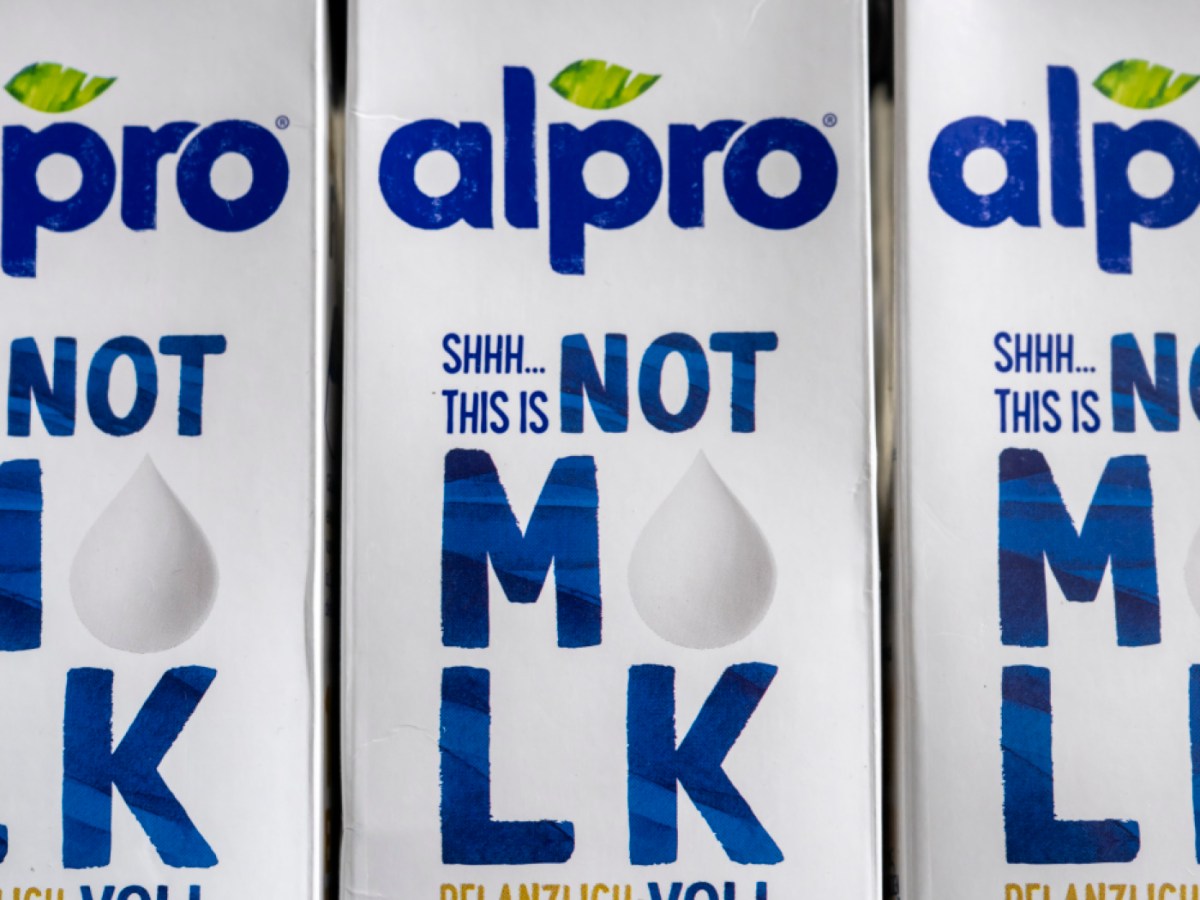
Switzerland reached the same place by a different door. Danone's Alpro carton read "SHHH.... THIS IS NOT MILK", with a white drop replacing the "i", while the back said "oat drink" [12] [13]. The Zurich cantonal laboratory banned the product in March 2022 [14]; the cantonal court upheld that, and in 2024 rejected Danone's appeal [15]; the Swiss Federal Court then rejected the appeal by four votes to one [16]. Swiss law defines milk as the product of mammary secretion of a mammal and protects the name, and labelling must not mislead as to composition or nature [17] [18]. One judge put it as: "If you have to call a spade a spade, you have to call milk milk" [19]. FoodNavigator reads the ruling as ending attempts to bypass dairy naming bans with design tricks [20]. Danone Switzerland says it accepts the ruling and that "Various options are currently being evaluated" [21].
Three things to watch. First, category spread: the EU has banned specific denominations for meat-free products including chicken, beef, steak and pork, which suggests "not steak" copy carries the same risk as "not milk" [22]. Second, jurisdictional divergence: the FDA's position is that clearly labelled nut milks can still use the term, so a single global pack design is now harder to justify [23]. Third, commercial context: Circana reports retail volumes of dairy-free milks have fallen more than 5% for three consecutive years, implying a cumulative drop of about 14% [24] [25]. Oatly has responded to losing the slogan by handing out "contraband" merchandise carrying it, which the T-shirt carve-out permits [8] [26].