Loading today’s stories
Science1 distinct publisher3 min readUpdated
A whole pot in a pit: the Florida find that is evidence about deposition, not decoration
Students at Mission San Francisco de Potano recovered an undecorated vessel unbroken after four centuries. The rarity is the deliberate placement, and the room around it is still unidentified.
The Scientist · Science desk
What happened
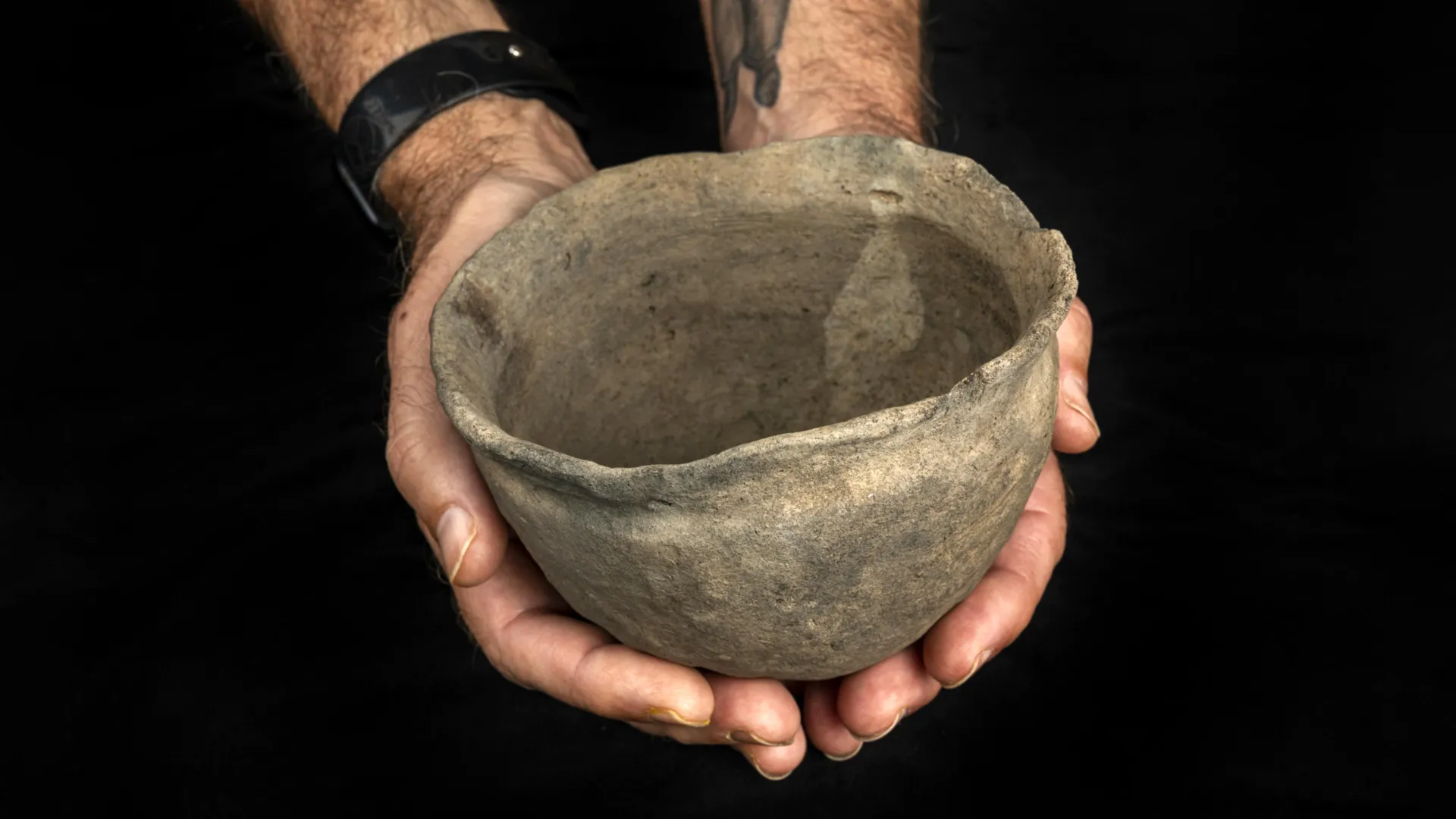
- A member of the Potano-Timucua hand-shaped a small clay vessel roughly 400 years ago: palm-sized, with a simple rim, a smooth dull gray surface and no decoration.
- University of Florida students uncovered the vessel earlier this year, still completely intact after centuries underground.
- The vessel's original purpose is unknown, as is the number of people who may have used it.
- Gifford Waters, collections manager for historical archaeology at the Florida Museum of Natural History: "It's very unique. Typically, we find things that were broken and discarded... You don't leave things behind that you can still use, so why was this purposefully put into a pit?"
- Waters has encountered complete artifacts in shipwreck collections, but this was the first time in his career he had been part of a team excavating an entirely unbroken pottery vessel from a terrestrial site.
Compiled by The ScientistSomething wrong?How this is made
Why it matters
An unbroken pot from a land site has to clear two filters. Someone had to put it into the ground whole, and the ground had to leave it alone afterwards. Gifford Waters of the Florida Museum of Natural History notes that pottery entering the soil intact often cracks anyway as soil pressure, farming and construction move the earth around it [6]. He has handled complete objects from shipwreck collections, but this is the first whole pottery vessel he has excavated from a terrestrial site in his career [5]. The interesting property here is not the pot but the pit.
The assemblage makes the point. Since 2006 the site has produced more than 7,000 artifacts, mostly fragments of Native pottery [13]. Spread across the twenty years to this August, that is upward of 350 items a year, nearly all of it breakage [21]. Waters has argued that the site's information comes from associations rather than objects: nearly all the recovered bone came from one spot, which is what identifies a cooking area and a trash pit [15]. On that logic a single complete vessel, put deliberately into a pit, records one decision rather than an accumulation of discards [4].
What it is not, yet, is evidence of trade. The museum's summary presents the find as revealing Native traditions, Spanish influence, trade and migration [18], while the excavators say the vessel itself has offered few direct clues about how it was used [16], and it carries no decoration to argue from [1]. The contact-era material at San Francisco de Potano sits elsewhere in the collection: glass beads and nails, alongside stone tools and bones from meals of turtle, freshwater fish and turkey [14]. The pot's contribution runs entirely through its location. It was inside a Spanish-made structure whose function has not been worked out, and more excavation is needed before anyone can say what happened there [17].
The demography is worth holding onto while that gets settled. At its height the village held several hundred Potano, and the mission's European population was one, the friar [12]. Spanish influence at this site is therefore a signal from a single resident, read against several hundred people who went on making their own pottery [23]. The Potano reached the area in 1585 after Spanish forces pushed them off land probably lying between Payne's Prairie and Orange Lake [9]; the friar arrived 21 years later, in 1606 [20]. A vessel made roughly 400 years ago would fall near the 1620s, early in the mission's hundred-year occupation before its abandonment in 1706 [24].
So the honest description is a well-recorded context with an unresolved room around it. The deposit is the rare case at this site where an object's setting preserves a single act instead of a century of dumping [15], and that act stays unreadable while the building does [17].
Loading topic controls
Loading related stories