Loading today’s stories
Science1 distinct publisher3 min readUpdated
Gamma-ray excess in nuclei traced to spin flips, tightening the data behind reactor and forensics models
An FRIB-led team reports in Nature that the decades-old low-energy gamma excess appears only in magnetic transitions, where protons and neutrons flip their internal magnets.
The Scientist · Science desk
What happened
- A new study led by the Facility for Rare Isotope Beams (FRIB), with researchers from Lawrence Livermore National Laboratory (LLNL), was published in Nature.
- For decades, scientists have observed that some nuclei emit an unexpectedly large number of low-energy gamma rays, an effect known as low-energy enhancement; it does not appear in every nucleus and researchers have not been able to reliably predict where it will occur.
- The new results provide strong evidence that magnetic transitions within the nucleus are responsible for the low-energy enhancement effect.
- Eleanor Ronning said: "This low-energy enhancement wasn't predicted by theory, so it was kind of a shock to the community when it was first observed" and that it is difficult to predict where it occurs.
- Eleanor Ronning is lead author of the study and a former FRIB graduate student.
Compiled by The ScientistSomething wrong?How this is made
Why it matters
A team led by the Facility for Rare Isotope Beams, with researchers from Lawrence Livermore National Laboratory, has published work in Nature attributing the long-standing excess of low-energy gamma rays from certain nuclei to magnetic transitions inside the nucleus [1][3]. The result matters less as a discovery than as a constraint: the same gamma-emission models feed calculations used for nuclear energy processes, heavy-element nucleosynthesis and nuclear forensics [13][14][15].
The anomaly is old and awkward. Gamma rays come off when an excited nucleus sheds energy on its way to a more stable state during radioactive decay [16]. For decades, measurements have shown some nuclei emitting far more low-energy gamma rays than expected, an effect called low-energy enhancement that does not show up in every nucleus and that nobody has been able to predict reliably [2]. "This low-energy enhancement wasn't predicted by theory, so it was kind of a shock to the community when it was first observed," said Eleanor Ronning, the study's lead author and a former FRIB graduate student [4][5].
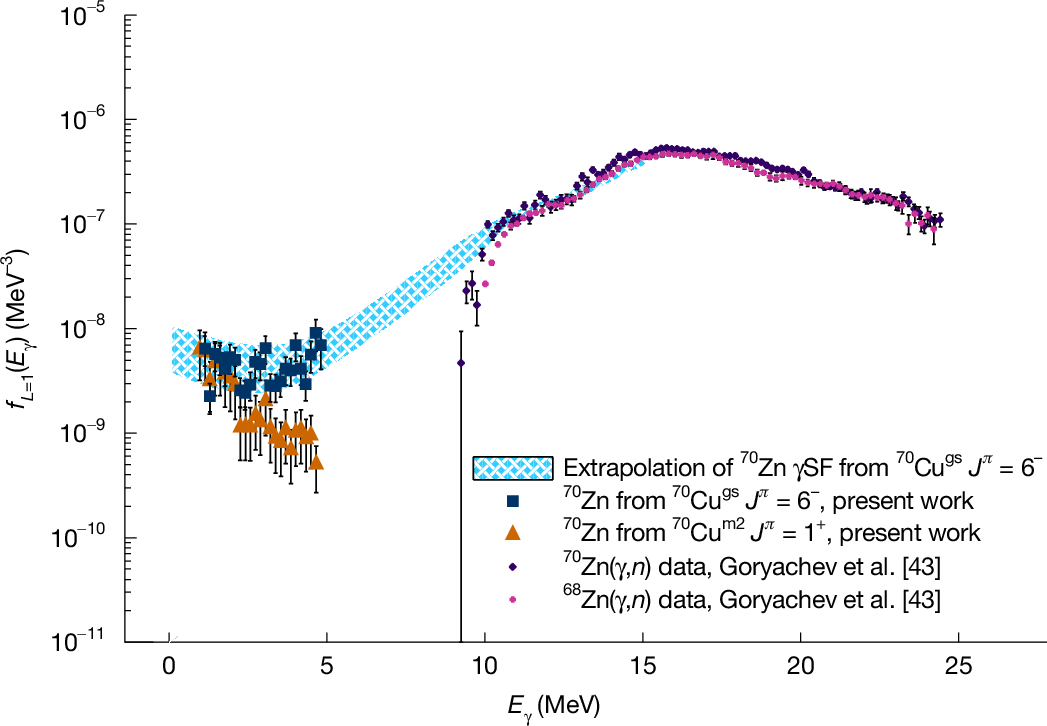
The experiment measured gamma rays emitted as a radioactive copper isotope decayed into zinc [7]. FRIB's instrumentation let the team isolate two distinct decay states and examine each on its own [8]. One proceeded by an electric transition, in which protons shifted position [9]. The other proceeded by a magnetic transition, in which protons and neutrons effectively flipped their internal magnets [10]. Only the magnetic transition produced the low-energy enhancement [11]. Because both states sit in the same decay of the same nucleus, the discriminating variable is the character of the transition rather than the identity of the nucleus [18]. Ronning and co-lead Andrea Richard proposed the experiment jointly, and LLNL staff monitored it continuously through a weeklong, round-the-clock run [12].
"We now have a consistent explanation that connects experimental observations with theory," said Richard, a former LLNL postdoctoral researcher now an assistant professor at Ohio University [6]. The practical pull is on the applied side. LLNL scientist Darren Bleuel said the improved theory could sharpen knowledge of stockpile performance and the interpretation of past test program results, and improve nuclear forensics, meaning the ability to determine whether a nuclear event has occurred and identify its likely source [14]. The authors also point to better modelling of reactions in stars, supernovae and neutron star mergers, including those that build heavy elements, and to processes relevant to nuclear energy [15].
The honest limit is scope. The study examined one nucleus, and the claim that it will improve models across a broader range of elements and reactions is the researchers' expectation rather than a demonstrated result [13]. The predictive gap Ronning describes also remains open: knowing the mechanism is magnetic does not yet tell anyone which nuclei will show the enhancement [2].
Worth watching: whether the magnetic assignment reproduces in other isotopes where separating electric and magnetic states is harder, and whether evaluated nuclear data libraries change their gamma-emission treatments rather than leaving the enhancement as an empirical patch.
Loading topic controls
Loading related stories