Invest1 publisher3 min readPublished
Three Korean national universities drew 10,414 more applications after each was promised 70 billion won
Jongno Academy counted 99,883 early applications at Pusan, Chonnam and Chungnam for 2027, up 11.6% in the first cycle after each was promised 70 billion won a year, with 63% of the gain at Pusan alone.
The Investor · Invest desk
What happened
- Jongno Academy's analysis, released on the 13th, put early admissions applications to Pusan, Chonnam and Chungnam national universities at 99,883 for the 2027 academic year, up 11.6% from 89,469.
- Each of the three is set to receive an additional 70 billion won a year for five years under the Lee Jae-myung administration's plan to build 10 Seoul National Universities.
- Pusan National University made the largest move of the three, up 19.0% or 6,599 applications, taking its competition ratio to 11.55 applicants per seat.
- Chungbuk National University, one of the flagship regional national universities outside the three, drew 23,440 applications, down 17.1% from a year earlier.
Compiled by The InvestorSomething wrong?How this is made
Why it matters
- cost The promise totals 210 billion won a year across the three schools. Set against 10,414 extra applications, that is about 20.2 million won apiece, and the five-year schedule does not depend on what next cycle's count shows.
- contradiction Hankuk University of Foreign Studies gained 22.7% with no designation while Seoul National University lost 8.0%, so this cycle's numbers cannot separate the funding promise from the crowding ahead of the 2028 overhaul.
- exposure Chungbuk is the flagship carrying the decline, roughly 4,835 applications on the reported 17.1%, and it recruits against three neighbours whose money is promised through a fifth year.
- constraint The relief process for students blocked by the system error has yet to run, so the competition ratios in this analysis will be restated before they are final.
Pusan supplied 6,599 of the 10,414 extra applications, or 63.4% [3][1][3]. Chungnam added 2,541 and Chonnam 1,274, and the three increments sum to the reported gain exactly [5][4][2]. All three were promised the same 70 billion won a year [2]. The gap between Pusan's 19.0% and Chonnam's 5.1% is 13.9 percentage points [8].
Outside the plan, Hankuk University of Foreign Studies drew 5,513 more applications, up 22.7% [9]. Chung-Ang rose 16.9% and Sogang 12.6% [10]. Each of those three beat the funded schools' combined 11.6% with no new state money [10]. Sungkyunkwan went the other way, 7,728 applications lighter, and Seoul National University and Yonsei, which closed early admissions on the 9th, fell 8.0% and 8.3% [12][11].
Jongno Academy reads the Seoul swings as timing, with applicants holding out until the deadline ahead of the admissions overhaul planned for the 2028 academic year [13]. "The competition ratios at major universities in Seoul show the psychological pressure students felt, because this is the last early admissions cycle under the current system," said Lim Sung-ho, head of Jongno Academy [14]. "That appears to have produced both fierce last-minute maneuvering and a tendency toward safe applications," he said [15].
Chungbuk's 23,440 applications and 17.1% decline imply about 28,275 a year earlier, a loss near 4,835 [6][4]. That is 46% of what the funded three gained, so more than half of their 10,414 came from somewhere other than the neighbouring flagship [5]. Kyungpook's 0.9% decline works out to roughly 543 applications on a base of about 60,292 [7][9]. Sedaily reports that some observers attribute that decline to Kyungpook's exclusion from the funded list [16], and a 0.9% move is thin support for that.
At 70 billion won a year for five years, each school is set for 350 billion won, and 1.05 trillion won across the three [2][7]. The analysis counts applications and competition ratios; it does not report how many applicants will enroll [1]. The average ratio for the three rose to 9.16 applicants per seat from 8.29 [8].
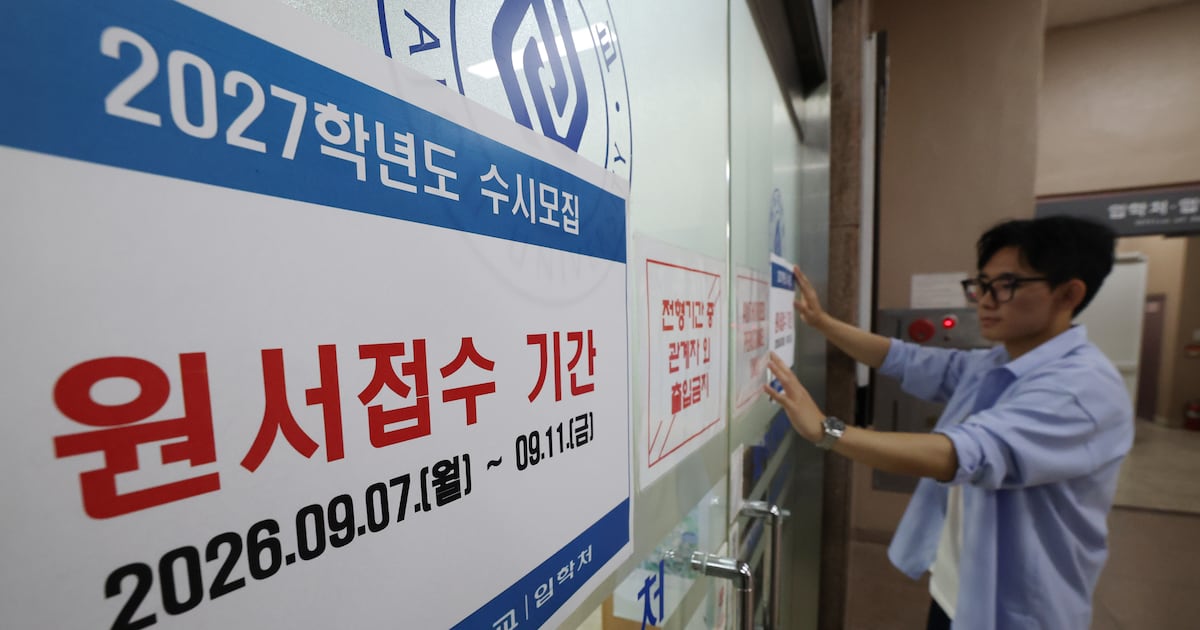
Submissions did not close cleanly. A system error shortly before the deadline extended the window by about an hour, and some applicants were able to check competition ratios up to the originally announced deadline before submitting, prompting complaints about fairness [17]. The Ministry of Education said it will focus first on helping students who could not submit because of the error, then review possible changes to the system [18].
One cycle does not tell designation apart from the deadline, and these numbers cut both ways: Pusan's rise is the strongest case for the money, and Hankuk's, with none of it, the strongest case against. The first cycle under the 2028 system separates the two. If the three hold these numbers once the last-minute crowding is over, the 70 billion won explains them; if they converge back toward Chungbuk, this year was a deadline effect.
What to watch
- The revised competition ratios at the three schools once the Education Ministry's relief process for blocked applicants has run.
- Whether a later round of the 10-university plan adds Kyungpook or Chungbuk to the funded list.
- Enrollment counts next spring, which are a different measure from the application totals in this analysis.