Science1 publisher2 min readPublished
Plunderfish cells cultured for the first time show enlarged lysosomes at near-freezing
A Cambridge and British Antarctic Survey team grew spiny plunderfish cells in the lab, then imaged them alive near 0 degrees Celsius. The preprint reports enlarged lysosomes and more networked mitochondria than in a temperate fish.
The Scientist · Science desk
What happened
- A team grew Antarctic fish cells in culture for the first time, then captured the first images inside living Antarctic fish cells at near-freezing temperatures.
- Engineers at the University of Cambridge built a microscope able to capture detailed images at around 0 degrees Celsius, and fluorescent dyes made the cells' internal structures visible.
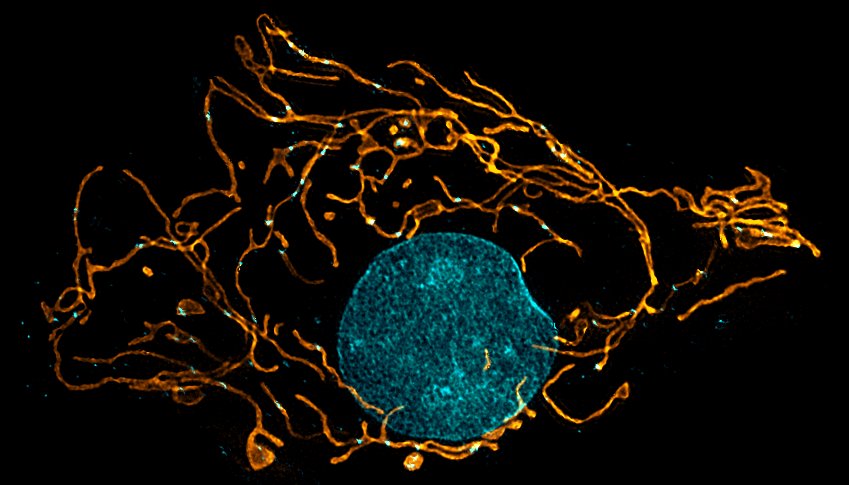
- Inside the spiny plunderfish cells the researchers found larger lysosomes and more mitochondria joined together in networks.
- The plunderfish develops slowly, but its mitochondria moved at roughly the same speed as those in cells from a shanny, the temperate comparison fish.
- The initial findings are posted as a bioRxiv preprint on organelle morphology and dynamics in Antarctic fish cell cultures.
Compiled by The ScientistSomething wrong?How this is made
Why it matters
- capability Watching living cells at sub-zero temperatures lets the team test whether an Antarctic fish fails first inside its cells or in larger systems such as circulation, a question they could not previously put to living tissue.
- constraint Everything reported here is shape and movement, so any claim about suppressing protein misfolding waits on a measurement of how fast those lysosomes actually clear damaged protein.
- exposure If the first failure point is inside the cell, animals living in a 3.8 degree band are reachable by warming well before anything shows at the level of the whole fish.
- precedent Naming cold storage of donated human tissue as a possible application sets the frame future funding will be argued in, and no tissue was stored or tested in this work.
Cold makes protein folding errors more likely inside the spiny plunderfish, and its cells keep working anyway [18]. The fish lives on the seabed in the Southern Ocean and around sub-Antarctic islands, where the water stays between minus 1.8 and 2 degrees Celsius all year [19][10]. Francesca van Tartwijk, a cell biologist on the team, compares folding to origami [17]. In the human brain, folding errors play a role in Alzheimer's, Parkinson's and Huntington's disease [16].
Lysosomes break down material a cell no longer needs [4]. Larger ones might help clear proteins damaged by the cold, and the researchers say plainly that size alone cannot show how well they do that job [3][5]. The account of the preprint gives no lysosome sizes and no count of the cells imaged [25].
The comparison animal was a shanny, a small fish from UK coastal waters [7]. One polar species against one temperate species leaves a confound that imaging detail does not close, because differences between the two can follow from lineage, body plan or depth as much as from temperature. On the networks, the team offers a functional reading: more mitochondria joined together may help the cells meet their energy needs when cold makes protein production less efficient [9]. Mitochondria supply cells with energy [22].
"It is super exciting to be able to study living cells at sub-zero temperatures and see with our own eyes what is going on," said Clemens Kaminski, the University of Cambridge professor who co-leads the project [13]. The other co-lead, British Antarctic Survey geneticist Melody Clark, said that "Raising temperatures just a few degrees can be lethal" [14]. The band the plunderfish occupies is 3.8 degrees Celsius wide from top to bottom [11], so the lethal margin Clark describes is about as wide as everything the animal normally experiences [26].
"Our findings have the potential to affect a range of scientific disciplines and applications, far beyond ecology and the polar regions," van Tartwijk said in a press release [12]. The researchers name human disease and the cold storage of donated human tissue as areas the work might eventually inform [20], and the work itself tested neither. In my view the durable result is the culture step: growing Antarctic fish cells in a lab at all [1] is the thing other groups need before any of the rest can be measured.
What to watch
- Whether the lysosome and mitochondrial network differences survive peer review of the bioRxiv preprint.
- A functional assay of degradation rate in the cultured cells, which would test whether the larger lysosomes actually clear more damaged protein.
- Warming experiments on the cultures to find the temperature at which these cells, rather than whole animals, start to fail.