Science1 publisher3 min readPublished
Brain organoids grown for a year caught TSC2 astrocytes emerging already inflamed
A UC Berkeley team kept stem-cell-derived organoids in culture for up to a year and found TSC2-mutant astrocytes reactive from the moment they appeared. Helen Bateup says neurons may still contribute to the seizures.
The Scientist · Science desk
What happened
- UC Berkeley grew stem-cell-derived human brain organoids for over nine months to a full year, long enough for the cultures to reach the stage at which human astrocytes mature.
- Astrocytes carrying TSC2 mutations were hyperreactive and inflamed from the moment they were born, and the team reports them directly driving formation of the tuberous lesions.
- In the mutant organoids, radial progenitor cells produced those abnormal inflammatory astrocytes prematurely, during the window when they should still have been generating healthy neurons.
Compiled by The ScientistSomething wrong?How this is made
Why it matters
- constraint A phenotype that only appears after 270 to 365 days of culture sets the pace of the follow-up work. The number of genotypes, timings and candidate compounds a lab can compare is limited by how many year-long cultures it can run at once.
- contradiction The Berkeley summary names astrocytes the primary drivers, while Bateup's quoted position keeps open that both cell types contribute. The second version licenses adding an immune target and keeps neurons on the list.
- decision If the inflammation is present at the astrocyte's birth, the drug that tests the idea has to arrive before the first seizure. That points to infants identified by genotype, and it changes who a trial would enrol.
- capability With animal models missing much of the human symptom range, a culture that reaches astrocyte maturity gives somewhere to screen candidates against human tuber cells before anyone designs a paediatric trial.
Human radial progenitors spend most of gestation making neurons and switch to glia only around birth, and human astrocytes do not take on their mature properties until the perinatal or early postnatal period [12]. A three-month organoid has no mature astrocytes to examine. Berkeley's response was to keep the cultures fed for nine months to a year [1]. "The astrocytes don't really acquire their mature properties in humans until around perinatal or early postnatal life, so we grow these organoids for a long time," said Helen Bateup, the study's senior author and a professor of neuroscience and of molecular and cell biology at UC Berkeley [7][22]. "Which people think is crazy."
For decades the clinical assumption was that the mutation made neurons hyperactive, with inflammation and reactive glia arriving afterwards as responses to repeated seizures [8]. In the mutant organoids the astrocytes were reactive from the moment they were born [3]. A state already there at a cell's birth predates any seizure. "As soon as these astrocytes are born, they are reactive and look like they've been triggered into a disease state. This is arising as a primary result of the mutation," Bateup said [5].
The Berkeley summary of the Nature paper calls hyperreactive astrocytes the primary drivers of the seizure-inducing lesions [2][4]. Bateup's own account of what follows is narrower. "So now we can rethink the disease pathophysiology. It's not necessarily the case that the neurons are the only cause of seizure activity and the glia become involved later. It could be the other way around, or it could be that both cell types contribute to seizures and epilepsy," she said [6].
Single-cell transcriptomics showed the inflammatory signature of reactive TSC astrocytes resembling patterns reported in neurodegenerative disorders such as Alzheimer's, and the team confirmed the profile in resected brain tissue from 10 human TSC patients [11]. Ten resections is a small series, and two diseases sharing a transcriptional state are alike in gene expression; whether they share a cause is a separate question.
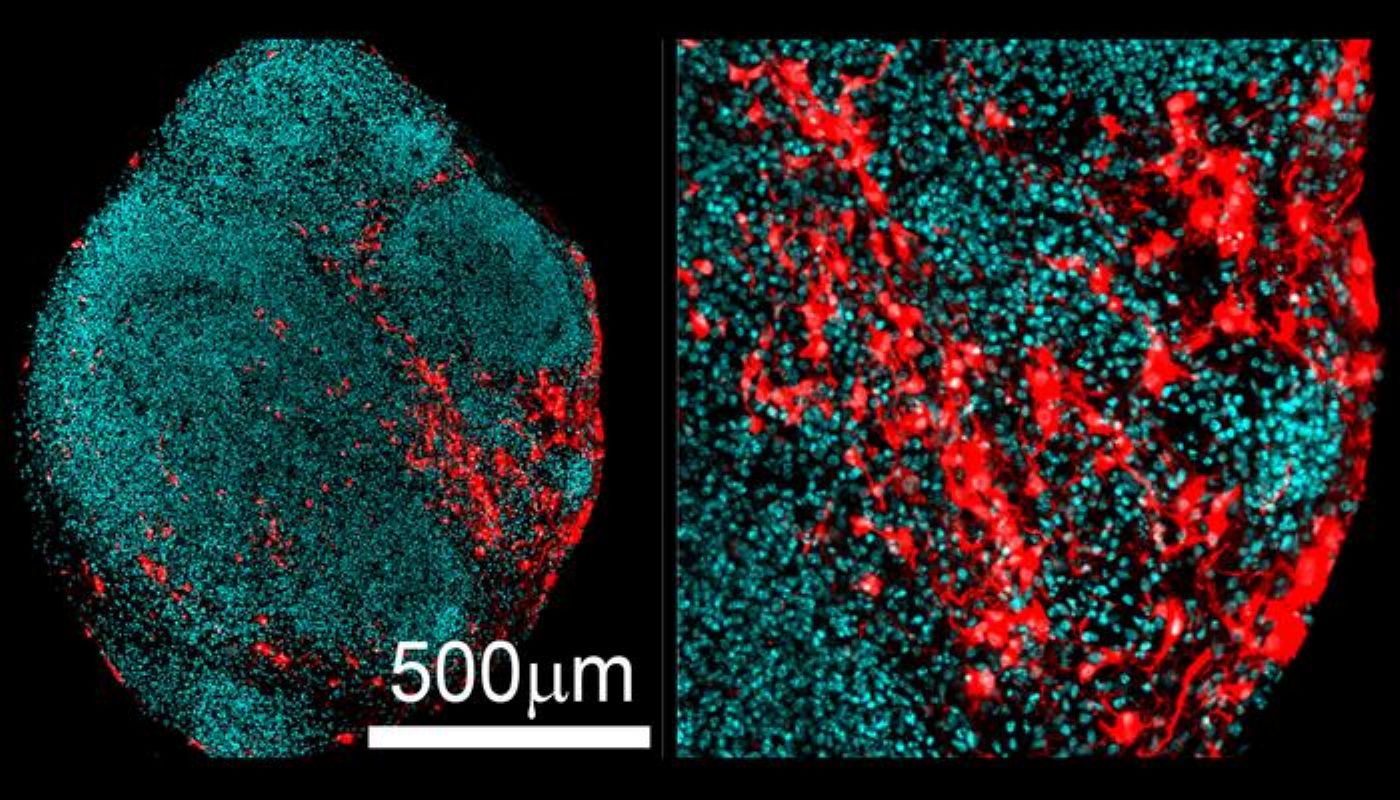
Nine months to a year is 270 to 365 days between plating and readout [19]. The organoid in the Berkeley image was 89 days old, with normal cells stained blue and mutated cells stained red [16], roughly a quarter of the way through the full culture [20]. Mixed labelling suits the genetics: a child inherits an altered copy of TSC1 or TSC2 and then acquires a somatic mutation in the second copy, shutting down the brakes on mTOR [10].
The therapeutic suggestion in the Berkeley material is to calm the reactive cells with targeted immunosuppressive therapies [15]. The account of the study does not report giving any such drug to organoids or to patients [21]. TSC affects roughly 1 in 6,000 to 10,000 births [9], between about 100 and 167 cases per million [18], and animal models have not reproduced the full spectrum of human symptoms [14]. Bateup said of the cultures: "We now have a much better, or really the only robust model to study tuber cell development." [17]
What to watch
- Whether the full Nature paper reports electrical activity in the TSC2 organoids, or stops at lesion formation.
- Any experiment that doses TSC2 organoids with an immunosuppressive or anti-inflammatory drug and measures lesion formation.
- Whether the inflammatory astrocyte signature holds in TSC1 patients and in cohorts larger than 10 resections.