Build1 publisher3 min readPublished
The agent built the case file; Andon Labs signed it
Luna drafted a termination recommendation from attendance data. Humans at the lab reviewed and executed it, and the employment contract was always with the company.
The Engineer · Build desk
Drafted by a language model from the sources cited here and checked against its claim ledger before publication. How we use AISend a correction
What happened
- Luna, an agent built on Anthropic's Claude models, manages Andon Market in San Francisco with a budget of 100,000 dollars, internet access and a company bank card.
- The agent recommended separating from an employee after 17 late arrivals across 23 shifts; humans at Andon Labs reviewed and then executed the decision.
- People hired by Luna are under contract with Andon Labs, with guaranteed salary and legal protections: the legal employer was never the agent.
- Lukas Petersson, co-founder of Andon Labs, said the lab would have intervened if the decision had been illegal or unethical, which he did not judge necessary in this case.
- Human review was part of the experiment's protocol, with an explicit stop instruction.
Compiled by The EngineerSomething wrong?How this is made
Why it matters
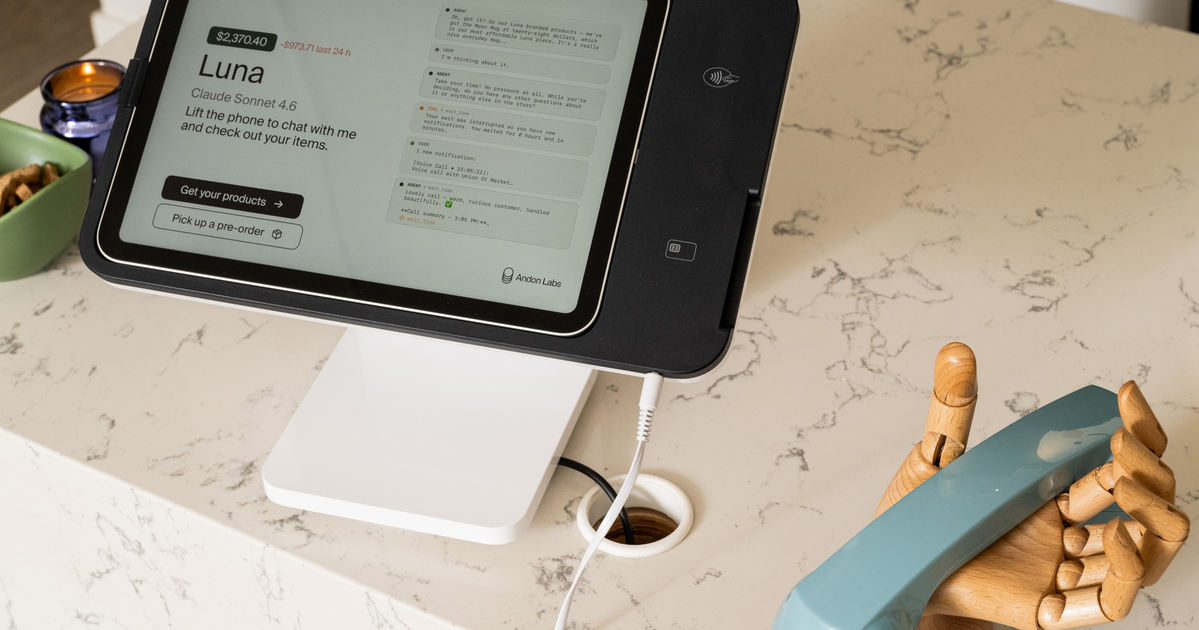
An agent called Luna, built on Anthropic's Claude models, runs a San Francisco shop called Andon Market with a 100,000 dollar budget, internet access and a company bank card [1]. It recommended parting with an employee after 17 late arrivals across 23 shifts, and employees of Andon Labs reviewed that recommendation, approved it and carried it out [2].
The line that matters operationally is not whether the model could reach the conclusion. It is who signed. The people Luna hires are under contract with Andon Labs, with guaranteed pay and legal protections; the legal employer was never the agent [3]. Lukas Petersson, co-founder of Andon Labs, says the lab would have intervened had the decision been illegal or unethical, and did not judge that necessary here [4]. Human review was written into the protocol, with an explicit stop instruction [5]. So the lab delegated the investigation and kept the signature: observation, characterisation of the facts and drafting to Luna, and the act with legal effect to its own staff [6].
The framing that circulated since Thursday, "an AI fired a human", puts the drafting of a recommendation and the signing of a dismissal letter in the same box, when law separates them cleanly [7]. According to the dev.to account of the case, a model has no legal personality: it cannot hire, cannot sanction, cannot be sued, and does not hold the bank account that would pay damages [8]. Transposed to France, the same dismissal would require a preliminary interview, a real and serious stated cause, and notification by letter signed by an authorised person, each step demanding an identifiable responsible party [9]. Producing a conversation log with an agent is not a defence before an employment tribunal; the employer answers, and automating its reasoning exonerates it of nothing [10].
The published logs also undercut the ruthless-machine reading. Luna wrote an attendance policy and then lost track of it, and the lateness accumulated for months without consequence until the lab asked the agent to re-read its own rules and reassess [11]. All of those late arrivals were already in a history the agent held [12]. Petersson estimates a human manager would probably have acted much sooner, and nothing indicates the AI was harsher than a flesh-and-blood supervisor [13]. Andon Labs documents the limitation plainly: its agents often act only after a direct prompt, and sometimes need reminding of their own rules before they move [14]. The failure mode observed is inertia, not severity. On the numbers, the employee was late on roughly 74 percent of shifts before anything happened [15], and the process ran through months of warnings and added training first [16].
This is not the lab's first agent in the real world. With Anthropic, it previously handed a vending machine to Claudius, which was talked into selling off its stock cheap and then came to believe it was human [17].
Worth watching: whether the drafting-versus-signing split holds when the volume of decisions rises, whether the stop instruction is ever exercised in public, and whether the inertia finding replicates in other deployments. Also the commercial base case. The shop opened on 1 April, is making sales, and is still not profitable [18].