Science1 publisher2 min readPublished
Chemists run three carbonylations in one pot to turn aldehydes into threofuranoses
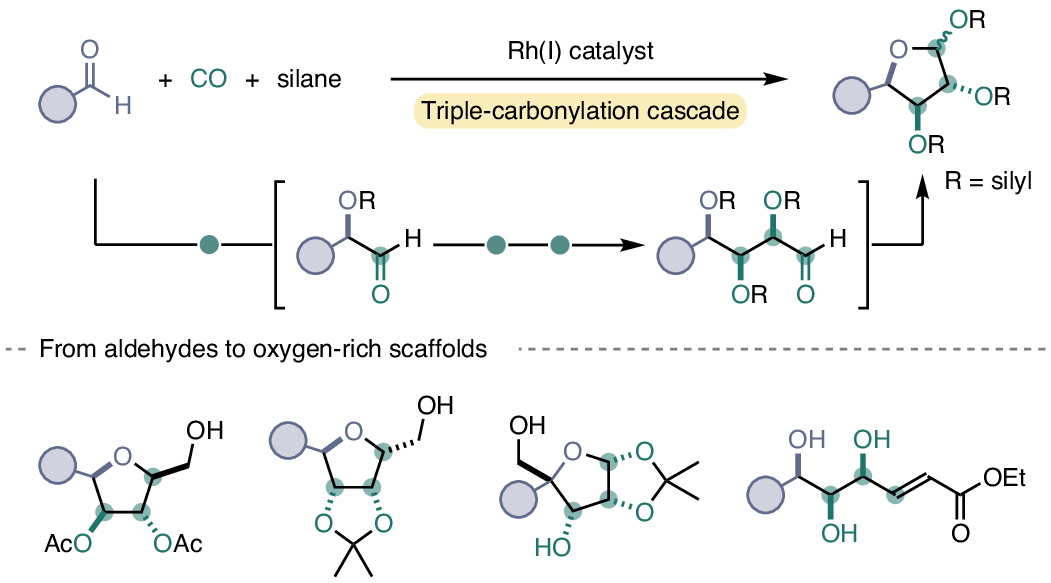
A rhodium cascade assembles a threofuranose ring from an aldehyde in one operation. The authors' larger claim is that carbonylative cascades can stand in for the protecting-group sequences sugar chemistry runs on.
The Scientist · Science desk
What happened
- A rhodium-catalysed triple-carbonylation cascade converts diverse aldehydes into structurally defined 4-carbothreofuranoses in a single step, according to the paper's abstract.
- A chelation-relay mechanism carries stereochemistry across three contiguous centres, which the authors describe as good diastereocontrol.
- The substrate set the authors report spans aromatic aldehydes through to steroidal ones.
- Downstream transformations of the products give N- and C-glycosides, nitrogen heterocycles and polyol motifs the authors call relevant to pharmaceutical applications.
Compiled by The ScientistSomething wrong?How this is made
Why it matters
- capability Groups that need threofuranose scaffolds can start from a commodity aldehyde, on the authors' account, instead of treating the sugar itself as the hard part of the route.
- constraint The protecting-group-free claim has been shown on one four-carbon ring family, so it does not yet reach the hexose targets most carbohydrate drug programmes care about.
- cost One operation does not mean one cost: rhodium, a selected ligand and a metered silane are what a process chemist pays for, and a shorter route can still cost more per gram.
- decision Anyone weighing whether to adopt the cascade can interrogate the stereochemical claim now from the four deposited structures, before paying for the full method.
Errors compound in a cascade. Three carbon monoxide insertions under one catalyst mean the third has to fire in a pot where the metal has already run two, and each new carbon has to be set on the same face as the one before it. The abstract names both failure modes that had kept iterative carbonylation out of reach: cumulative catalyst deactivation and stereochemical drift [2]. With round numbers, three stereochemistry-setting steps at 90 percent selectivity each would leave 73 percent of the material in the intended configuration [1].
The reported fix is narrow. Precise silane stoichiometry and ligand selection enforce kinetic synchronization of the three CO insertions, and a silicon-directed cyclization terminates the sequence [3]. Precise stoichiometry is easier to hit in a small flask than in a reactor. The abstract does not report yields, diastereomeric ratios or catalyst loading, and the full text sells for USD 39.95 [12].
For a result that is entirely about stereochemistry, the X-ray work is the part a reader can check for free: crystallographic data for four compounds [2] (37b, 37b', 69b-1 and 1i) were deposited at the Cambridge Crystallographic Data Centre under deposition numbers 2428978, 2429909, 2453930 and 2487049, and copies can be obtained free of charge [7].
The target sugar has a constituency in nucleic-acid chemistry. The paper's reference list cites Schoening and colleagues' 2000 report in Science on the alpha-threofuranosyl-(3' to 2') oligonucleotide system [8]. The same list cites Ko and colleagues' 1983 total synthesis of the L-hexoses [9], and those six-carbon sugars are a different synthetic problem from the four-carbon ring reported here.
Whether this displaces protection and deprotection routes in practice turns on rhodium loading, ligand price and silane equivalents at working scale. The authors' own summary states that the work establishes carbonylative cascades as a platform for oxygen-rich scaffold assembly, bypassing classical protection-deprotection sequences in carbohydrate synthesis [10].
What to watch
- Yields, diastereomeric ratios and catalyst loading in the supplementary information, and whether they hold at gram scale.
- Whether the same chelation relay can be pushed to five- and six-carbon sugars.
- An independent group reproducing the cascade, ideally with a lower rhodium loading or a catalytic silane.