Science1 publisher2 min readPublished
Pittsburgh researchers reverse two-dimensional turbulence's energy cascade with one angled obstacle
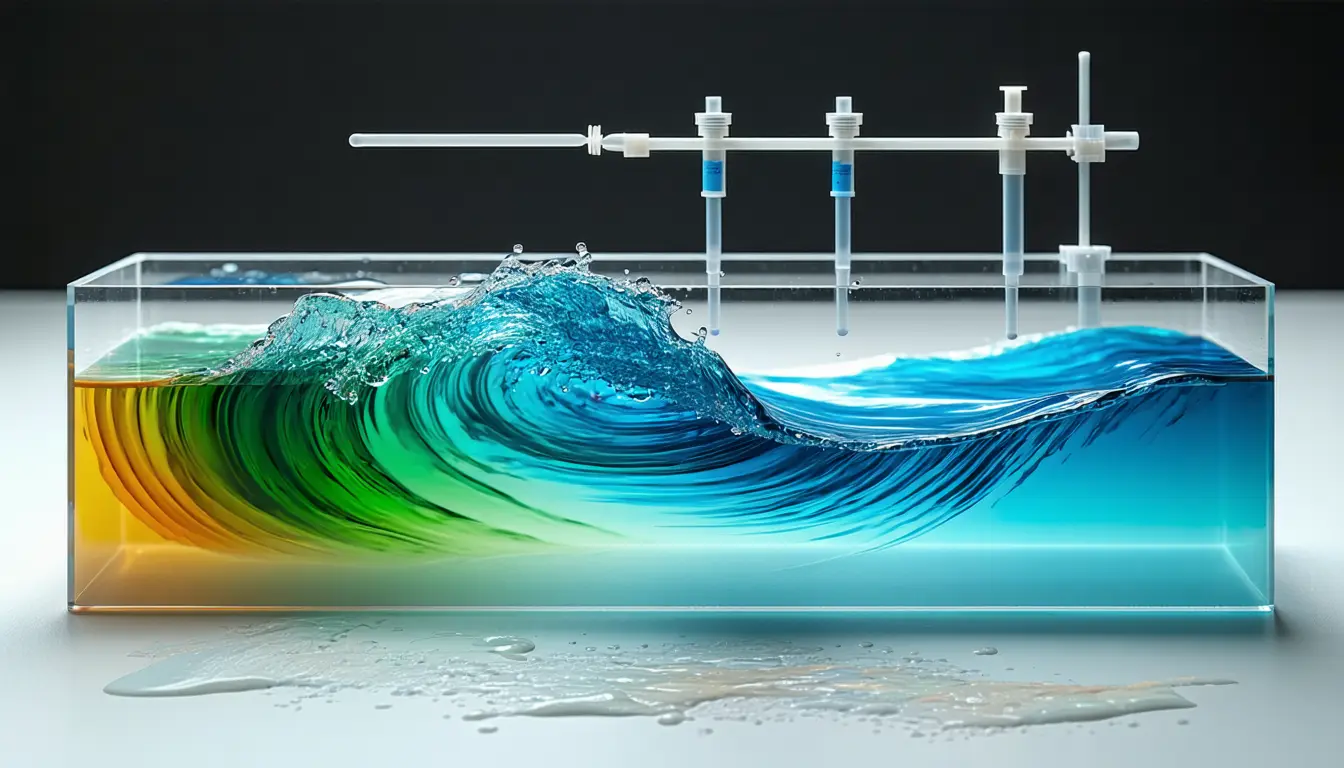
University of Pittsburgh researchers reversed the direction of the energy cascade in two-dimensional turbulence using one small, correctly angled obstacle. The result loosens the long-held rule that a flow's dimensions alone decide whether energy moves to larger or smaller eddies.
The Scientist · Science desk
Drafted by a language model from the sources cited here and checked against its claim ledger before publication. How we use AISend a correction
What happened
- The team's idea came from watching brine shrimp, the small swimmers also sold as sea monkeys, according to Quanta Magazine's account of the Pittsburgh work.
- Andrey Kolmogorov's mathematics, begun in the early 1940s, describes three-dimensional turbulence passing energy from large eddies down to small ones.
- In the late 1960s, Robert Kraichnan and George Batchelor showed that two-dimensional turbulence runs the other way, feeding energy from small eddies up to large ones.
Compiled by The ScientistSomething wrong?How this is made
Why it matters
- constraint Turbulence models that take the cascade direction straight from a flow's dimensions now face a known two-dimensional case, an angled obstacle, where that shortcut can give the wrong direction.
- capability If the effect holds up, a fixed obstacle could let designers pick by geometry alone whether a flow's energy feeds large vortices or breaks down into small eddies.
- constraint The pollution-control and drug-design uses Quanta raises depend on the effect carrying over to larger, more chaotic three-dimensional flows; the reported experiment was two-dimensional.
"The geometry matters," said Lei Fang, the Pittsburgh engineer who led the study [4]. In two-dimensional flow, the upward cascade is what feeds large structures [10]. In Jupiter's Great Red Spot, smaller eddies and vortices near the perimeter feed the giant storm [11]. An angled obstacle that reverses the cascade sends energy toward smaller eddies instead [3][10]. Lewis Fry Richardson put that direction into verse in 1922, describing large whorls breaking into ever smaller ones until viscosity takes over [8].
Gregory Falkovich, a physicist at the Weizmann Institute of Science and a pioneer in the study of two-dimensional turbulence, said the discovery draws on a basic piece of the mathematics of how forces push energy through a system. He added that this piece often goes unrecognized [5]. "This is a beautiful and skillful experimental work," he said [6].
I think his first remark is the more useful one. If the reversal comes out of mathematics physicists already had, the two-dimensional theory Robert Kraichnan and George Batchelor developed in the late 1960s still stands [5][10]. What would fall is the shorthand that a flow's dimensions alone set the direction of its cascade [1]. This reading claims less than Quanta's headline, which says sea monkeys show scientists how to rewrite a rule of turbulence [12].
Quanta's account does not report the obstacle's angle or how much of the energy changed direction. Those two numbers decide how much of this an engineer can use. A reversal that works only in a narrow band of angles is a laboratory result. One that survives a loosely mounted obstacle could become a design tool.
What to watch
- The published paper's numbers: the obstacle angle that works, how wide the working range of angles is, and what fraction of the energy flux reverses.
- An independent laboratory reproducing the reversal with a different obstacle shape or flow setup.
- A theoretical derivation, from Falkovich or others, of which obstacle angles should reverse the cascade and why.