Product1 publisher3 min readPublished Updated
Chesky's own number: 159 of 175 YC companies are enterprise, and he sits on the board
The Airbnb CEO says founders are afraid to build for consumers. The statistic he cited describes a funding pipeline, not a mood, and he helps govern the institution that produced it.
The Product Desk · Product desk
Drafted by a language model from the sources cited here and checked against its claim ledger before publication. How we use AISend a correction
What happened
- Brian Chesky, CEO of Airbnb, made his argument about consumer AI on the Yahoo Finance podcast Power Players with Brian Sozzi this week.
- Chesky said: "I think part of it's a narrative issue that we're not talking about AI correctly."
- Chesky said: "We need to actually be developing more products that just regular people can use."
- Chesky said that compared with when he started Airbnb 18 years ago, founders now seem "afraid" to build for consumers.
- Chesky himself supplied the statistic that in Y Combinator's most recent batch, 159 of 175 companies were enterprise rather than consumer.
Compiled by The Product DeskSomething wrong?How this is made
Why it matters
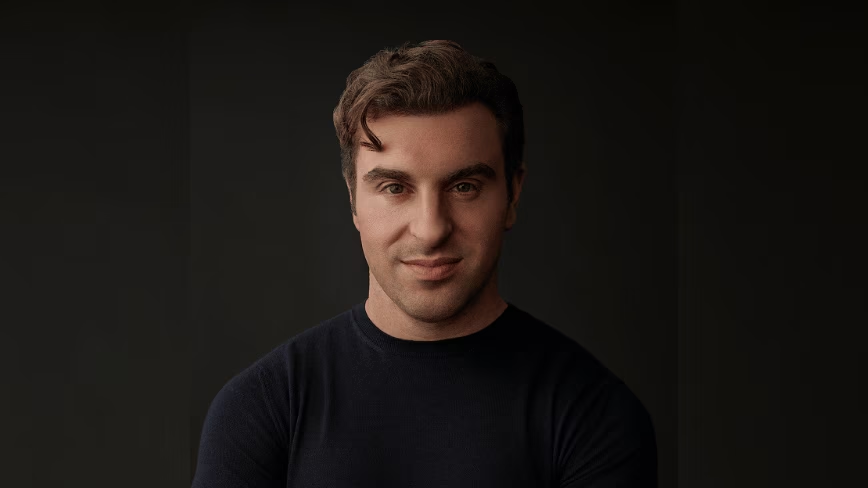
Brian Chesky told the Yahoo Finance podcast Power Players with Brian Sozzi this week that founders have grown "afraid" to build for consumers, and supplied a statistic to prove it: in Y Combinator's most recent batch, 159 of 175 companies were enterprise rather than consumer [1][4][5]. Chesky sits on Y Combinator's board [6], which turns the number from a comment on founder nerve into a description of a pipeline he helps oversee.
The arithmetic is the part worth holding onto. On his own figure, roughly 91 percent of that batch is enterprise and about 16 companies in the whole cohort are consumer [5][14]. A single accelerator batch is not the market, but it is one of the few public snapshots of what the earliest stage of the funding chain has decided to underwrite. Whatever is not in it does not get a seed round from that route, does not get a Series A eighteen months later, and does not ship a consumer product in the window Chesky says he is waiting for. He predicts a consumer AI renaissance in two to three years [9]. The cohort that would have to build it has already been selected against.
Chesky's explanation is psychological. "Almost all AI is enterprise," he said. "I think consumer is a huge gap" [7]. He also said there has been "very little progress on consumer AI" and that "ChatGPT is about what we've seen" [8]. The likelier explanation is commercial rather than emotional: enterprise buyers pay, sign multi-year contracts and tolerate rough software, while consumers churn, cost money to acquire and expect the good version free [15]. For a company paying for inference on every request, that is not cowardice. It is the revenue.
Airbnb's own disclosed AI results sit on the same side of the ledger. The company says AI customer service resolved 45 percent of inquiries last quarter and cut support costs per booking by 16 percent [16]. Those are cost-side wins inside the business, not consumer products, which is an odd evidence base for an argument about building for regular people.
Where Chesky is on firmer ground is demand. Pew Research found in June that 40 percent of US adults expect AI's effect on society over the next 20 years to be negative, against 16 percent who expect it to be positive [11], a two-and-a-half-to-one gap [17] on a technology the industry is spending hundreds of billions to build [12]. The response so far has largely been communications: feel-good advertising from several AI companies and chief executive manifestos, including Mark Zuckerberg's personal superintelligence essay this month [13]. Chesky's other half-diagnosis, that "part of it's a narrative issue that we're not talking about AI correctly" [2], is undercut by his own conduct in the same interview, where he confirmed for the first time that Airbnb has an AI lab and then declined to say anything further about it [10].
What to watch is whether the batch composition moves. The next Y Combinator cohort is the cheapest available test of whether consumer AI is capital-starved by fashion or by unit economics, and Chesky has a board seat from which to influence it. Watch Airbnb too: he says the company is a year to 18 months from becoming a fundamentally bigger service, adding rental cars and hotel rooms [18], and expects chatbots to take over destination discovery and itineraries before they touch reservations [19]. That is a consumer AI bet with a date on it, which is more than the accelerator numbers currently describe.