Science1 publisher3 min readPublished
Counting what happens without lime turns Mississippi Basin liming into a net CO2 sink
A Yale-led team writing in Nature argues that crushed limestone spread on farmland across 41 percent of the contiguous United States removes more CO2 than it releases, because the acid it neutralises would have released CO2 anyway.
The Scientist · Science desk
What happened
- A Yale-led study in Nature finds that farmland in the Mississippi River Basin stores more carbon dioxide in the soil than is emitted when farmers spread crushed limestone on their fields.
- Liming is an old agronomic practice, used for generations in the basin to raise soil pH, cut acidity and lift crop yields.
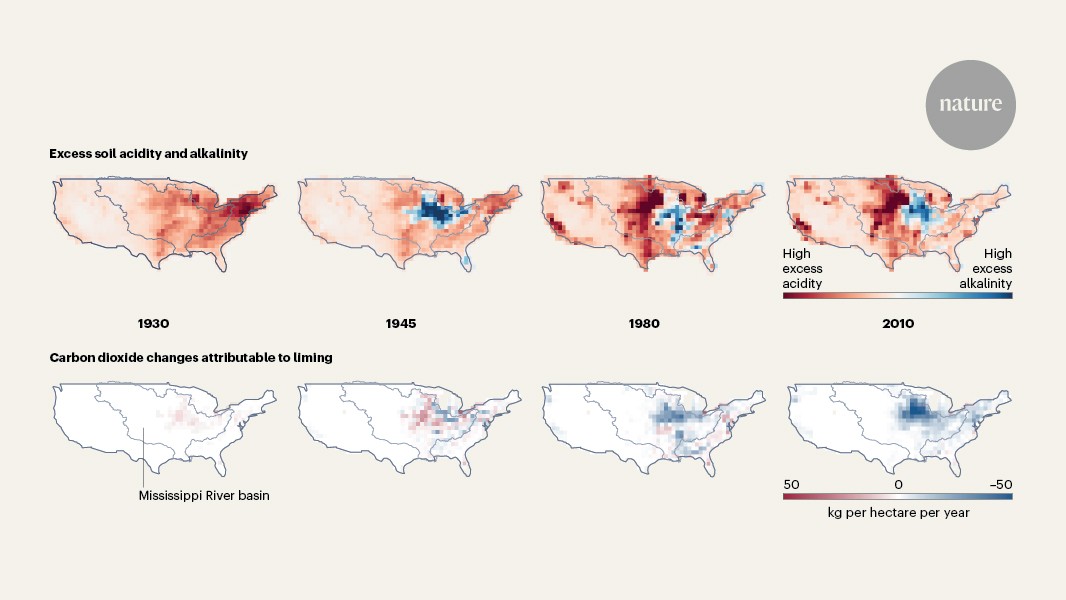
- The study's central move is to ask what happens without lime: fertiliser use and unrelated air pollution acidify soil anyway, and that acidity drives reactions releasing CO2 on its own.
Compiled by The ScientistSomething wrong?How this is made
Why it matters
- decision Inventory compilers who use the IPCC default now face a choice about the sign of an entire category, and it is an accounting decision.
- constraint Any credit built on this finding inherits the baseline it was measured against, and a no-lime scenario is modelled, not observed.
- capability Carbonate rock comes back into scope for enhanced weathering, which has mostly been pursued with silicates because limestone carries its own carbon.
Everything in this result depends on the counterfactual. Lime neutralises acid in soil, and the origin of that acid decides how the carbon books come out. Nitrogen fertiliser and unrelated air pollution acidify soils whether or not a farmer spreads crushed limestone, and that acidity drives reactions with soil and water that release CO2 on their own, the researchers said [7]. Measured against that baseline, liming comes out as net carbon removal over the long term [8].
The chemistry is not new. Crushed rock reacts with CO2 in the soil to form stable bicarbonate ions, which travel through soils, groundwater and rivers and eventually reach the ocean, where the carbon can stay for long periods [5]. Enhanced weathering work has leaned toward silicate rocks, partly because limestone arrives with carbon of its own that can be released as CO2 [6]. The authors argue that carbonate-based enhanced weathering deserves renewed attention as a way to scale up mitigation [16].
Scale is why this basin matters for national accounting. It covers 41 percent of the contiguous United States and roughly 65 percent of US croplands [3], so its share of cropland runs about 1.6 times its share of land area [1].
"One of the exciting things about this result is that it aligns climate action with something that is already good for farmers," said Tim Jesper Suhrhoff, the Yale geochemist who is first author on the paper [2][14]. Christopher Reinhard, a Georgia Institute of Technology professor and co-corresponding author, said: "Better soil pH management can improve yields and soil health, and our work shows that it can also be good for the climate" [13].
Conventional greenhouse gas accounting runs the other way. The IPCC's default methodology treats the carbon contained in applied lime as emitted CO2 [9]. Suhrhoff said the authors support the IPCC's measurement work, and added: "Rather than treating good soil pH management as an additional source of CO2, a more complete framework could recognize situations in which liming benefits both farmers and the climate" [11].
The evidence base here is the practice itself, drawn from more than a century of data on crushed carbonate rock added to agricultural soil [15]. "This is a once-in-a-lifetime opportunity to trace more than 120 years of historical records that can tell us whether enhanced weathering works," said Noah Planavsky, a Yale professor of Earth and planetary science and a corresponding author [10][17]. Those records show where lime went, but not what the same fields would have done unlimed. The finding rests on that modelled baseline.
The phys.org account of the study does not report how much CO2 the basin removes, over what period, or with what uncertainty [2]. The researchers also noted that the Mississippi River Basin results will not always transfer directly to every agricultural setting [12].
What to watch
- Whether the full Nature paper reports a basin-scale tonnage and an uncertainty range for the net removal.
- Whether IPCC guidance authors or national inventory teams revisit the default that treats lime carbon as emitted CO2.
- Whether the same counterfactual accounting holds in farming regions where the dominant acid source is not fertiliser and air pollution.