Science1 publisher3 min readPublished
Nature paper pins each gas in lithium-metal cells to an electrode, then buys 10x cycles for free
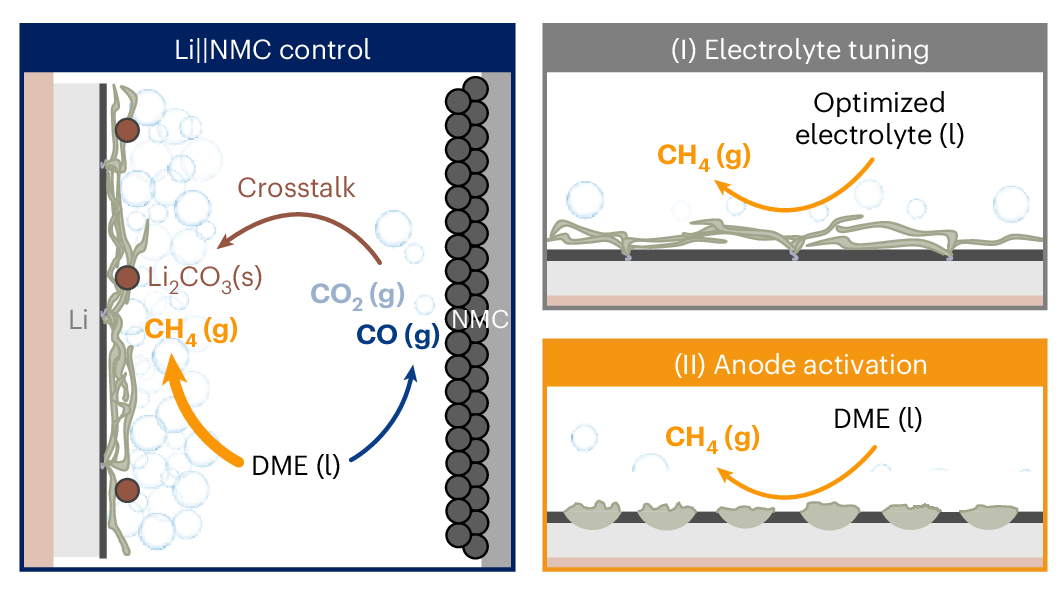
CO and CO2 are traced to the cathode and methane to the lithium anode. Activating the anode alone delayed gas onset by an order of magnitude, with the 4 M ether electrolyte left untouched.
The Scientist · Science desk
Drafted by a language model from the sources cited here and checked against its claim ledger before publication. How we use AISend a correction
What happened
- The study links CO and CO2 production to the cathode and CH4 evolution to the anode in ether-based lithium metal batteries.
- In a high-concentration ether electrolyte, anode activation improved Li deposition morphology and suppressed interfacial reactions, extending the number of cycles to gas onset and to cell failure by an order of magnitude; the gains were achieved without altering the electrolyte, enabling reconsideration of seemingly impractical electrolytes.
- An order of magnitude corresponds to approximately a factor of ten.
- Uncontrolled gas evolution can rupture pouch cells or trigger premature venting in prismatic and cylindrical formats, leading to electrolyte leakage and the release of toxic, flammable gases.
- Lithium metal anodes have a theoretical capacity of 3,860 mAh g-1.
Compiled by The ScientistSomething wrong?How this is made
Why it matters
A paper in Nature assigns each gas species evolved in ether-based lithium-metal pouch cells to a specific electrode, linking CO and CO2 to the cathode and CH4 to the lithium anode [1]. The authors then report that activating the anode, with no change to the electrolyte, extended both the number of cycles to gas onset and the number to cell failure by an order of magnitude [2], which is roughly a factor of ten [3].
The reason to care about gassing is mechanical, not academic. Uncontrolled gas evolution can rupture pouch cells or trigger premature venting in prismatic and cylindrical formats, causing electrolyte leakage and the release of toxic, flammable gases [4]. The prize on the other side is a lithium metal anode with a theoretical capacity of 3,860 mAh per gram [5], aimed at electric aviation including eVTOL aircraft and long-range electric vehicles [6]. Lithium metal cells preceded lithium-ion and were largely displaced by it after safety-related recalls, including Moli Energy in 1989 [7].
The measurement setup is worth noting because it is unglamorous and quantitative: Li-NMC single-layer-stack pouch cells with 4 M lithium bis(fluorosulfonyl)imide in DME, cell volume change tracked by Archimedes methods, and gas composition determined by ex situ gas chromatography [8]. That sits alongside operando gas analysis, NMC811 cathodes and first-principles simulation [9].
Two mechanistic findings shape how you would read any gas measurement on this chemistry. First, the CO and CO2 produced at the cathode are consumed at the lithium anode to form lithium-containing species such as Li2CO3 [10]. Read literally, headspace gas in these cells is a net figure, not the cathode's gross output. Second, although CH4 ends up dominating the gaseous products, its evolution during cycling is delayed until a distinct onset point [11]. Gassing here is a knee, not a slow linear drift, which means a cell that looks quiet at cycle 50 is not thereby cleared.
Temperature is the operating constraint the authors put in front. Under constrained pack-level thermal management, high-rate operation can drive cell temperatures above 50 C [12], and simulations of high-energy prismatic cells under air-cooled conditions predict temperatures approaching 62 C during 8 C discharge [13].
The angle for anyone allocating research money is the literature gap. Ether electrolytes are widely used in lithium metal cells because of their stability against lithium metal [14], yet operando investigations of them remain limited, with most existing gassing studies focused on carbonate electrolytes and built on lithium-ion-derived frameworks [15]. Those frameworks do not transfer directly, because replacing graphite with metallic lithium changes the interfacial chemistry and the gas pathways [16]. Earlier carbonate work reported reductive C-O bond cleavage, which raises the possibility of analogous pathways for ether solvents such as DME [17]. If an order-of-magnitude improvement is available from interfacial engineering at fixed electrolyte composition [2], then screening data that condemned an ether formulation on gassing grounds was measuring the interface, not the solvent.
Two caveats sit in plain view. The abstract states the improvement as "an order of magnitude" without absolute cycle counts [18], and it characterises anode activation only as improving lithium deposition morphology and suppressing interfacial reactions, without specifying the protocol [19]. Both matter for anyone trying to reproduce the result on their own line.