Science1 publisher3 min readPublished
Principal component analysis reads a brown dwarf's weather from its JWST light curve
Astronomers at Trinity College Dublin report that two components account for most of what changes in SIMP 0136's rotating spectrum, a decomposition they hope to refine for fainter brown dwarfs.
The Scientist · Science desk
What happened
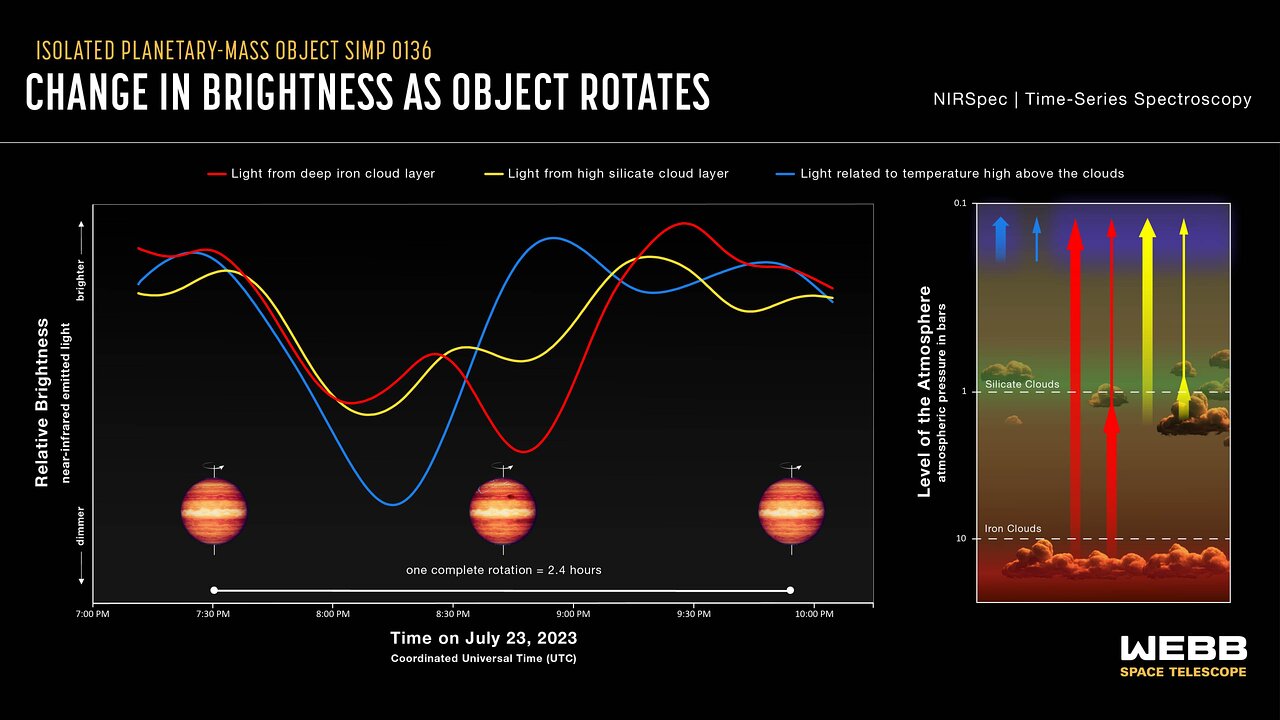
- Scientists at Trinity College Dublin applied principal component analysis to JWST observations of the brown dwarf SIMP 0136, tracking how its light changed as the object rotated.
- The team describes three recurring weather states rotating in and out of view: hotter regions with thinner cloud, and cooler ones with thicker, vertically extended cloud.
- The paper, in Astronomy & Astrophysics, concludes that the atmosphere changes in an organized way instead of reorganizing randomly.
Compiled by The ScientistSomething wrong?How this is made
Why it matters
- capability An observer can now describe how one of these atmospheres changes without first committing to a cloud model, because the key processes were identified from the data itself.
- constraint The credibility check available here depends on a bright target already worked over by established methods, and fainter brown dwarfs come without that earlier work.
- precedent Brown dwarfs can be observed directly, so a decomposition that holds up on them sets what counts as credible when the same treatment is aimed at giant exoplanet atmospheres.
Principal component analysis takes a stack of measurements recorded over time and finds the patterns that change together across them, ranked by how much of the variation each one accounts for [3]. It is a statistical procedure. The astrophysics gets added afterwards, by whoever reads the output.
So the Trinity result has two parts worth keeping apart. The count is a property of the data: two components carry the vast majority of the variation in the rotating spectrum [4]. The labels are an interpretation, and the team's own phrasing is that the two components are consistent with changes in temperature and in the vertical structure of the clouds [4]. phys.org does not report the share of variance the two components account for.
The components also stay put while the visible pattern changes. "We also discovered that these drivers of the weather patterns on SIMP 0136 persist over time, even as the detailed appearance of the atmosphere evolves over more than a dozen rotations," said Merle Schrader, the paper's first author and a Ph.D. candidate in Trinity's School of Physics [8]. Noise would have lost that shape long before a dozen rotations were done.
The test was run on a target where the answer was already partly known. Schrader said, "In relative terms, SIMP 0136 is one of the easier brown dwarfs for us to capture high-quality data from. These data have been studied before by established methods, allowing us to compare some of the results from this new technique to what we already know about this object" [9]. That earlier work is what makes the check possible. It also bounds the claim: so far the technique has been shown to work on data established methods had already covered. In my view the portable part here is the pipeline, and the open question is whether two components still dominate when the signal is weaker. Schrader's stated hope is that the approach "can be further refined and applied to other, less well-known brown dwarfs in different parts of space" [11]. This paper does not do it.
All of it comes from one unresolved point of light, thrown by an object larger and hotter than a gas giant but not massive enough to shine like a star, with an atmosphere dominated by huge, fast-changing cloud systems [14]. "I think it's amazing that we have been able to discern the intimate weather patterns of a distant world and map their interactions from our cozy little corner of the universe, when all we observe directly of these objects is a single pixel spread across the light spectrum," Schrader said [16]. The brightness changes recorded as the object turned were minute, and the sensitivity of JWST's instruments is what made them detectable [15]. SIMP 0136 is about 20 light-years away [12] and JWST first observed it in 2023 [13], so the light carrying this weather left the object around 2003 [18].
What to watch
- Whether the same two-component structure appears in JWST rotation data on fainter brown dwarfs, where established methods have not already supplied an answer to check against.
- The published variance fraction for the two components, which sets how much signal-to-noise a weaker target would need.
- Whether the three recurring weather states show up again in later JWST visits to the same object.