Science1 publisher3 min readPublished
Ultra-deep GTC imaging caps Cloud-9's possible stars at 16,000 solar masses
Ignacio Trujillo's team spent two June nights hunting starlight in a gas cloud near the galaxy M94 and found none, which tightens the ceiling on any stars there without settling where the hydrogen came from.
The Scientist · Science desk
What happened
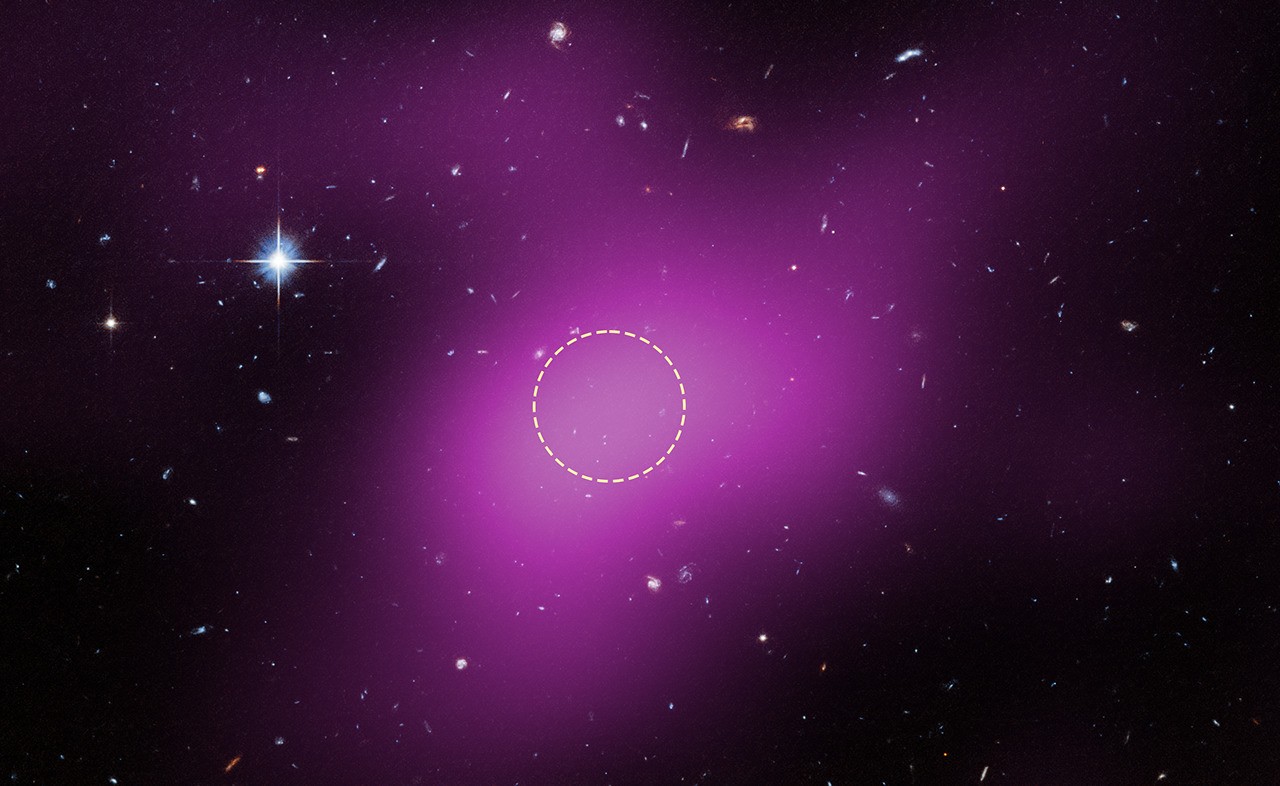
- A team led by Ignacio Trujillo used the HiPERCAM camera on the Gran Telescopio Canarias to image Cloud-9 in five filters at once, across two nights in June 2026.
- The run reached a limiting surface brightness of 31.4 magnitudes per square arcsecond in the g-band, deep enough to pick up stellar populations that earlier surveys would have missed entirely.
- No starlight showed up across the object's central region, which sets an upper limit of 16,000 solar masses of stars inside a region roughly 4,200 light-years wide.
- Cloud-9 sits near the spiral galaxy M94 at about 4.66 megaparsecs and holds an estimated million solar masses of hydrogen, with no obvious stars in prior surveys.
- The observers shifted the pointing between exposures and masked the area centered on Cloud-9 before subtracting background, so any genuine faint emission would survive the processing.
Compiled by The ScientistSomething wrong?How this is made
Why it matters
- capability A ground-based telescope can now bound the stellar mass of one of these objects without borrowing the structural assumptions of a comparison galaxy, which is what the deeper Hubble star count had to lean on.
- constraint The output of this method is a ceiling, never a zero, so "starless" remains a statement about a threshold and any claim of confirmation depends on where observers agree to put it.
- decision The halo-versus-debris question survives a starlight non-detection, so whoever wants to settle it has to spend time on something other than a longer optical exposure.
- precedent Because the model's claim is about how many such halos exist, this measurement mostly sets the vetting standard the next candidates will have to clear.
The prediction under test concerns cooling rather than gas supply. Gravity pulls hydrogen inward while the ultraviolet background, the diffuse radiation from quasars and stars across the universe, heats it, and in the lowest-mass halos the heating is thought to win, so the gas never condenses [4]. Lambda Cold Dark Matter therefore expects a large number of small halos holding gas and no stars [3], and by the account in phys.org, finding one such object would confirm a key prediction of standard cosmology [5].
The ratio carries the argument. Sixteen thousand solar masses of stars set against roughly a million solar masses of hydrogen [7][12] works out to 62.5 to 1, which the paper reports as at least 60 to 1 [13]; inverted, any stellar population is capped at 1.6 percent of the gas mass [14]. The area that ceiling covers is about 4,200 light-years wide [12], and at 15 million light-years that subtends close to 58 arcseconds, just under an arcminute [15]. A diffuse target an arcminute across is precisely the case where a background fit can absorb the object you are trying to weigh, which is why the processing choices here are load-bearing in a way they would not be for a compact source.
The non-detection leaves an origin unsettled. The authors list tidal debris, high-velocity clouds and transient gaseous structures as live alternatives for starless HI clouds, and note that some of those could carry very faint stellar components, which is the reason for imaging this deep [8]. Against that last version the method works well: had the debris held stars at these masses, they would have shown. A purely gaseous tidal stream, though, looks the same in five optical filters as a starless halo does, and imaging measures light, not motion [9]. Whether the hydrogen is bound in a dark matter halo at all is a question this imaging cannot answer.
The new limit lands between two earlier estimates, one from a survey the team describes as not designed to preserve low surface brightness signal, the other a deeper Hubble star count that leaned heavily on a comparison galaxy that may be too compact [17]. So the case for this measurement rests less on it being the smallest number on the board and more on it depending less on what someone assumed a comparison object should look like. Earlier attempts to rule out stars in Cloud-9 outright did not succeed [18], and this one comes closer while still stopping at a ceiling. The team's own wording stays inside that boundary: the result "supports the idea that Cloud-9 is an excellent candidate for a starless galaxy" [16]. The paper is a preprint, posted on August 21 [2].
One object with a tight bound on its starlight shows that such an object can exist and is now the best-characterized candidate going [1]. The model's claim is about how many of them there are [3], and counting is a different measurement than looking hard at one target.
What to watch
- Peer review of the Trujillo preprint, and whether referees accept the 16,000 solar mass figure as the operative ceiling.
- An HI kinematic measurement showing whether Cloud-9's gas is rotating in a bound halo or streaming as debris.
- A recomputed Hubble star count using a comparison galaxy with a less compact light profile.