Science1 distinct publisher3 min readPublished
An international team sorted triangular flakes under 2 cm wide out of the Uzbek site's oldest layers by their fracture damage. The points match the size of ones Homo sapiens left in the Rhone Valley 25,000 years later, a similarity the intervening record has yet to connect.
The Scientist · Science desk

Compiled by The ScientistSomething wrong?How this is made
An unretouched flake with a snapped tip is otherwise just a broken flake. So the diagnosis here rests on telling one kind of breakage from another: the international team sorted small triangular pieces out of the general lithic debris using macroscopic and microscopic impact marks, then checked those marks against experimental reference data [3][19]. The experimental set is the control, and it carries the argument. Knapping accidents and trampling both break stone; what they are not supposed to reproduce is the fracture signature of a tip stopped by a target at speed.
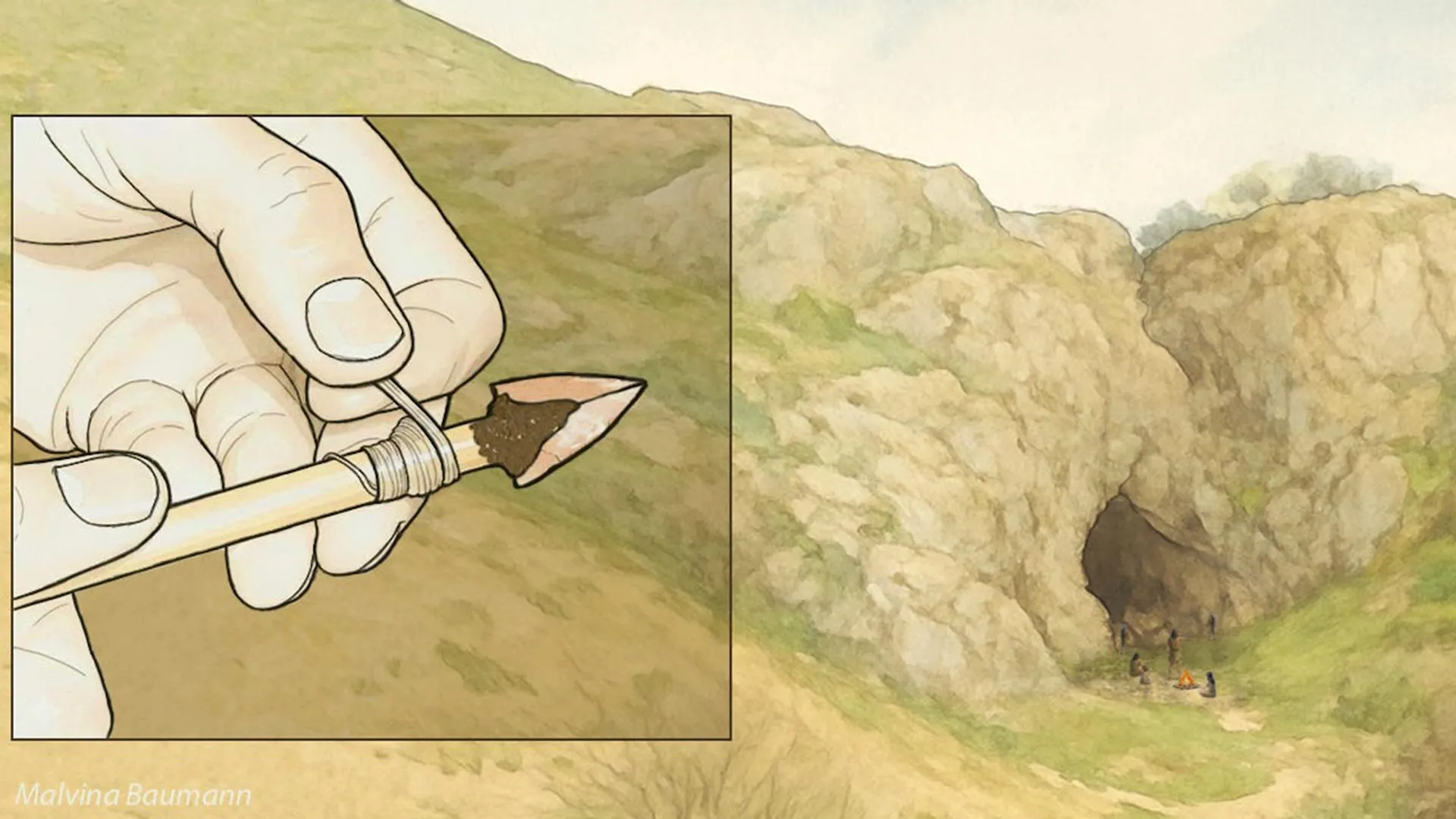
Grant the diagnosis, and impact damage still only tells you that something hit hard. The pieces are less than 2 cm wide [4], a size the authors read as that of small arrowheads and as directly comparable to points made by Homo sapiens during an incursion into Neanderthal territory in the Rhone Valley 25,000 years later [5]. A bow and a spearthrower can both deliver a tip that small.
Who made them is the wider gap. An industry filed for years as Initial Upper Paleolithic now appears to the authors to derive instead from the Levantine Early Middle Paleolithic [9], a tradition associated with archaic Homo sapiens at Misliya cave that had gone from the Near East by roughly 100,000 years ago [10]. The only hominin remains mentioned are a child's skull from a layer around 70,000 years old, some 10,000 years above the points [4], with some features read as Neanderthal and others as anatomically modern, a combination the authors suggest could be hybridization [11].
The dates repay a second look, because the account does not settle on one anchor for Europe. Subtract the stated 25,000-year offset from 80,000 and the Rhone comparator sits near 55,000 years ago [1]. Separately, the earliest Australian evidence at about 65,000 years is said to predate Europe by 10 millennia, which also lands on 55,000 [13][2]. Yet the same text puts the contentious colonization of Western Eurasia at over 45,000 years ago [14], leaving about 35,000 years between that and the Uzbek layers [3]. How large the anomaly looks depends on which of those two baselines a reader picks up.
What the find supports is narrow and worth having. Small projectile tips were in use at 1,250 metres in the Tien Shan at 80,000 years ago [1][7], which removes the assumption that miniaturised weaponry is a late Western Eurasian signature. That gives Ludovic Slimak's 2023 proposal of a Central Asian origin something underneath it [12]. It does not, on this evidence, give a route: similarly sized tips separated by 25,000 years and several thousand kilometres are two observations until sites in between join them, and the region's archaeological record is thin by the authors' own description [17]. That is a reason to dig, not a reason to conclude.
Ranked by verification strength, evidence, and original report placement.
Unretouched triangular microlithic projectile points have been identified from their impact traces in the oldest occupation layers of the Obi-Rakhmat site in Uzbekistan, dating to 80,000 years ago.
The study was published in the journal PLOS One; the account was written for The Conversation and carried by ScienceDaily on September 5, 2026.
The points were distinguished based on their macroscopic and microscopic impact marks, which were compared to experimental reference data.
The Obi-Rakhmat rock shelter was discovered in 1962, and its latest excavation campaigns were led by Andrei Krivoshapkin.
The site sits at the south-western end of the Talassky Alatau range of the Tien Shan mountains, at an altitude of 1,250 metres.
Distinct publishers with included, body-backed reporting in this cluster.
1 article · September 5, 2026
Follow any of these and your For You feed starts watching them — no settings page required.
science
Antarctica's own seismometers hear hundreds of icequakes at Thwaites and Pine Island1 distinct publisher
science
Tooth wear from 460 English sites pushes the ox-plough peak into the 12th century1 distinct publisher
invest
Alaska's disappearing lakes make permafrost thaw an asset-level observable1 distinct publisher
science
HIPAA Covers Less Than You Think, And "Anonymized" Is Not A Legal Shield1 distinct publisher
Evidence-backed comparisons of source perspectives and observed adoption signals. Read the methodology
Which Builder, Operator, and Investor concerns the observed source mix emphasized—not a truth score.
Evidence, demonstrated adoption, hype gap, incentives, and confidence are assessed independently, each on its own current evidence. How these are measured.
Primary, specific, unaudited
The method is unusually concrete for a popular account: impact damage read at two scales against an experimental reference set, then edge width compared with ethnographically documented arrow shaft diameters. What a reader cannot reach is any of the underlying numbers, which stay in the PLOS One paper, and no dating technique is named for the layers that carry the 80,000-year figure. A bow or an arrow shaft would have been made of organic material that has not survived, so function here is inferred from size and breakage rather than confirmed directly.
Too early to gauge uptake
This reporting records a publication and nothing after it. No other specialist has reanalysed the assemblage in our coverage, no comparable Central Asian collection has been re-examined for the same damage signatures, and no revision to anyone else's chronology follows. Uptake of a claim like this is measurable only once someone outside the team tests it.
Headline outruns the flakes
ScienceDaily's headline says the arrowheads rewrite human history; the team's own text says the study offers a strong argument that could rewrite the first settlement of Europe. Beneath both sits a resemblance between sub-2 cm Uzbek flakes and Rhône Valley points 25,000 years younger, in a text that also concedes the Levantine record either comes from old digs or fails to fit the lineage. The identification and the migration conclusion are being sold at the same confidence, and only the first has evidence behind it here.
The diggers write their own verdict
The byline belongs to the excavation team explaining its own paper to a general audience, a normal and mostly useful arrangement that nonetheless leaves the same people making the claim and grading its importance. The framing lands squarely on Ludovic Slimak's 2023 Central Asian proposal, which this find would move from suggestion to argument. ScienceDaily's contribution is a sharper headline than the text supports.
One retelling, internally consistent
Our coverage rests on a single retelling of a single paper with no outside specialist anywhere in it. Consistency helps a little: the account's arithmetic agrees with itself, since the Rhone offset and the Australian comparison both land on roughly 55,000 years for Europe. What holds the figure down is that a peer-reviewed damage study can be entirely right about the points and still over-read for migration, and this reporting gives readers no way to tell which of those two claims they are being asked to accept.